Albert Einstein College of Medicine
 | |
| Motto | Science at the heart of medicine |
|---|---|
| Type | Private medical school |
| Established | 1953 |
Parent institution | Montefiore Health System |
| Dean | Yaron Tomer |
Academic staff | 739 full-time, 40 part-time (fall 2022)[1] |
| Students | 1,303 (fall 2022)[1] |
| Location | The Bronx, New York City , New York , U.S. |
| Campus | Urban |
| Website | www |
The Albert Einstein College of Medicine is a private medical school in New York City. Founded in 1953, Einstein is an independent degree-granting institution within the Montefiore Health System.
Einstein offers an M.D. program, a Ph.D. program in the biomedical sciences and clinical investigation, and two Master of Science (M.S.) degrees. Admission to Einstein's MD program is among the most competitive in the United States, with an acceptance rate of 1.87% in 2024. Einstein also hosts one of the original three Medical Scientist Training Programs—which award MD/PhD degrees—to be awarded funding from the National Institutes of Health (NIH) in 1964, and has received continuous funding since.
Einstein arose from plans by Yeshiva University president Samuel Belkin in the 1940s. Physicist Albert Einstein, who noted that the college would be "unique" as it would provide medical training to "students of all creeds and races", lent his name to the school. Due to Yeshiva's financial difficulties, Einstein was transferred to Montefiore in 2015. Following a $1 billion donation to the school by Ruth Gottesman in 2024, Einstein became tuition-free for all MD students.
The college includes several NIH-designated centers and has been the site of medicals feats such as the first coronary artery bypass surgery. Faculty members have included 18 members of the National Academy of Sciences, as well as neurologist and writer Oliver Sacks. Alumni have made significant scientific contributions and include seven members of the National Academy of Sciences, two Howard Hughes Medical Investigators, a MacArthur Fellow, and a National Medal of Science awardee.
History
Founding
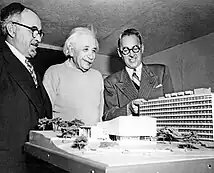

As early as 1945, Yeshiva University president Samuel Belkin began planning a new medical school. Six years later, Belkin and New York City Mayor Vincent Impellitteri entered into an agreement to begin its construction with funding from Henry H. Minskoff[2] and Phillip Stollman.[3]
Around the same time, physicist and humanitarian Albert Einstein sent a letter to Belkin. He remarked that such an endeavor would be "unique" in that the school would "welcome students of all creeds and races".[4] Two years later, on his 74th birthday, March 14, 1953, Einstein agreed to have his name attached to the medical school.[5][6]
The first classes began September 12, 1955, with 56 students.[7] Irving London was the founding chair of the department of medicine.[8] Einstein was the first new medical school to open in New York City since 1897.[9]
Expansion
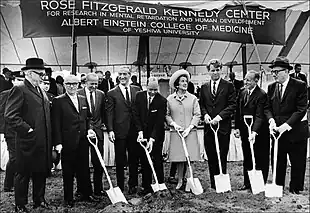
The Sue Golding Graduate Division was established in 1957 to offer Doctor of Philosophy (PhD) degrees in biomedical science.[10] The Medical Scientist Training Program, a combined MD–PhD program, was established in 1964.[11] The Clinical Research Training Program, which confers Master of Science degrees in clinical research methods, began in July 1998.[12]
The world's first coronary artery bypass surgery was performed May 2, 1960 at Einstein by a team led by Robert H. Goetz and the thoracic surgeon, Michael Rohman with the assistance of Jordan Haller and Ronald Dee.[13][14]
The Ullmann Research Center for Health Sciences, a 12-story facility, opened in 1964.[15] The following year, on behalf of the Joseph P. Kennedy Jr. Foundation, Senator Robert F. Kennedy announced a $1.45 million donation to Einstein to establish a center to study human development and mental disabilities.[16] The center, named for Rose F. Kennedy, had 200 staff scientists upon opening.[16][17] In the late 20th century, neurology dean and Rose F. Kennedy Center faculty member Isabelle Rapin was instrumental in the recognition that autism is a spectrum disorder.[18]
In 2002, the college opened the three-story Gruss Magnetic Resonance Research Center. Equipped with magnetic resonance equipment beyond conventional MRI, the center was the only such facility in the New York metropolitan area and one of six in the world, upon opening.[19] In 2008, Einstein opened a $225 million research complex, the Price Center.[20] This expansion doubled the size of Einstein's campus to nearly 40 acres.[21] Also that year, the college replaced its old logo—a "staid" portrait of Albert Einstein—with a stylized symbol that represents the helical structure of DNA, a notable spiral staircase on campus, and "E" for Einstein.[20]
Recent history
.jpg)
In February 2015, Yeshiva University announced the transfer of ownership of Einstein to the Montefiore Health System, in order to eliminate a large deficit from the university's financial statements. The medical school accounted for approximately two-thirds of the university's annual operating deficits, which had reached about $100 million before the announcement.[22] On September 9, 2015, the agreement between Yeshiva and Montefiore was finalized, and financial and operational control of Albert Einstein College of Medicine was transferred to Montefiore.[23][24] Yeshiva University continued to grant Einstein's degrees until 2018, as the medical school achieved independent degree-granting authority in the spring of 2019.[25][26]
In February 2024, Ruth Gottesman, who had been a long-time professor at the medical school and is head of the board of trustees, donated $1 billion to the school to make free tuition available to all students in perpetuity.[27][28][29] The donation was one of the largest to any educational insitution, and, according to The New York Times, likely the largest donation to any medical school. One condition of the contribution was that Einstein never change its name.[30]
Student body
There are 183 first-year medical students in the Class of 2025. 9,773 people applied for seats, and 1,200 were interviewed. 60% of the class identify as women and 20% identify with groups underrepresented in medicine. Ages range from 21 to 34 with an average age of 23.5. 16% of students were born outside the United States and students come from 17 U.S. states.[31]
Academics

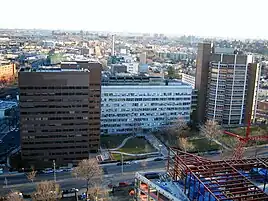
MD program
Applicants are expected to demonstrate a solid foundation in science, but there is no strict requirement on which prerequisite courses must be taken. This "competency-based" approach also provides candidates greater flexibility, for example, by substituting laboratory experience gained, while employed, for laboratory and or course requirements taken in school, or by substituting online courses that free up time to pursue interests that enhance the applicant's level of maturity and readiness for the medical profession.[32][33]
Medical Scientist Training Program
Einstein's Medical Scientist Training Program was one of the original three programs funded by the NIH in 1964, and has been funded continuously since then.[34] The program is designed to train investigators who could bridge the gap between basic science and clinical research by providing integrated graduate and clinical training. Einstein's program offers an integrated first-year curriculum covering both graduate and medical coursework. Second-year students complete the second year M.D. curriculum while working to select a Ph.D. thesis advisor. After performing one clinical clerkship, students commence their thesis research while completing any remaining coursework required for their graduate department. Students are expected to publish at least one first author, peer-reviewed paper. On average, students publish two first-author papers and four papers. After defending their dissertation, students complete the required clinical clerkships then have the opportunity to take "fourth-year" electives.[35] While on dissertation status, students have the opportunity to attend a continuity clinic which ensures they stay in touch with patients and the clinical atmosphere.[36]
Since the first graduating class in 1961, the Graduate Division of Biomedical Sciences has trained over 1600 students, including 400 M.D./Ph.D. students. The average time to complete the degree is 5.8 years, and students produce an average of four peer-reviewed papers and two first-author peer-reviewed papers.[37] Students do not apply to a specific department, but rather to the Ph.D. program as a whole, permitting them to rotate across laboratories and disciplines to make an informed choice regarding their thesis laboratory.
Master's degree programs
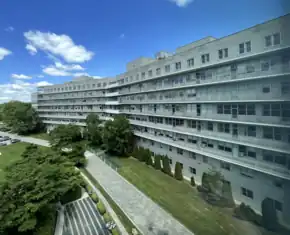
The Clinical Research Training Program, founded in 1998, leads to the awarding of the Master of Science in Clinical Research Methods. This program involves spending one year after clerkships and some elective time during the fourth year completing courses in clinical research methods and driving a mentor-guided research project that leads to two first-author manuscripts. This program is offered at no additional cost to medical students and fellowship stipends are available.[38]
In partnership with The Cardozo School of Law, Einstein offers a Master of Science in Bioethics that focuses on transnational work in bioethics to help professionals improve care and communication.[39]
PhD Program in Biomedical Sciences
Applicants apply directly to the PhD program, not to a specific department. This allows graduate students to gain exposure many areas of research before making an informed decision about the thesis work.[40] There are more than 200 biomedical laboratories for students to choose.[41]
PhD Program in Clinical Investigation
The Ph.D. concentration in Clinical Investigation provides advanced training that prepares students for an independent research career in clinical and translational science. It is offered for Ph.D. students enrolled in Einstein’s graduate division and for M.D./Ph.D. students in Einstein’s Medical Scientist Training Program.[42]
Affiliations

Montefiore Health System
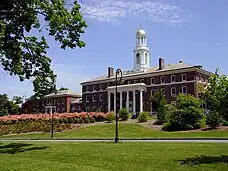
Einstein's parent institute, Montefiore Health System, is a private healthcare system and one of the largest employers in New York. It comprises 15 member hospitals, including Montefiore Medical Center and Children's Hospital at Montefiore,[43] and more than 200 outpatient ambulatory care sites that provide coordinated, comprehensive care to patients and their families across the Bronx, Westchester and the Hudson Valley.[44]
Jacobi Medical Center
Jacobi Medical Center, a public hospital adjacent to Einstein, provides healthcare for some 1.2 million Bronx and New York City area residents. Jacobi is the primary clerkship site for 3rd- and 4th-year medical students from Einstein.
NIH-designated centers
The college hosts several NIH-designated centers:[45]
- Montefiore Einstein Comprehensive Cancer Center
- Center for AIDS Research
- Diabetes Research Center
- Harold and Muriel Block Institute for Clinical and Translational Research at Einstein and Montefiore
- Institute for Aging Research
- Marion Bessin Liver Research Center
- New York Regional Center for Diabetes Translation Research
- Rose F. Kennedy Intellectual and Developmental Disabilities Research Center[46]
Notable people
Faculty
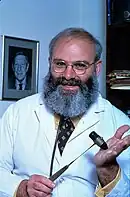
As of 2025, Einstein had over 2,000 faculty members, yielding a faculty-student ratio of 2.6:1.[47] Faculty members that have taught or are currently teaching at Einstein include 18 members of the National Academy of Sciences and 5 members of the American Academy of Arts and Sciences. One faculty member—William R. Jacobs Jr.—has been a Howard Hughes Medical Investigator.[48] In 1987, professor Harry Eagle was awarded the National Medal of Science for developing Eagle's minimal essential medium (MEM), widely used for cell culture.[48][49]
Neurologist and author Oliver Sacks taught at the college for over 40 years.[50] His 1973 book Awakenings—documenting his work with encephalitis lethargica at Beth Abraham, a Montefiore hospital in the Bronx—was adapted into a 1990 film starring Robin Williams and Robert De Niro.[51]
Alumni
Alumni of the Albert Einstein College of Medicine include seven elected members of the National Academy of Sciences, two Howard Hughes Medical Investigators, and five American Academy of Arts and Sciences members.[48] Einstein graduate Charles S. Peskin, who developed mathematical models for blood flow in the heart and other biological fluids, was awarded a MacArthur "genius grant" in 1983.[48][52] Alumnus Lucy Shapiro was awarded the National Medal of Science in 2011 for her work on bacterial genetics that helped found modern developmental biology.[48][53]
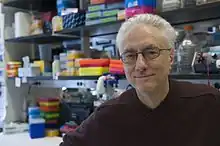
Scientific achievements by alumni include the co-discovery of the hepatitis C virus by George Kuo.[54] Rudolph Leibel discovered the hormone leptin and cloned the genes of it and its receptors.[55] Sankar Ghosh, currently a professor at Columbia University, conducted fundamental research on transcription factor NF-KB.[56] Raymond Vahan Damadian invented magnetic resonance imaging (MRI);[57] alumnus Ronald J. Ross was the first to apply it in a clinical setting.[58]
Notable physicians include anesthesiologist Gary Hartstein, who served as the FIA Medical Delegate for the Formula One World Championship.[59] Notable psychologist alumni include Daniel Stern.[60] Other notable alumni include Howard Dean—former governor of Vermont, 2004 presidential candidate, and Democratic National Committee chairman,[61] along with Baruch Goldstein, perpetrator of the 1994 Cave of the Patriarchs massacre.[62]
References
Citations
- 1 2 "College Navigator - Albert Einstein College of Medicine". National Center for Education Statistics. 2024. Archived from the original on September 21, 2024. Retrieved September 21, 2024.
- ↑ New York Times: "Henry H. Minskoff, 73, Head of Major Building Company" by Glenn Fowler Archived March 30, 2018, at the Wayback Machine August 15, 1984.
- ↑ "Phillip Stollman Dies, Held Many Top Posts". Jewish Post (Indianapolis). May 13, 1998. Archived from the original on June 28, 2020. Retrieved July 25, 2020.
- ↑ "Bronx Info". Archived from the original on September 21, 2022. Retrieved September 21, 2022.
- ↑ Berman, Eliza (March 14, 2016). "How Albert Einstein Celebrated His Birthday". TIME. Retrieved August 6, 2024.
- ↑ Zeng, Hao. "University Libraries: Einstein and Yeshiva University: Yeshiva University's Albert Einstein College of Medicine". library.yu.edu. Archived from the original on August 6, 2024. Retrieved August 6, 2024.
- ↑ Wolfer, Sondra (September 12, 2005). "GOLDEN! EINSTEIN TURNS 50. BIG PLANS AT MED COLLEHE". New York Daily News. Archived from the original on August 6, 2024. Retrieved August 6, 2024.
- ↑ "Irving London, founding director of Harvard-MIT Program in Health Sciences and Technology, dies at 99". MIT News | Massachusetts Institute of Technology. May 25, 2018. Archived from the original on September 19, 2024. Retrieved August 6, 2024.
- ↑ "History: Albert Einstein College of Medicine". Archived from the original on July 1, 2024. Retrieved November 19, 2016.
- ↑ "History: Albert Einstein College of Medicine". Archived from the original on July 1, 2024. Retrieved November 19, 2016.
- ↑ "Albert Einstein College of Medicine". Albert Einstein College of Medicine. May 1, 2023. Archived from the original on October 31, 2021. Retrieved July 16, 2024.
- ↑ "C.R.T.P. Home — Clinical & Translational Research — Albert Einstein College of Medicine". Archived from the original on July 1, 2024. Retrieved January 9, 2011.
- ↑ Dee R (2003). "Who assisted whom?". Texas Heart Institute Journal. 30 (1): 90. PMC 152850. PMID 12638685.
- ↑ Haller JD, Olearchyk AS (2002). "Cardiology's 10 greatest discoveries". Texas Heart Institute Journal. 29 (4): 342–4. PMC 140304. PMID 12484626.
- ↑ "Einstein College Opens Laboratory". The New York Times. April 29, 1964. Retrieved February 23, 2025.
- 1 2 Benjamin, Philip (March 19, 1965). "Kennedys Donate $1.4 Million For Einstein Retarded Center". The New York Times. Archived from the original on February 23, 2025. Retrieved February 23, 2025.
- ↑ "Research Center for Retarded Due; U.S. and City Backing New Einstein: College Unit". The New York Times. October 22, 1964. Retrieved February 23, 2025.
- ↑ Sandomir, Richard (June 9, 2017). "Isabelle Rapin, Who Advanced Concept of an Autism Spectrum, Dies at 89". The New York Times. Archived from the original on January 14, 2025. Retrieved February 23, 2025.
- ↑ "Postings: Einstein Medical School; In the Bronx, New Building For Research". The New York Times. April 21, 2002. Archived from the original on May 27, 2015. Retrieved February 23, 2025.
- 1 2 New York Daily News.
- ↑ Spiegel 2008, p. 524.
- ↑ Yeshiva U. Finally Closes Deal To Shed Burden of Money-Losing Einstein Medical School Archived April 11, 2015, at the Wayback Machine The Jewish Daily Forward, 4 February 2015.
- ↑ "Yeshiva University, Montefiore Finalize New Agreement for Albert Einstein College of Medicine". news-medical.net. September 10, 2015. Archived from the original on September 16, 2017. Retrieved November 18, 2016.
- ↑ "Yeshiva University, Montefiore finalize new agreement for Albert Einstein College of Medicine". September 10, 2015. Archived from the original on September 16, 2017. Retrieved September 16, 2017.
- ↑ Spiegel, Allen M. (September 9, 2015). "Promising Future for "New" Einstein" (PDF). Albert Einstein College of Medicine. Archived (PDF) from the original on November 4, 2021. Retrieved November 18, 2016.
- ↑ "Albert Einstein College of Medicine Achieves Independent Degree-Granting Authority" (Press release). Albert Einstein College of Medicine. March 4, 2019. Archived from the original on July 16, 2022. Retrieved July 16, 2022.
- ↑ Goldstein, Joseph (February 26, 2024). "$1 Billion Donation Will Provide Free Tuition at a Bronx Medical School". The New York Times. ISSN 0362-4331. Archived from the original on February 26, 2024. Retrieved February 26, 2024.
- ↑ Oladipo, Gloria (February 26, 2024). "$1bn donation means students at New York medical school will pay no tuition". The Guardian. ISSN 0261-3077. Archived from the original on July 1, 2024. Retrieved May 13, 2024.
- ↑ "Widow of top Warren Buffett investor donates $1 billion to cover tuition for all future students of Albert Einstein College of Medicine". Fortune. Archived from the original on July 1, 2024. Retrieved May 13, 2024.
- ↑ Goldstein, Joseph (February 26, 2024). "$1 Billion Donation Will Provide Free Tuition at a Bronx Medical School". The New York Times. Archived from the original on February 26, 2024. Retrieved February 23, 2025.
- ↑ "Profile of the Class of 2025 | M.D. Admissions | Albert Einstein College of Medicine". Archived from the original on October 31, 2021. Retrieved April 30, 2022.
- ↑ "Course Requirements | M.D. Admissions | Albert Einstein College of Medicine". einsteinmed.edu. Archived from the original on November 4, 2021. Retrieved January 15, 2021.
- ↑ Kerrigan, Noreen; Akabas, Myles H.; Betzler, Thomas F.; Castaldi, Maria; Kelly, Mary S.; Levy, Adam S.; Reichgott, Michael J.; Ruberman, Louise; Dolan, Siobhan M. (February 3, 2016). "Implementing competency based admissions at the Albert Einstein College of Medicine". Medical Education Online. 21: 30000. doi:10.3402/meo.v21.30000. ISSN 1087-2981. PMC 4742465. PMID 26847852.
- ↑ "History | Medical Scientist Training Program (MSTP) | Albert Einstein College of Medicine". Archived from the original on October 31, 2021. Retrieved March 2, 2019.
- ↑ "Program Description | Medical Scientist Training Program (MSTP) | Albert Einstein College of Medicine". www.einsteinmed.edu. Archived from the original on October 31, 2021. Retrieved March 2, 2019.
- ↑ "Features | Medical Scientist Training Program (MSTP) | Albert Einstein College of Medicine". www.einsteinmed.edu. Archived from the original on July 1, 2024. Retrieved March 2, 2019.
- ↑ "Einstein Graduate Student Outcomes & Alumni Statistics | Graduate Programs in the Biomedical Sciences | Albert Einstein College of Medicine". www.einsteinmed.edu. Archived from the original on October 31, 2021. Retrieved March 2, 2019.
- ↑ "Master Degree Programs | M.D. Program | Albert Einstein College of Medicine". Archived from the original on October 31, 2021. Retrieved March 2, 2019.
- ↑ "Einstein Students Complementing the M.D. with the M.B.E. | Einstein-Cardozo Bioethics Graduate Education | Albert Einstein College of Medicine". Archived from the original on July 1, 2024. Retrieved March 2, 2019.
- ↑ "PhD Program | Graduate Programs in the Biomedical Sciences | Albert Einstein College of Medicine". einsteinmed.edu. Archived from the original on October 31, 2021. Retrieved January 15, 2021.
- ↑ "Opportunities for Discovery at Einstein | Graduate Programs in the Biomedical Sciences | Albert Einstein College of Medicine". www.einsteinmed.edu. Archived from the original on October 31, 2021. Retrieved January 15, 2021.
- ↑ "Ph.D. Concentration In Clinical Investigation (PCI) | Harold and Muriel Block Institute for Clinical and Translational Research at Einstein and Montefiore | Albert Einstein College of Medicine". www.einsteinmed.edu. Archived from the original on July 1, 2024. Retrieved January 15, 2021.
- ↑ "Getting to The Weiler Division". Montefiore.org. Archived from the original on 31 December 2010. Retrieved 9 January 2011.
- ↑ "Montefiore Medical Center". www.montefiore.org. Archived from the original on February 6, 2006. Retrieved January 15, 2021.
- ↑ "Academic Departments & Centers | Albert Einstein College of Medicine". einsteinmed.edu. Archived from the original on October 31, 2021. Retrieved January 16, 2021.
- ↑ "Overview | Rose F. Kennedy Children's Evaluation & Rehabilitation Center | Albert Einstein College of Medicine". www.einsteinmed.edu. Archived from the original on October 31, 2021. Retrieved January 15, 2021.
- ↑ "Albert Einstein College of Medicine". US News and World Reports. Retrieved February 23, 2025.
- 1 2 3 4 5 "Distinguished Scientists". Albert Einstein College of Medicine. Archived from the original on September 19, 2024. Retrieved February 23, 2025.
- ↑ "Harry Eagle". National Science and Technology Medals Foundation. Archived from the original on December 8, 2024. Retrieved February 23, 2025.
- ↑ Cowles, Gregory (August 30, 2015). "Oliver Sacks, Neurologist Who Wrote About the Brain's Quirks, Dies at 82". The New York Times. Archived from the original on January 20, 2021. Retrieved February 23, 2025.
- ↑ Ebert 1990.
- ↑ "Charles S. Peskin". MacArthur Foundation. Retrieved February 23, 2025.
- ↑ "Lucy Shapiro". National Science and Technology Medals Foundation. Archived from the original on December 27, 2024. Retrieved February 23, 2025.
- ↑ Boyer, J..; Blum, H.E.; Maier, K.P.; Sauerbruch, T.; Stalder, G.A. (March 31, 2001). Liver Cirrhosis and Its Development. Springer. ISBN 9780792387602. Archived from the original on April 21, 2024. Retrieved June 17, 2020.
- ↑ Shell E (January 1, 2002). "Chapter 4: On the Cutting Edge" and "Chapter 5: Hunger". The Hungry Gene: The Inside Story of the Obesity Industry. Atlantic Monthly Press. ISBN 978-1422352434.
- ↑ Solomont, E.B. (July 21, 2008). "Columbia Medical Center Recruits Yale Immunologist". The New York Sun. Archived from the original on October 19, 2019. Retrieved January 16, 2016.
- ↑ Kauffman, George (March 21, 2014). "Nobel Prize for MRI Imaging Denied to Raymond V. Damadian a Decade Ago" (PDF). The Chemical Educator. 19: 73–90. Archived from the original (PDF) on December 11, 2015. Retrieved January 16, 2016.
- ↑ "Former Fulbright Association President Highlights Importance of Planned Giving and Provides Bequest for Association" (PDF). The Fulbrighters' Newsletter. XXV (2). Fulbright Association: 10. Summer 2004. Archived (PDF) from the original on April 7, 2023. Retrieved April 21, 2024.
- ↑ Spurgeon, Brad (August 30, 2002). "Formula One: Grand Prix makes sure there's a doctor in the crowd". The New York Times. Archived from the original on April 21, 2024. Retrieved April 21, 2024.
- ↑ Martin, Douglas (November 18, 2012). "Daniel Stern, Who Studied World of Babies, Dies at 78". The New York Times. Archived from the original on November 4, 2016. Retrieved April 21, 2024.
- ↑ Wilgoren 2004.
- ↑ Mitchell 1994.
Works cited
Journal articles
- Spiegel, Allen (May 2008). "Albert Einstein College of Medicine". Academic Medicine. 83 (5). Association of American Medical Colleges: 524. PMID 18448914.
News articles
- "Einstein College in Bronx gets logo reboot". New York Daily News. November 20, 2008. Retrieved February 23, 2025.
- Ebert, Roger (December 20, 1990). "Awakenings". RogerEbert.com. Retrieved February 28, 2025.
- Wilgoren, Jodi (January 13, 2004). "The 2004 Campaign: The Ex-Governor's Wife - The Other Doctor in Dean's House Shuns Politics". The New York Times. Archived from the original on November 7, 2018. Retrieved January 16, 2016.
- Mitchell, Alison (February 26, 1994). "West Bank Massacre: At Leats 40 Slain in West Bank as Israeli Fires into Mosque; Clinton Moves to Rescue Talks; A Killer's Path of Militancy: From Brooklyn to West Bank". The New York Times. Retrieved February 23, 2025.
Albert Einstein | |
|---|---|
| Physics |
|
| Works |
|
| In popular culture |
|
| Prizes |
|
| Books about Einstein |
|
| Family |
|
| Related |
|
| |


