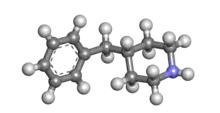
4-Benzylpiperidine
 | |
 | |
| Legal status | |
|---|---|
| Legal status |
|
| Identifiers | |
IUPAC name
| |
| CAS Number | |
| PubChem CID | |
| ChemSpider | |
| UNII | |
| ChEMBL | |
| CompTox Dashboard (EPA) | |
| ECHA InfoCard | 100.045.926 |
| Chemical and physical data | |
| Formula | C12H17N |
| Molar mass | 175.275 g·mol−1 |
| 3D model (JSmol) | |
SMILES
| |
InChI
| |
  (what is this?) (verify) (what is this?) (verify) | |
4-Benzylpiperidine is a drug and research chemical used in scientific studies. It has been encountered as a designer drug.[1]
Pharmacology
4-Benzylpiperidine acts as a monoamine releasing agent with 20- to 48-fold selectivity for releasing dopamine versus serotonin. It is most efficacious as a releaser of norepinephrine, with an EC50 of 109 nM (DA), 41.4 nM (NE), and 5,246 nM (5-HT).[2]
It also functions as a weak monoamine oxidase inhibitor (MAOI) (IC50 = 130 μM for MAO-A and 750 μM for MAO-B).[3]
The drug has a fast onset of action and a short duration.[2]
Synthesis
4-Cyanopyridine can be reacted with toluene to give 4-benzylpyridine.[4] Catalytic hydrogenation of the pyridine ring then completes the synthesis.[5]
Applications
RMI-10608 is a derivative of 4-benzylpiperidine and analog of haloperidol that was discovered to have potential use in treating psychosis and preventing brain damage by virtue of its NMDA antagonist pharmacology.[6][7]
See also
- 2-Benzylpiperidine
- Benzylpiperazine
- Tetrahydroisoquinoline
References
- ↑ "EMCDDA–Europol 2011 Annual Report on the implementation of Council Decision 2005/387/JHA". www.euda.europa.eu. 2 July 2024. Retrieved 9 December 2024.
- 1 2 Negus SS, Baumann MH, Rothman RB, Mello NK, Blough BE (April 2009). "Selective suppression of cocaine- versus food-maintained responding by monoamine releasers in rhesus monkeys: benzylpiperazine, (+)phenmetrazine, and 4-benzylpiperidine". The Journal of Pharmacology and Experimental Therapeutics. 329 (1): 272–281. doi:10.1124/jpet.108.143701. PMC 2670586. PMID 19151247.
- ↑ Arai Y, Hamamichi N, Kinemuchi H (October 1986). "Time-dependent inhibition of rat brain monoamine oxidase by an analogue of 1-methyl-4-phenyl-1,2,3,6-tetrahydropyridine (MPTP), 4-(4-chlorophenyl)-1,2,3,6-tetrahydropyridine". Neuroscience Letters. 70 (2): 255–260. doi:10.1016/0304-3940(86)90473-8. PMID 3490636. S2CID 30243106.
- ↑ Hoshikawa T, Inoue M (2013). "Photoinduced direct 4-pyridination of C(sp3)–H Bonds". Chemical Science. 4 (8): 3118. doi:10.1039/c3sc51080h. ISSN 2041-6520.
- ↑ Siegel S (2001). "Rhodium on alumina.". e-EROS Encyclopedia of Reagents for Organic Synthesis. New York: John Wiley & Sons. doi:10.1002/047084289X.rr003. ISBN 978-0-471-93623-7. OCLC 1031885332.
- ↑ Rafael Foguet, et al. U.S. patent 5,395,841 (1995 to Ferrer Internacional SA).
- ↑ Sui Xiong Cai, et al. WO1996002250 (Cocensys Inc, Acea Pharmaceuticals Inc).