Uusimaa
Uusimaa
Nyland | |
|---|---|
Region | |
| Region of Uusimaa Uudenmaan maakunta (Finnish) Landskapet Nyland (Swedish) | |
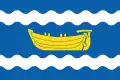 Flag 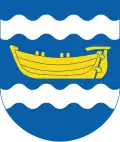 Coat of arms | |
| Anthem: Uusmaalaisten laulu | |
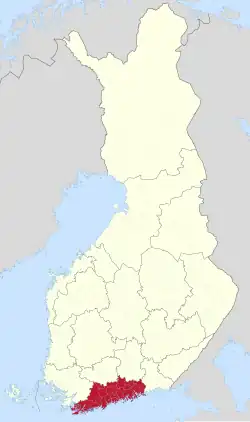 Uusimaa in red on a map of Finland | |
| Coordinates: 60°15′N 24°30′E / 60.250°N 24.500°E | |
| Country | Finland |
| Historical province | Uusimaa |
| Capital | Helsinki |
| Other cities and towns | Espoo, Hanko, Hyvinkää, Järvenpää, Karkkila, Kauniainen, Kerava, Lohja, Loviisa, Porvoo, Raseborg and Vantaa |
| Government | |
| • Regional Mayor | Ossi Savolainen |
| • President of the Council | Eero Heinäluoma |
| Area | |
• Total | 9,568 km2 (3,694 sq mi) |
| Population (December 31, 2022) | |
• Total | 1,734,000[1] |
| • Density | 181/km2 (470/sq mi) |
| Demonym(s) | uusmaalainen (Finnish) nylänning (Swedish) |
| GDP | |
| • Total | €105.831 billion (2022) |
| Time zone | UTC+2 (EET) |
| • Summer (DST) | UTC+3 (EEST) |
| ISO 3166 code | FI-18 |
| NUTS | 181 |
| – HDI (2021) | 0.960[3] very high |
| Regional bird | Blackbird |
| Regional fish | Zander |
| Regional flower | Windflower |
| Regional animal | European hedgehog |
| Regional stone | Hornblende |
| Regional lake | Lake Tuusula |
| Website | uudenmaanliitto.fi |
Uusimaa (Finnish: [ˈuːsimɑː]; Swedish: Nyland, Finland Swedish: [ˈnyːlɑnd]; both lit. 'new land') is a region of Finland. It borders the regions of Southwest Finland, Tavastia Proper (Kanta-Häme), Päijänne Tavastia (Päijät-Häme), and Kymenlaakso. Finland's capital and largest city, Helsinki, along with the surrounding metropolitan area, are both contained in the region, and Uusimaa is Finland's most populous region. The population of Uusimaa is 1,734,000.
While predominantly Finnish-speaking, Uusimaa has the highest total number of native speakers of Swedish in Finland even at a much lower share than two other regions.
History
From the time of the Vikings in the 8th century, an eastern road ran along the Gulf of Finland. The first inhabitants were nomads.[4] The place name of Nuuksio derives from the Sami word njukča which means 'swan'.[5] Later Finns proper and Tavastians inhabited the area. Some place names have traces of Tavastian village names, like Konala, which likely derives from the older Tavastian village name Konhola.[6] Estonians inhabited the region to a smaller extent, specifically for seasonal fishing.[7]
Swedish colonisation of coastal Uusimaa started after the second crusade to Finland in the 13th century.[8][9] The colonisation was part of converting pagan areas to Catholicism. Eastern Uusimaa had its first Christian Swedish colonialists earlier than the western part, which got its colonialists in one mass transfer of people to Porvoo in the 14th century. The colonisation was supported by the Swedish kingdom and the immigrants were provided with grain seeds and cattle. They also got a four-year tax exemption from the crown.[7] All the Swedish place names of Uusimaa date back to this period.[10]
The names Uusimaa and Nyland, meaning 'new land' in English, derived from the Swedish colonisation era. The Swedish-language name Nyland appears in documents from the 14th century. The Finnish-language name Uusimaa appears for the first time in 1548 as Wsimaa in the first translation of the New Testament to Finnish by Mikael Agricola.[11] Much of Uusimaa is literally new – it has risen off the Baltic Sea due to post-glacial rebound.
The Finnish provinces were ceded to Imperial Russia in the War of Finland in 1809. After this, Uusimaa became the Province of Uusimaa in the old lääni system of the newly established Grand Duchy of Finland. From 1997 to 2010, Uusimaa was a part of the Province of Southern Finland. In 1994 it was divided into the regions of Uusimaa and Eastern Uusimaa, but in 2011 the two regions were merged as Uusimaa.[12]
Heraldry
The coat of arms of the province is Azure, a boat Or between two fesses wavy Argent (a golden boat which is a symbol for the coastal areas, and two silver wavy fesses which are the symbol for rivers.)
Uusimaa received its coat of arms at the end of the 16th century. There is an image of the coat of arms made in 1599. In 1997, the traditional coat of arms became the official coat of arms of the region.
Municipalities
The region of Uusimaa consists of 26 municipalities, 13 of which have city status (marked in bold).[13]
Municipalities on the map


nummi


Finland

Häme
Häme

laakso

Sub-regions
Helsinki sub-region
 Espoo (Esbo)
 Helsinki (Helsingfors)
 Hyvinkää (Hyvinge)
 Järvenpää (Träskända)
 Karkkila (Högfors)
 Kauniainen (Grankulla)
 Kerava (Kervo)
 Kirkkonummi (Kyrkslätt)
 Lohja (Lojo)
 Mäntsälä
 Nurmijärvi
 Pornainen (Borgnäs)
 Sipoo (Sibbo)
 Siuntio (Sjundeå)
 Tuusula (Tusby)
 Vantaa (Vanda)
 Vihti (Vichtis)
Loviisa sub-region
 Lapinjärvi (Lappträsk)
 Loviisa (Lovisa)
Raseborg sub-region
 Hanko (Hangö)
 Ingå (Inkoo)
 Raseborg (Raasepori)
Porvoo sub-region
 Askola
 Myrskylä (Mörskom)
 Porvoo (Borgå)
 Pukkila
Municipalities listed

| Coat of arms |
Municipality | Population | Land area (km2) |
Density (/km2) |
Finnish speakers |
Swedish speakers |
Other speakers |
|---|---|---|---|---|---|---|---|
| Askola | 4,678 | 212 | 22 | 92 % | 4 % | 4 % |
| Espoo | 322,180 | 312 | 1,031 | 68 % | 6 % | 25 % |
| Hanko | 7,689 | 117 | 65 | 52 % | 41 % | 6 % |
| Helsinki | 686,595 | 214 | 3,202 | 74 % | 5 % | 20 % |
| Hyvinkää | 47,077 | 323 | 146 | 90 % | 1 % | 9 % |
| Ingå | 5,401 | 351 | 15 | 44 % | 51 % | 5 % |
| Järvenpää | 46,933 | 38 | 1,250 | 89 % | 1 % | 10 % |
| Karkkila | 8,434 | 242 | 35 | 90 % | 1 % | 9 % |
| Kauniainen | 10,176 | 6 | 1,728 | 59 % | 31 % | 11 % |
| Kerava | 38,461 | 31 | 1,256 | 82 % | 1 % | 17 % |
| Kirkkonummi | 41,720 | 367 | 114 | 72 % | 15 % | 13 % |
| Lapinjärvi | 2,421 | 330 | 7 | 63 % | 30 % | 8 % |
| Lohja | 45,648 | 940 | 49 | 90 % | 3 % | 7 % |
| Loviisa | 14,334 | 820 | 17 | 55 % | 39 % | 6 % |
| Myrskylä | 1,683 | 200 | 8 | 86 % | 9 % | 4 % |
| Mäntsälä | 20,914 | 581 | 36 | 93 % | 1 % | 6 % |
| Nurmijärvi | 45,177 | 362 | 125 | 90 % | 1 % | 8 % |
| Pornainen | 4,948 | 147 | 34 | 94 % | 2 % | 4 % |
| Porvoo | 51,758 | 655 | 79 | 63 % | 27 % | 9 % |
| Pukkila | 1,739 | 145 | 12 | 96 % | 1 % | 4 % |
| Raseborg | 26,982 | 1,149 | 23 | 30 % | 64 % | 6 % |
| Sipoo | 22,889 | 340 | 67 | 65 % | 27 % | 8 % |
| Siuntio | 6,199 | 241 | 26 | 65 % | 26 % | 9 % |
| Tuusula | 42,373 | 220 | 193 | 90 % | 1 % | 9 % |
| Vantaa | 251,936 | 238 | 1,057 | 69 % | 2 % | 29 % |
| Vihti | 28,765 | 522 | 55 | 91 % | 2 % | 7 % |
| Total | 1,787,110 | 9,103 | 196 | 71 % | 7 % | 19 % |
Places of interest
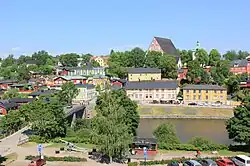
Uusimaa, the region surrounding Finland’s capital Helsinki, offers many sights and attractions, from historical landmarks to natural wonders.[4]
- Amusement parks: Linnanmäki, Serena Waterpark
- Castles and fortresses: Suomenlinna, Raseborg Castle, Svartholm fortress, Musto Castle
- Churches and cathedrals: Helsinki Cathedral, Porvoo Cathedral, Espoo Cathedral, Temppeliaukio Church, Sipoo Old Church, Church of St. Lawrence, Vantaa
- Harbour: Hanko and Hauensuoli
- Historical houses: Seurasaari, Parliament House, Helsinki, Paikkari croft, Glims, Hvitträsk, Alikartano, Malmgård Mansion
- Ironworks: Fiskars Bruk, Billnäs Bruk, Fagervik Brik, Strömfors
- Libraries: Helsinki Central Library Oodi, National Library of Finland, Helsinki University Library
- Museums: Ainola, Ateneum, Espoo Car Museum, Finnish Aviation Museum, Finnish Railway Museum, Gallen-Kallela Museum, Helsinki City Museum, Heureka, Home of Runeberg, Kiasma, Mannerheim Museum, National Museum of Finland, Taaborinvuori, WeeGee house
- Natural attractions: Nuuksio National Park, Karkali Strict Nature Reserve, Sipoonkorpi National Park, Porvoo Linnamäki
- Sport venues: Helsinki Olympic Stadium, Töölö Stadium
- Squares: Senate Square, Helsinki, Market Square, Helsinki
- Zoo: Korkeasaari
Economy
The gross domestic product (GDP) of the region was €91.2 billion in 2018, accounting for 38.9% of Finnish economic output. GDP per capita adjusted for purchasing power was €43,500 or 144% of the EU27 average in the same year. The GDP per employee was 120% of the EU average.[14] The employment rate is 76% as of 2022, second highest in Finland. There were 836,000 workplaces in Uusimaa in 2021, over 35% of the workplaces in Finland. The most common sectors were health and social services, wholesale and retail trade as well as professional, scientific and technical activities.[15]
Languages
Uusimaa is a bilingual region, with municipalities both bilingual in Finnish and Swedish, and monolingual in Finnish. Uusimaa's coastal areas tend to be Swedish-speaking. The traditional regional dialects of Swedish (nyländska) are currently mostly spoken in Eastern Uusimaa, while in the rest of the Uusimaa Swedish dialect has become more standardised.
The Finnish-speaking population started to grow when the capital of the Grand Duchy of Finland was moved from Turku to Helsinki by the Emperor of Russia Alexander I in 1812, and the region attracted settlers from other parts of Finland. Helsinki's slang first evolved in the late 19th century. 7.6% of the population of the region speaks the Swedish language natively.
Due to immigration, many foreign languages[note 1] are spoken in Uusimaa. 18% speak a foreign language as their mother tongue, the highest proportion in Finland and 58% of all foreign-language speakers in Finland. The figure was 1.1% in 1990, 3.9% in 2000, 8.0% in 2010 and 14.7% in 2020. Meanwhile, the proportion of Finnish and Swedish speakers has decreased from 87.6% and 11.3% in 1990 to 75.9% and 7.5% in 2021 respectively. On a municipal level, the highest shares of foreign speakers are in Vantaa (26.9%), Espoo (23.6%), Helsinki (19.6%) and Kerava (16.2%). The lowest share is in Pukkila (3.4%).
The most spoken foreign languages are Russian (2.8%), Estonian (1.9%), Arabic (1.4%), Somali (1.2%) and English (1.2%). Other languages include Albanian, Chinese, Persian, Kurdish, Vietnamese, Spanish, Turkish, Thai, Tagalog, German, Nepali, Bengali, French, Romanian, Urdu, Hindi, Portuguese, Ukrainian, Italian, Polish, Tamil, Bulgarian, Hungarian, Swahili, Amharic, Serbo-Croatian, Latvian, Japanese, Dutch, Sinhalese, Tigrinya, Uzbek, Greek, Punjabi, Pashto and Telugu, all with over 1,000 speakers.[17]
Health
In late March 2020, the region of Uusimaa went into lockdown to be isolated from the rest of Finland due to the global COVID-19 pandemic (2020/21).[18]
Regional council
The regional council is the main governing body for the region and focuses primarily on urban planning. Like all regional councils, it is mandated by law.
Media
Newspapers
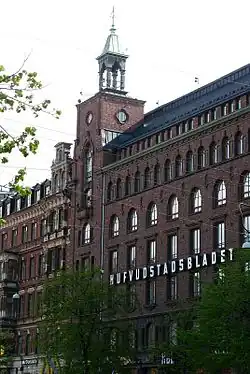
The largest subscription newspapers published in the region are Helsingin Sanomat and Hufvudstadsbladet in Helsinki, Aamuposti in Hyvinkää, Länsi-Uusimaa in Lohja, Loviisan Sanomat and Östra Nyland in Loviisa, Uusimaa and Borgåbladet in Porvoo, Västra Nyland in Raseborg, and Keski-Uusimaa in Tuusula. Also two popular tabloid newspapers, Iltalehti and Ilta-Sanomat, are published there.
Radio stations
Yle's local radio stations in the western part of the region are the Finnish-language Ylen läntinen and Swedish-language Yle Vega Västnyland, in the Helsinki metropolitan area the Finnish-language Yle Radio Suomi Helsinki and Swedish-language Yle Vega Huvudstadsregionen, and in the eastern part the Finnish-language Yle Radio Itä-Uusimaa (discontinued) and Swedish-language Yle Vega Östnyland.
Elections
The results of the 2023 Finnish parliamentary election in the Uusimaa constituency are:[19]
- National Coalition Party: 26.2%
- Social Democratic Party: 19.2%
- Finns Party: 18.2%
- Swedish People's Party: 8.7%
- Green League: 7.6%
- Centre Party: 4.8%
- Left Alliance: 4.6%
- Movement Now: 3.7%
- Christian Democrats: 3.5%
The results of the 2023 Finnish parliamentary election in the Helsinki constituency are:[20]
- National Coalition Party: 26.5%
- Social Democratic Party: 20.8%
- Green League: 15.3%
- Left Alliance: 11.8%
- Finns Party: 11.3%
- Swedish People's Party: 5.1%
- Movement Now: 2.3%
- Christian Democrats: 1.9%
- Centre Party: 1.6%
See also
- List of European regions by GDP
- Eastern Uusimaa – former region of Finland, now part of Uusimaa
Notes
- ↑ A language other than Finnish, Swedish or one of the Sami languages.
References
- ↑ "Preliminary population structure by Month, Area, Sex, Age and Information". StatFin. Retrieved January 26, 2023.
- ↑ "EU regions by GDP, Eurostat". www.ec.europa.eu. Retrieved September 18, 2023.
- ↑ "Sub-national HDI – Area Database – Global Data Lab". hdi.globaldatalab.org. Retrieved September 13, 2018.
- 1 2 Paavola, Arja-Leena; Selén, Otto; Pekkanen, Risto (2009). Matkalla maakunnissa - tietoa maakunnista ja nähtävyyksistä [Traveling in the regions - information about the regions and attractions] (in Finnish). Saarijärvi: AtlasArt. ISBN 978-952-5671-19-3., pp. 5-7
- ↑ Tarkiainen, Kari (2010). Ruotsin itämaa (in Finnish). Helsinki: Svenska litteratursällskapet i Finland. p. 120.
- ↑ Ainiala, Terhi; Saarelma, Minna; Sjöblom, Paula (2008). Nimistötutkimuksen perusteet (in Finnish). Helsinki: Suomalaisen Kirjallisuuden Seura. p. 66.
- 1 2 Tarkiainen, Kari (2010). Ruotsin itämaa (in Finnish). Helsinki: Svenska litteratursällskapet i Finland. pp. 119–136.
- ↑ V.-P. Suhonen and Janne Heinonen (2011). "Helsingin keskiaikaiset ja uuden ajan alun kylänpaikat 2011, Inventointiraportti 2011. Museovirasto" (PDF).
- ↑ Tarkiainen, Kari (2010). Ruotsin itämaa. Porvoo: Svenska litteratussällskapet i Finland. pp. 122–125. ISBN 9789515832122.
- ↑ Ainiala, Terhi; Saarelma, Minna; Sjöblom, Paula (2008). Nimistötutkimuksen perusteet (in Finnish). Helsinki: Suomalaisen Kirjallisuuden Seura. p. 68.
- ↑ Uusimaa Regional Council (May 12, 2010). "Nytt Land, Nylands historia" (in Swedish). Archived from the original on July 16, 2011. Retrieved May 17, 2010.
- ↑ "Valtioneuvosto päätti Uudenmaan ja Itä-Uudenmaan maakuntien yhdistämisestä" (in Finnish). Finnish Ministry of Finance. October 22, 2009. Archived from the original on August 7, 2011.
- ↑ "Regional Council – Uudenmaan liitto". www.uudenmaanliitto.fi. March 5, 2013. Retrieved January 31, 2017.
- ↑ "Regional GDP per capita ranged from 30% to 263% of the EU average in 2018". Eurostat.
- ↑ "Työllisyystilastot". Uudenmaan liitto (in Finnish). Retrieved December 5, 2023.
- ↑ "Väestö". Stat.fi: Statistics – Population structure. Statistics Finland. 2017. Retrieved November 26, 2018.
- ↑ "Language according to age and sex by region, 1990-2021". Statistics Finland. Retrieved May 19, 2022.
- ↑ "Checkpoints ready: Parliament approves government plans to isolate Uusimaa". News Now Finland. Archived from the original on April 9, 2020.
- ↑ "Electoral district of Uusimaa, results 2023". Ministry of Justice - Information and Result Service. Retrieved April 4, 2023.
- ↑ "Electoral district of Helsinki, results 2023". Ministry of Justice - Information and Result Service. Retrieved April 4, 2023.
Further reading
- Åke Granlund (1979), Studier över östnyländska ortnamn / Åke Granlund., Skrifter utgivna av Svenska litteratursällskapet i Finland (in Swedish), Helsinki: Society of Swedish Literature in Finland, ISSN 0039-6842, Wikidata Q113528530
- Greta Hausen (1920), Nylands ortnamn, deras former och förekomst till år 1600. 1 / Greta Hausen., Skrifter utgivna av Svenska litteratursällskapet i Finland (in Swedish), Helsinki: Society of Swedish Literature in Finland, ISSN 0039-6842, Wikidata Q113518924
- Greta Hausen (1922), Nylands ortnamn, deras former och förekomst till år 1600. 2 / Greta Hausen., Skrifter utgivna av Svenska litteratursällskapet i Finland (in Swedish), Helsinki: Society of Swedish Literature in Finland, ISSN 0039-6842, Wikidata Q113518944
- Greta Hausen (1924), Nylands ortnamn, deras former och förekomst till år 1600. 3 / Greta Hausen., Skrifter utgivna av Svenska litteratursällskapet i Finland (in Swedish), Helsinki: Society of Swedish Literature in Finland, ISSN 0039-6842, Wikidata Q113518968
- Gunvor Kerkkonen (1945), Västnyländsk kustbebyggelse under medeltiden / Gunvor Kerkkonen., Skrifter utgivna av Svenska litteratursällskapet i Finland (in Swedish), Helsinki: Society of Swedish Literature in Finland, ISSN 0039-6842, Wikidata Q113526340¨
- Arnold Nordling (1938), Iakttagelser över västnyländsk accent / Arnold Nordling., Skrifter utgivna av Svenska litteratursällskapet i Finland (in Swedish), Helsinki: Society of Swedish Literature in Finland, ISSN 0039-6842, Wikidata Q113519092
- Rolf Pipping; Hugo Pipping (1928), Anteckningar om nyländska ortnamn / Rolf Pipping., Skrifter utgivna av Svenska litteratursällskapet i Finland (in Swedish), Helsinki: Society of Swedish Literature in Finland, ISSN 0039-6842, Wikidata Q113518993
- Ebba Selenius (1972), Västnyländsk ordaccent / Ebba Selenius., Skrifter utgivna av Svenska litteratursällskapet i Finland (in Swedish), Helsinki: Society of Swedish Literature in Finland, ISSN 0039-6842, Wikidata Q113528492
External links
 Media related to Uusimaa at Wikimedia Commons
 Uusimaa travel guide from Wikivoyage
Regions of Finland | ||
|---|---|---|
| Regions |
|  |
| Former regions |
| |