Subterranea (geography)
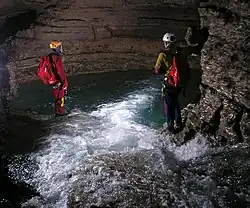
Subterranean river in Castellet-lès-Sausses
Subterranea are underground structures, both natural (such as caves) and human-made (such as mines).[1]
Some subterranea and related topics include:
Natural
- Caves
- Cenote
- Ice cave
- Sea cave
- Sinkhole
- Karst
- Lava tube
- Lunar and Martian lava tubes
- Subterranean river
- Subterranean waterfall
- Underground lake
- Volcanic pipe
Human-made or human-related by common function

Entrance to the underground vault of the Federal Reserve Bank of New York Building
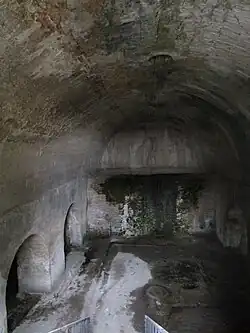
Large underground Ancient Roman cistern in Chieti, Italy
The following is a list of examples of structures which are or can be underground.
- Civil defense
- Air raid shelter
- Blast shelter
- Fallout shelter
- Storm cellar
- Cultural heritage
- Catacombs
- Dungeon
- Erdstall
- Fogou
- Hypogeum
- Passage grave
- Rock-cut architecture
- Rock-cut tomb
- Disposal of corpses or religion:
- Burial vault
- Crypt
- Living
- Basement
- Cave dwelling
- Dugout
- Earth shelter
- Underground city
- Maintenance
- Manhole
- Utility vault
- Extractive activities
- Mine
- Quarry
- Military
- Bunker
- Casemate
- Foxhole
- Missile launch facility
- Spiderhole
- Underground base
- Underground hangar
- Storage
- Bank vault
- Root cellar
- Wine cave
- Transport
- Tunnel
- Smuggling tunnel
- Secret passage
- Underground rapid transit system
- Tunnel
- Water supply, wastewater or drainage
- Dry well
- Stepwell
- Sewerage
- Well
- Other or multiple functions
- Borehole
- Ventilation shaft
See also
- Boring (earth)
- Seattle Underground
- Subterranean London
References
- ↑ Margineanu, Romul Mircea (2019). "Radon measurements in underground mines and caves from several European countries". AIP Conference Proceedings. 2076. Author(s): 050004. doi:10.1063/1.5091643.
This article is issued from Wikipedia. The text is licensed under Creative Commons - Attribution - Sharealike. Additional terms may apply for the media files.