Lapua
Lapua
Lappo | |
|---|---|
Town | |
| Lapuan kaupunki Lappo stad | |
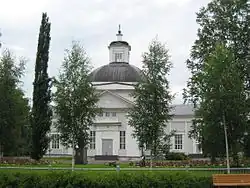 Lapua Cathedral | |
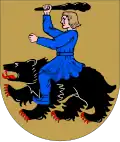 Coat of arms | |
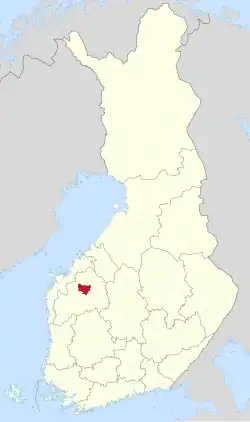 Location of Lapua in Finland | |
| Coordinates: 62°58.2′N 023°00.5′E / 62.9700°N 23.0083°E | |
| Country |  Finland Finland |
| Region | South Ostrobothnia |
| Sub-region | Seinäjoki |
| Charter | 1865 |
| Market town | 1964 |
| City rights | 1977 |
| Government | |
| • Town manager | Satu Kankare |
| Area (2018-01-01)[1] | |
• Total | 751.82 km2 (290.28 sq mi) |
| • Land | 737.16 km2 (284.62 sq mi) |
| • Water | 13.67 km2 (5.28 sq mi) |
| • Rank | 115th largest in Finland |
| Population (2025-03-31)[2] | |
• Total | 14,028 |
| • Rank | 79th largest in Finland |
| • Density | 19.03/km2 (49.3/sq mi) |
| Population by native language | |
| • Finnish | 95.3% (official) |
| • Swedish | 0.2% |
| • Others | 4.6% |
| Population by age | |
| • 0 to 14 | 17.8% |
| • 15 to 64 | 57.6% |
| • 65 or older | 24.6% |
| Time zone | UTC+02:00 (EET) |
| • Summer (DST) | UTC+03:00 (EEST) |
| Website | lapua |


Lapua (Finnish: [ˈlɑpuɑ]; Swedish: Lappo) is a town and municipality of Finland.
It is located next to the Lapua River in the region of South Ostrobothnia. The town has a population of 14,028 (31 March 2025)[2] and covers an area of 751.82 square kilometres (290.28 sq mi) of which 13.67 km2 (5.28 sq mi) is water.[1] The population density is 19.03 inhabitants per square kilometre (49.3/sq mi). The municipality is unilingually Finnish.
History
In the early 14th century, permanent settlement began to spread to the Lapuanjoki Valley. Residents came from, among other areas, the settlement center of Suur-Sastamala in Upper Satakunta, which had good land and water connections to the north. The focus of Ostrobothnia's settlement was initially on the lower reaches of the Kyrönjoki River. The proximity to the sea of the Kvarken area, which is rich in natural resources, was especially attractive. Lapua at that time had some Sámi people who considered the region their wilderness area. The name Lapuan was probably given by the coastal Swedes precisely because of the Sámi, then called Lapps, who lived in the area.
The Battle of Lapua was fought between Swedish and Russian forces near the outskirts of the town on 14 July 1808 as part of the Finnish War.
Lapua is the seat of the Evangelical Lutheran Diocese of Lapua. The Lapua Cathedral, designed by Carl Ludvig Engel, was built in 1827.
Lapua Movement
In 1929 the anti-communist Lapua Movement was founded and named after the town. The Lapua Movement was a powerful force in Lapua. They organized large rallies and marches in the town center, drawing huge crowds of supporters. Some of the movement's leaders, like Vihtori Kosola and Vilho Annala, were based in Lapua. On 30 October 1930, the Lapua March was hosted, where thousands of their paramilitary members marched through Lapua to protest against leftist threats and government policies they opposed. The Lapua movement was criminalized in 1932, and would be succeeded by the Patriotic People's Movement.
Lapua State Cartridge Factory
Lapua is also home to a large ammunition factory, which commenced operations in 1927 as the State Cartridge Factory. This factory was the primary supplier of ammunition to the Finnish Army during the Winter War and World War II. An explosion occurred in a warehouse of this factory on 13 April 1976, resulting in the deaths of 40 employees. After the explosion, the factory was relocated 6 kilometres (4 mi) away from the town centre and continues production today as Nammo Lapua, part of the Nordic Ammunition Group (Nammo). The original site of the factory and the surviving buildings are now an arts centre, a library and a theater.
International relations
Twin towns — Sister cities
Lapua is twinned with:[4]
 Hagfors, Sweden
 Hohenlockstedt, Germany
 Lantana, Florida, United States
 Rakvere, Estonia[5]
 Kiskőrös, Hungary
Notable people
- Juho Annala
- Vilho Annala
- Perttu Blomgren
- Johannes Gabriel Granö
- Anneli Jäätteenmäki
- Vihtori Kosola
- Aatu Kujanpää
- Teemu Mäki
- Esko Nikkari
- Arttu Seppälä
- Ilari Seppälä
- Jutta Urpilainen
- Jukka Haapalainen
See also
- Lapua Movement
- .338 Lapua Magnum
- Finnish national road 19
- Blue Highway, an international tourist route
References
- 1 2 "Area of Finnish Municipalities 1.1.2018" (PDF). National Land Survey of Finland. Retrieved 30 January 2018.
- 1 2 3 "Finland's preliminary population figure was 5,640,437 at the end of March 2025". Population structure. Statistics Finland. 25 April 2025. ISSN 1797-5395. Retrieved 25 April 2025.
- ↑ "Population according to age (1-year) and sex by area and the regional division of each statistical reference year, 2003–2020". StatFin. Statistics Finland. Retrieved 2 May 2021.
- ↑ "Lapua info (statistics)". Lapua. Archived from the original on 2 May 2014. Retrieved 30 April 2014.
- ↑ "Twin Cities". Rakvere. Archived from the original on 14 October 2013. Retrieved 30 April 2014.
External links
 Media related to Lapua at Wikimedia Commons
- Town of Lapua – Official website
- History of Nammo Lapua Oy at lapua.com
- Lapua WebCam provided by Media-Wolf
- Vanhan Paukun Festivaali Music Festival at the Cultural Center Vanha Paukku.


Municipalities of South Ostrobothnia | ||
|---|---|---|
| Municipalities |  | |
| Former municipalities |
| |
| ||