Hayat Davud Rural District
Hayat Davud Rural District
Persian: دهستان حيات داود | |
|---|---|
Rural District | |
  Hayat Davud Rural District | |
| Coordinates: 29°42′43″N 50°34′35″E / 29.71194°N 50.57639°E[1] | |
| Country |  Iran Iran |
| Province | Bushehr |
| County | Ganaveh |
| District | Central |
| Capital | Mohammad Salehi |
| Population (2016)[2] | |
• Total | 15,177 |
| Time zone | UTC+3:30 (IRST) |
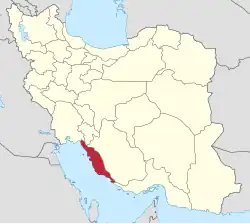
Hayat Davud Rural District (Persian: دهستان حيات داود) is in the Central District of Ganaveh County, Bushehr province, Iran.[2] Its capital is the village of Mohammad Salehi.[3] The region was historically inhabited by the Hayat-Dawudi.[4]
Demographics
Population
At the time of the 2006 National Census, the rural district's population was 10,819 in 2,392 households.[5] There were 12,920 inhabitants in 3,261 households at the following census of 2011.[6] The 2016 census measured the population of the rural district as 15,177 in 4,204 households. The most populous of its 40 villages was Mal-e Qayed, with 4,564 people.[2]
Other villages in the rural district include Abbasi, Chah Bordi, Mal-e Khalifeh, Sarbast, and Shul.
See also
Iran portal
References
- ↑ OpenStreetMap contributors (27 August 2024). "Hayat Davud Rural District (Ganaveh County)" (Map). OpenStreetMap (in Persian). Retrieved 27 August 2024.
- 1 2 3 Census of the Islamic Republic of Iran, 1395 (2016): Bushehr Province. amar.org.ir (Report) (in Persian). The Statistical Center of Iran. Archived from the original (Excel) on 3 August 2017. Retrieved 19 December 2022.
- ↑ Oberling, Pierre. "ḤAYĀT-DĀWUDI". Encyclopaedia Iranica. Retrieved 15 March 2024.
- ↑ Census of the Islamic Republic of Iran, 1385 (2006): Bushehr Province. amar.org.ir (Report) (in Persian). The Statistical Center of Iran. Archived from the original (Excel) on 20 September 2011. Retrieved 25 September 2022.
- ↑ Census of the Islamic Republic of Iran, 1390 (2011): Bushehr Province. irandataportal.syr.edu (Report) (in Persian). The Statistical Center of Iran. Archived from the original (Excel) on 3 April 2023. Retrieved 19 December 2022 – via Iran Data Portal, Syracuse University.
Bushehr province, Iran | |||||||||||||||||||||
|---|---|---|---|---|---|---|---|---|---|---|---|---|---|---|---|---|---|---|---|---|---|
| Capital |
|  | |||||||||||||||||||
| Counties and cities |
| ||||||||||||||||||||
| Landmarks |
| ||||||||||||||||||||
| populated places |
| ||||||||||||||||||||
| Capital |
| ||||||||||||||
|---|---|---|---|---|---|---|---|---|---|---|---|---|---|---|---|
| Districts |
| ||||||||||||||
This article is issued from Wikipedia. The text is licensed under Creative Commons - Attribution - Sharealike. Additional terms may apply for the media files.