Zeta Boötis
  | |
| Observation data Epoch J2000 Equinox J2000 | |
|---|---|
| Constellation | Boötes |
| Right ascension | 14h 41m 08.95158s[1] |
| Declination | +13° 43′ 41.8967″[1] |
| Apparent magnitude (V) | 3.78[2](4.46 + 4.55)[3] |
| Characteristics | |
| Spectral type | A1V[4] |
| U−B color index | +0.05[2] |
| B−V color index | +0.05[2] |
| Astrometry | |
| Radial velocity (Rv) | −8.5±0.6[5] km/s |
| Proper motion (μ) | RA: +51.95 mas/yr[1] Dec.: -11.08 mas/yr[1] |
| Parallax (π) | 18.56±0.76 mas[1] |
| Distance | 176 ± 7 ly (54 ± 2 pc) |
| Absolute magnitude (MV) | +0.13[6] |
| Details[7] | |
| A | |
| Mass | 2.21+0.14 −0.05 M☉ |
| Radius | 2.6+0.3 −0.4 R☉ |
| Temperature | 8,800+1,000 −600 K |
| Age | 560+150 −240 Myr |
| B | |
| Mass | 2.15+0.10 −0.03 M☉ |
| Radius | 2.4±0.3 R☉ |
| Temperature | 8,750+800 −550 K |
| Age | 560+150 −240 Myr |
| HIP 71759 | |
| Mass | 1.655±0.131[8] M☉ |
| Radius | 1.738±0.114[8] R☉ |
| Luminosity | 8.85±0.28[8] L☉ |
| Temperature | 7,570±253[8] K |
| Orbit[7] | |
| Primary | A |
| Companion | B |
| Period (P) | 125.04+0.24 −0.21 years |
| Semi-major axis (a) | 41.84+0.46 −0.44 au |
| Eccentricity (e) | 0.98045 |
| Inclination (i) | 125.88±0.16° |
| Longitude of the node (Ω) | 176.63±0.16° |
| Periastron epoch (T) | 2023.9548 |
| Argument of periastron (ω) (secondary) | 62.08+0.13 −0.14° |
| Other designations | |
| ζ Boo, 30 Boötis, BD+14° 2770, GC 19777, HIP 71795, SAO 101145, ADS 9343, CCDM 14411+1344, WDS J14411+1344[9] | |
| A: HD 129247, HR 5478[10] | |
| B: HD 129246, HR 5477[11] | |
| Database references | |
| SIMBAD | data |
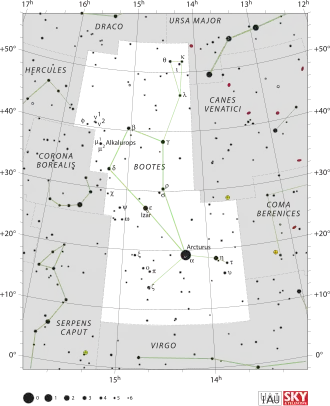
Zeta Boötis, Latinized from ζ Boötis, is a triple star system in the constellation of Boötes. They have the Flamsteed designation 30 Boötis; Zeta Boötis is the Bayer designation. This system is visible to the naked eye with a combined apparent magnitude of +3.78.[2] The individual magnitudes differ slightly, with component A having a magnitude of 4.46 and component B at the slightly dimmer magnitude 4.55.[3] It is located at a distance of approximately 180 light years based on parallax,[1] but is drifting closer with a radial velocity of −9 km/s.[5]
The duplicity of this star was discovered by English astronomer William Herschel in 1796, and their changing positions have been tracked from 1823 onward.[12] They complete an orbit every 125 years. The orbit of this pair has a very high eccentricity of 0.98045, bringing the stars within 0.818 au at their closest approach (periastron). The eccentricity of this system is possibly the second-highest known, after HIP 26245, whose eccentricity is 0.985±0.002. The last periastron occured during November 2023.[7] Considering the extreme nature of their orbit, it is unlikely that any exoplanets could have stable orbits around either star.[13]
Together with the distant companion HIP 71759, Zeta Boötis make a triple star system. This distant star has an estimated orbital period of three million years, being at an observed distance of 41,300 au (6,180×109 km; 0.653 ly) from the inner pair.[14]
In 1976, T. W. Edwards found a stellar classification of A2III for both components, suggesting they may be evolved A-type giant stars. Helmut A. Abt reported a class of A2V in 1981, which matches an A-type main-sequence star.[15] Abt and Nidia Morrell updated the classification to A1V in 1995.[4]
Gallery
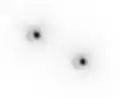 Zeta Bootis imaged with the Nordic Optical Telescope on 13 May 2000 using the lucky imaging method. (The Airy discs around the stars is diffraction from the 2.56m telescope aperture.)
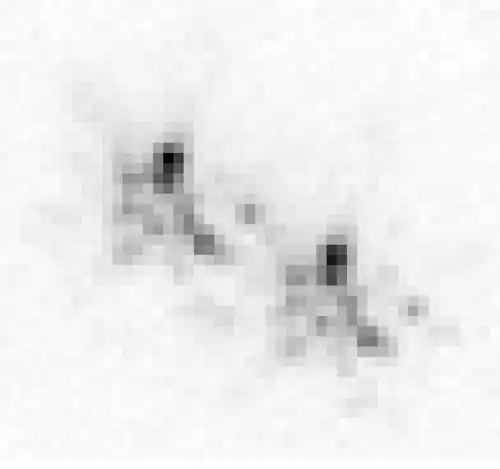 Typical short-exposure image of a binary star, as seen using speckle imaging through the Earth's atmosphere.
References
- 1 2 3 4 5 6 van Leeuwen, F. (November 2007), "Validation of the new Hipparcos reduction", Astronomy and Astrophysics, 474 (2): 653–664, arXiv:0708.1752, Bibcode:2007A&A...474..653V, doi:10.1051/0004-6361:20078357, S2CID 18759600
- 1 2 3 4 Nicolet, B. (1978), "Photoelectric photometric Catalogue of homogeneous measurements in the UBV System", Astronomy and Astrophysics Supplement Series, 34: 1–49, Bibcode:1978A&AS...34....1N.
- 1 2 Mason, B. D.; et al. (2014), "The Washington Visual Double Star Catalog", The Astronomical Journal, 122 (6): 3466–3471, Bibcode:2001AJ....122.3466M, doi:10.1086/323920.
- 1 2 Abt, Helmut A.; Morrell, Nidia I. (July 1995), "The Relation between Rotational Velocities and Spectral Peculiarities among A-Type Stars", Astrophysical Journal Supplement, 99: 135, Bibcode:1995ApJS...99..135A, doi:10.1086/192182.
- 1 2 Gontcharov, G. A. (2006), "Pulkovo Compilation of Radial Velocities for 35 495 Hipparcos stars in a common system", Astronomy Letters, 32 (11): 759–771, arXiv:1606.08053, Bibcode:2006AstL...32..759G, doi:10.1134/S1063773706110065, S2CID 119231169.
- ↑ Anderson, E.; Francis, Ch. (2012), "XHIP: An extended hipparcos compilation", Astronomy Letters, 38 (5): 331, arXiv:1108.4971, Bibcode:2012AstL...38..331A, doi:10.1134/S1063773712050015, S2CID 119257644.
- 1 2 3 Waisberg, Idel; Klein, Ygal; Katz, Boaz (2025-04-24), Which is the most eccentric binary known? Insights from the 2023/4 pericenter passages of Zeta Boötis and Eta Ophiuchi, arXiv:2504.17858
- 1 2 3 4 Hardegree-Ullman, Kevin K.; Apai, Dániel; Bergsten, Galen J.; Pascucci, Ilaria; López-Morales, Mercedes (2023-06-01). "Bioverse: A Comprehensive Assessment of the Capabilities of Extremely Large Telescopes to Probe Earth-like O2 Levels in Nearby Transiting Habitable-zone Exoplanets". The Astronomical Journal. 165 (6): 267. arXiv:2304.12490. Bibcode:2023AJ....165..267H. doi:10.3847/1538-3881/acd1ec. ISSN 0004-6256.
- ↑ "zet Boo". SIMBAD. Centre de données astronomiques de Strasbourg. Retrieved 2020-12-31.
- ↑ "zet Boo A". SIMBAD. Centre de données astronomiques de Strasbourg. Retrieved 2020-12-31.
- ↑ "zet Boo B". SIMBAD. Centre de données astronomiques de Strasbourg. Retrieved 2020-12-31.
- ↑ Wierzbiński, St. (1956), "Orbites des étoiles doubles", Acta Astronomica, 6: 82, Bibcode:1956AcA.....6...82W.
- ↑ Muterspaugh, Matthew W.; et al. (December 2010), "The Phases Differential Astrometry Data Archive. III. Limits to Tertiary Companions", The Astronomical Journal, 140 (6): 1631–1645, arXiv:1010.4044, Bibcode:2010AJ....140.1631M, doi:10.1088/0004-6256/140/6/1631, S2CID 9272936.
- ↑ Waisberg, Idel; Klein, Ygal; Katz, Boaz (March 2024). "Hidden Companions to Intermediate-mass Stars. XVI. Unveiling a 41,300 au Companion to the Very Eccentric Binary Zeta Boötis". Research Notes of the AAS. 8 (3): 55. Bibcode:2024RNAAS...8...55W. doi:10.3847/2515-5172/ad2df5. ISSN 2515-5172.
- ↑ Abt, H. A. (1981), "Visual multiples. VII. MK classifications", The Astrophysical Journal Supplement Series, 45: 437, Bibcode:1981ApJS...45..437A, doi:10.1086/190719.
External links
- Kaler, James B., "ZETA BOO (Zeta Bootis)", Stars, University of Illinois, retrieved 2011-12-18
- HR 5477
- Image Zeta Boötis
- CCDM J14411+1344
| Stars |
| ||||||||||
|---|---|---|---|---|---|---|---|---|---|---|---|
| |||||||||||
| |||||||||||
| Galaxies |
| ||||||||||
| |||||||||||
| |||||||||||
 Category Category | |||||||||||