YZ Cassiopeiae
  | |
| Observation data Epoch J2000 Equinox J2000 | |
|---|---|
| Constellation | Cassiopeia[1] |
| A | |
| Right ascension | 00h 45m 39.0777s[2] |
| Declination | +74° 59′ 17.063″[2] |
| Apparent magnitude (V) | 5.653[3] |
| B | |
| Right ascension | 00h 45m 42,1503s[4] |
| Declination | +74° 58′ 43.242″[4] |
| Apparent magnitude (V) | 11.23[5] |
| Characteristics | |
| A | |
| Spectral type | A2IV[6] (A1Vm + F2V[7]) |
| U−B color index | +0.07[5] |
| B−V color index | +0.05[5] |
| Variable type | Algol[8] |
| B | |
| Spectral type | F2V[9] |
| U−B color index | +0.64[5] |
| B−V color index | +0.94[5] |
| Astrometry | |
| Radial velocity (Rv) | +8.90±0.4[10] km/s |
| Proper motion (μ) | RA: −15.07[2] mas/yr Dec.: −22.17[2] mas/yr |
| Parallax (π) | 11.24±0.55 mas[2] |
| Distance | 103.8[9] pc |
| Absolute magnitude (MV) | +0.251[7] |
| Orbit[11] | |
| Companion | TYC 4307-2168-1 |
| Period (P) | 86 580 yr |
| Orbit[9] | |
| Primary | Aa |
| Companion | Ab |
| Period (P) | 4.467 days |
| Semi-major axis (a) | 17.47 R☉[12] |
| Eccentricity (e) | 0.0 |
| Inclination (i) | 88.332° |
| Details | |
| Aa | |
| Mass | 2.308[12] M☉ |
| Radius | 2.547[12] R☉ |
| Luminosity | 41.69[12] L☉ |
| Surface gravity (log g) | 3.988[9] cgs |
| Temperature | 9,200[12] K |
| Rotational velocity (v sin i) | 29.2[9] km/s |
| Ab | |
| Mass | 1.325[13] M☉ |
| Radius | 1.359[12] R☉ |
| Luminosity | 3.34[12] L☉ |
| Surface gravity (log g) | 4.311[9] cgs |
| Temperature | 6,890[13] K |
| Metallicity [Fe/H] | +0.10[13] dex |
| Rotational velocity (v sin i) | 15.0[9] km/s |
| Age | 490 - 550[9] Myr |
| Other designations | |
| 21 Cassiopeiae, HR 192, BD+74 27, HD 4161, SAO 4216, HIP 3572, GC 891, ADS 624 A, CCDM J00457+7459[14] | |
| Database references | |
| SIMBAD | data |
YZ Cassiopeiae (21 Cas) is a star system 103.8 parsecs (339 ly) away from Earth, in the constellation Cassiopeia. It comprises three stars: an eclipsing Algol-type binary and a visually fainter star about 3000 AU distant.[11] It is faintly visible to the naked eye under good observing conditions.
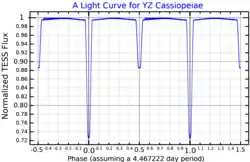
The primary star in the YZ Cassiopeiae system is a white subgiant (main sequence) star of spectral type A1Vm and 2.31 solar masses[11] (M☉) with a less massive main sequence dwarf star of type F2V[3] and 1.35 M☉.[11]
In 1924, Joel Stebbins announced his discovery that the star, then known as 21 Cassiopeiae, is an eclipsing binary.[16] It was given its variable star designation, YZ Cassiopeiae, in 1925.[17] The apparent magnitude of the eclipsing binary varies from 5.65 to 6.05[3] with a period of 4.4672 days.[11] Combined, they appear to have a spectral type of A2IV.[11]
The binary has a dimmer (magnitude 9.7 according to Norton,[18] or 10.5 by SIMBAD) companion of 0.8 M☉[11] orbiting with a period of about 86 580 years.[11]
References
- ↑ Anderson, E.; Francis, Ch. (May 2012). "XHIP: An extended hipparcos compilation". Astronomy Letters. 38 (5): 331–346. arXiv:1108.4971. Bibcode:2012AstL...38..331A. doi:10.1134/S1063773712050015. eISSN 1562-6873. ISSN 1063-7737. S2CID 119257644.
- 1 2 3 4 5 van Leeuwen, F. (November 2007). "Validation of the new Hipparcos reduction". Astronomy and Astrophysics. 474 (2): 653–664. arXiv:0708.1752. Bibcode:2007A&A...474..653V. doi:10.1051/0004-6361:20078357. S2CID 18759600.
- 1 2 3 Jerzy M. Kreiner, Chun-Hwey Kim, Il-Seong Nha. YZ CAS: Atlas of O-C Diagrams of Eclipsing Binary Stars
- 1 2 Hog, E.; Kuzmin, A.; Bastian, U.; Fabricius, C.; Kuimov, K.; Lindegren, L.; Makarov, V. V.; Roeser, S. (1998). "The TYCHO Reference Catalogue". Astronomy and Astrophysics. 335: L65. Bibcode:1998A&A...335L..65H.
- 1 2 3 4 5 Eggen, O. J. (1963). "Three-color photometry of the components in 228 wide double and multiple systems". Astronomical Journal. 68: 483. Bibcode:1963AJ.....68..483E. doi:10.1086/109000.
- ↑ Grenier, S.; Baylac, M.-O.; Rolland, L.; Burnage, R.; Arenou, F.; Briot, D.; Delmas, F.; Duflot, M.; Genty, V.; Gómez, A. E.; Halbwachs, J.-L.; Marouard, M.; Oblak, E.; Sellier, A. (1999). "Radial velocities. Measurements of 2800 B2-F5 stars for HIPPARCOS" (PDF). Astronomy and Astrophysics Supplement. 137 (3): 451. Bibcode:1999A&AS..137..451G. doi:10.1051/aas:1999489.
- 1 2 Bilir, S.; Ak, T.; Soydugan, E.; Soydugan, F.; Yaz, E.; Filiz Ak, N.; Eker, Z.; Demircan, O.; Helvaci, M. (2008). "New absolute magnitude calibrations for detached binaries". Astronomische Nachrichten. 329 (8): 835. arXiv:0806.1290. Bibcode:2008AN....329..835B. doi:10.1002/asna.200811002. S2CID 6131326.
- ↑ Samus, N. N.; Durlevich, O. V.; et al. (2009). "VizieR Online Data Catalog: General Catalogue of Variable Stars (Samus+ 2007-2013)". VizieR On-line Data Catalog: B/GCVS. Originally Published in: 2009yCat....102025S. 1. Bibcode:2009yCat....102025S.
- 1 2 3 4 5 6 7 8 Pavlovski, K.; Southworth, J.; Kolbas, V.; Smalley, B. (2014). "Absolute dimensions of detached eclipsing binaries - III. The metallic-lined system YZ Cassiopeiae". Monthly Notices of the Royal Astronomical Society. 438 (1): 590–603. arXiv:1311.3482. Bibcode:2014MNRAS.438..590P. doi:10.1093/mnras/stt2229. S2CID 56144135.
- ↑ Gontcharov, G. A. (2006). "Pulkovo Compilation of Radial Velocities for 35 495 Hipparcos stars in a common system". Astronomy Letters. 32 (11): 759–771. arXiv:1606.08053. Bibcode:2006AstL...32..759G. doi:10.1134/S1063773706110065. S2CID 119231169.
- 1 2 3 4 5 6 7 8 Tokovinin 1997-1999. J/A+AS/124/75. Multiple star catalogue (MSC)
- 1 2 3 4 5 6 7 Eker, Z.; Soydugan, F.; Soydugan, E.; Bilir, S.; Yaz Gökçe, E.; Steer, I.; Tüysüz, M.; Şenyüz, T.; Demircan, O. (2015). "Main-Sequence Effective Temperatures from a Revised Mass-Luminosity Relation Based on Accurate Properties". The Astronomical Journal. 149 (4): 131. arXiv:1501.06585. Bibcode:2015AJ....149..131E. doi:10.1088/0004-6256/149/4/131. S2CID 118740259.
- 1 2 3 Maxted, P. F. L.; Serenelli, A. M.; Southworth, J. (2015). "Bayesian mass and age estimates for transiting exoplanet host stars". Astronomy & Astrophysics. 575: A36. arXiv:1412.7891. Bibcode:2015A&A...575A..36M. doi:10.1051/0004-6361/201425331. S2CID 54857801.
- ↑ "V* YZ Cas". SIMBAD. Centre de données astronomiques de Strasbourg. Retrieved 26 January 2018.
- ↑ "MAST: Barbara A. Mikulski Archive for Space Telescopes". Space Telescope Science Institute. Retrieved 8 December 2021.
- ↑ Stebbins, Joel (1924). "Photo-electric photometry at the Washburn Observatory". Popular Astronomy. 32: 233–234. Bibcode:1924PA.....32..233S. Retrieved 14 January 2025.
- ↑ Guthnick, P.; Prager, R. (March 1925). "Benennung von neu entdeckten veränderlichen Sternen". Astronomische Nachrichten. 224 (8): 129–148. Bibcode:1925AN....224..129G. doi:10.1002/asna.19252240802. Retrieved 14 January 2025.
- ↑ Norton, Arthur P. (1973). Norton's Star Atlas. Gall & Inglis. p. 118. ISBN 0-85248-900-5.
| Stars |
| ||||||||||||
|---|---|---|---|---|---|---|---|---|---|---|---|---|---|
| |||||||||||||
| |||||||||||||
| Nebulae |
| ||||||||||||
| Galaxies |
| ||||||||||||
| |||||||||||||
 Category Category | |||||||||||||