WISE 0825+2805
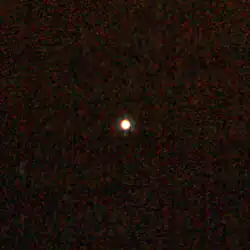 WISE 0825+2805 Credit: JWST/MIRI; Faherty et al. | |
| Observation data Epoch 2000 Equinox 2000 | |
|---|---|
| Constellation | Cancer |
| Right ascension | 08h 25m 07.35720s |
| Declination | 28° 05′ 48.5592″ |
| Characteristics | |
| Evolutionary stage | sub-brown dwarf |
| Spectral type | Y0.5[1] |
| Apparent magnitude (J) | 22.53 ±0.10 |
| Apparent magnitude (H) | 23.09 ±0.18 |
| Astrometry | |
| Proper motion (μ) | RA: -66.7 ±0.9 mas/yr[2] Dec.: -235.8 ±0.9 mas/yr[2] |
| Parallax (π) | 152.6±2 mas[2] |
| Distance | 21.4 ± 0.3 ly (6.55 ± 0.09 pc) |
| Details[3] | |
| Mass | 5 MJup |
| Surface gravity (log g) | 4 cgs |
| Temperature | 350 K |
| Age | 800 Myr |
| Other designations | |
| WISEA J082507.37+280548.2, WISE J082507.35+280548.5 | |
| Database references | |
| SIMBAD | data |
WISE 0825+2805 (WISE J082507.35+280548.5) is a (sub-)brown dwarf with a spectral type of Y0.5.[1] It is about 21.4 light-years away from Earth in the Cancer constellation.[2]
Discovery
WISE 0825+2805 was discovered in 2015 by Schneider et al. with the Wide-field Infrared Survey Explorer and the Hubble Space Telescope, using WFC3 near-infrared grism spectroscopy. The team also announced the discovery of three T-dwarfs as well as two additional Y-dwarfs (WISE J1206+8401 and WISE J2354+0240) in the same paper.[1]
Physical properties
WISE 0825+2805 was observed with JWST NIRCam and MIRI. The modeling requires phosphine-free and diabatic models to produce a good fit. The good fit requires an effective temperature of 350 Kelvin and a surface gravity of log g = 4.0. Alternatively a lower surface gravity could improve the fit. The model parameters correspond to a mass of 5 MJ and an age of 800 Myrs.[3]
See also
References
- 1 2 3 Schneider, Adam C.; Cushing, Michael C.; Kirkpatrick, J. Davy; Gelino, Christopher R.; Mace, Gregory N.; Wright, Edward L.; Eisenhardt, Peter R.; Skrutskie, M. F.; Griffith, Roger L.; Marsh, Kenneth A. (2015-05-01). "Hubble Space Telescope Spectroscopy of Brown Dwarfs Discovered with the Wide-field Infrared Survey Explorer". The Astrophysical Journal. 804 (2): 92. arXiv:1502.05365. Bibcode:2015ApJ...804...92S. doi:10.1088/0004-637X/804/2/92. ISSN 0004-637X.
- 1 2 3 4 Kirkpatrick, J. Davy; et al. (December 2023). "The Initial Mass Function Based on the Full-sky 20-pc Census of ∼3,600 Stars and Brown Dwarfs". The Astrophysical Journal Supplement Series. arXiv:2312.03639. Bibcode:2023arXiv231203639K.
{{cite journal}}: CS1 maint: numeric names: authors list (link) - 1 2 Leggett, S. K.; Tremblin, Pascal (2024-01-01). "James Webb Space Telescope Spectra of Cold Brown Dwarfs are Well-reproduced by Phosphine-free, Diabatic, ATMO2020++ Models". Research Notes of the American Astronomical Society. 8 (1): 13. Bibcode:2024RNAAS...8...13L. doi:10.3847/2515-5172/ad1b61. ISSN 2515-5172.
| Stars |
| ||||||||||
|---|---|---|---|---|---|---|---|---|---|---|---|
| |||||||||||
| |||||||||||
| |||||||||||
| Galaxies |
| ||||||||||
| |||||||||||
 Category Category | |||||||||||