V1054 Ophiuchi
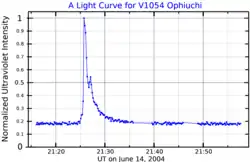 An ultraviolet band light curve for a flare on V1054 Ophiuchi, plotted from data published by Dal and Evren (2010)[1] | |
| Observation data Epoch J2000.0 Equinox J2000.0 | |
|---|---|
| Constellation | Ophiuchus[2] |
| AB | |
| Right ascension | 16h 55m 28.75757s[3] |
| Declination | −08° 20′ 10.7878″[3] |
| Apparent magnitude (V) | 9.74/10.34/10.84[4] |
| Gliese 643 | |
| Right ascension | 16h 55m 25.22225s[5] |
| Declination | −08° 19′ 21.2970″[5] |
| Apparent magnitude (V) | 11.74[4] |
| C (VB 8) | |
| Right ascension | 16h 55m 35.25574s[6] |
| Declination | −08° 23′ 40.7531″[6] |
| Apparent magnitude (V) | 16.80[4] |
| Characteristics | |
| AB | |
| Spectral type | M3 V[7] / M4 Ve[note 1] |
| Gliese 643 | |
| Spectral type | M3.5 V[7] |
| C (VB 8) | |
| Spectral type | M7.0 V[4] |
| Astrometry | |
| AB | |
| Radial velocity (Rv) | 14.89±0.05[8] km/s |
| Proper motion (μ) | RA: −817.84±6.68 mas/yr[3] Dec.: −873.53±3.53 mas/yr[3] |
| Parallax (π) | 161.41±5.64 mas[3] |
| Distance | 20.2 ± 0.7 ly (6.2 ± 0.2 pc) |
| Absolute magnitude (MV) | 10.23[2] |
| Gliese 643 | |
| Radial velocity (Rv) | 15.20±0.15[5] km/s |
| Proper motion (μ) | RA: −817.580(52) mas/yr[5] Dec.: −898.595(40) mas/yr[5] |
| Parallax (π) | 153.8754±0.0474 mas[5] |
| Distance | 21.196 ± 0.007 ly (6.499 ± 0.002 pc) |
| Absolute magnitude (MV) | 12.60[2] |
| VB 8 | |
| Proper motion (μ) | RA: −813.038(63) mas/yr[6] Dec.: −870.609(44) mas/yr[6] |
| Parallax (π) | 153.9659 ± 0.0570 mas[6] |
| Distance | 21.184 ± 0.008 ly (6.495 ± 0.002 pc) |
| Absolute magnitude (MV) | 17.75[4] |
| Orbit[7] | |
| Primary | V1054 Oph A |
| Companion | V1054 Oph B |
| Period (P) | 1.717267±0.000039[4] yr |
| Semi-major axis (a) | 0.2273±0.0004" (1.46683 AU[note 2]) |
| Eccentricity (e) | 0.042±0.001 |
| Inclination (i) | 160.3±0.1° |
| Longitude of the node (Ω) | −10.2±0.2° |
| Periastron epoch (T) | MJD 53943±3 |
| Argument of periastron (ω) (secondary) | 306.0±1.5° |
| Orbit[7] | |
| Primary | V1054 Oph Ba |
| Companion | V1054 Oph Bb |
| Period (P) | 2.965509±0.000006 d |
| Semi-major axis (a) | 0.00687[note 3]" (0.04432 AU[note 4]) |
| Eccentricity (e) | 0.0209±0.0008 |
| Inclination (i) | 164.18±0.08° |
| Periastron epoch (T) | MJD 50919.48±0.03 |
| Argument of periastron (ω) (secondary) | 150.0±3.0° |
| Details | |
| AB | |
| Mass | 0.4155±0.0057 / 0.3466±0.0047 / 0.3143±0.0040[7] M☉ |
| Gliese 643 | |
| Mass | 0.19[4] M☉ |
| C (VB 8) | |
| Mass | 0.0914+0.0026 −0.0025[9] M☉ |
| Radius | 0.1214+0.0060 −0.0057[9] R☉ |
| Luminosity | 0.000645+0.000004 −0.000005[9] L☉ |
| Temperature | 2,640+65 −64[9] K |
| Other designations | |
| CCDM J16555-0820 | |
| AB: V1054 Oph, BD−08°4352, GJ 644, HD 152751, HIP 82817, SAO 141439, LHS 428, Wolf 630[10] | |
| GJ 643: GJ 643, HIP 82809, LHS 427, Wolf 629[11] | |
| C: GJ 644 C, LHS 429, VB 8[12] | |
| Database references | |
| SIMBAD | ABab |
| GJ 643 | |
| C (vB 8) | |
V1054 Ophiuchi, together with the star Gliese 643, is a nearby quintuple star system, located in the constellation Ophiuchus at a distance of 21.2 light-years. It consists of five stars, all of which are red dwarfs. The alternative designation of Wolf 630 forms the namesake of a moving group of stars that share a similar motion through space.[13]
Overview
| A | |||||||||||||||||
| P = 1.72 yr | |||||||||||||||||
| Ba | |||||||||||||||||
| P = 2.97 d | |||||||||||||||||
| Bb | |||||||||||||||||
| 72″ separation | |||||||||||||||||
| GJ 643 | |||||||||||||||||
| 220″ separation | |||||||||||||||||
| C (VB 8) | |||||||||||||||||
Hierarchy of orbits in the system[4]
V1054 Ophiuchi/Gliese 643 is the nearest quintuple star system;[4] the next nearest star systems with at least five stars are Xi Ursae Majoris (quintuple, including a brown dwarf)[14] at 28.5 light-years, Castor[4] (sextuple) at 49.2 light-years, and GJ 2069 (quintuple)[7] at 54.3 light-years. V1054 Ophiuchi and Xi Ursae Majoris are the only two quintuple star systems within 10 parsecs.[14]
The system consists of three widely separated parts:
- close triple subsystem V1054 Ophiuchi A-Bab (including very close binary subsystem V1054 Ophiuchi Bab)
- Gliese 643
- V1054 Ophiuchi C (vB 8)
The brightest and most massive of these five stars is V1054 Ophiuchi A. The close binary subsystem V1054 Ophiuchi B is more massive than V1054 Ophiuchi A, however, its total visual magnitude is 0.1 mag fainter than V1054 Ophiuchi A's visual magnitude.[4]
The total apparent magnitude of the V1054 Ophiuchi A-Bab triple subsystem is 9.02.[4][15]
Despite V1054 Ophiuchi/Gliese 643 consisting of low-mass stars, the system's total mass, due to the large number of components, exceeds the Solar mass,[4] (it is about 1.35 M☉).
Distance
Currently, the most accurate distance estimate of V1054 Ophiuchi/Gliese 643 is a trigonometric parallax of Gliese 643 from Gaia DR3:[5] 153.8754±0.0474 mas, corresponding to a distance of 6.499±0.002 pc, or 21.196±0.007 ly.
Past V1054 Ophiuchi/Gliese 643 distance estimates
V1054 Ophiuchi A-Bab:
| Source | Paper | Parallax, mas | Distance, pc | Distance, ly | Ref. |
|---|---|---|---|---|---|
| Woolley | Woolley et al. 1970 | 156 ± 4 | 6.41 ± 0.17 | 20.9 ± 0.6 | [16] |
| GJ, 3rd version | Gliese & Jahreiß 1991 | 153.9 ± 2.6 | 6.50 ± 0.11 | 21.19 ± 0.36 | [17] |
| YPC, 4th edition | van Altena et al. 1995 | 154.8 ± 0.6 | 6.460 ± 0.025 | 21.07 ± 0.08 | [18] |
| Hipparcos | Perryman 1997 | 174.23 ± 3.90 | 5.74 ± 0.13 | 18.7 ± 0.4 | [15] |
| Soederhjelm | Soederhjelm 1999 | 155.63 ± 1.81 | 6.43 ± 0.08 | 20.96 ± 0.25 | [19] |
| Hipparcos2 | van Leeuwen 2007 | 161.41 ± 5.64 | 6.20 ± 0.22 | 20.21 ± 0.73 | [3] |
Gliese 643:
| Source | Paper | Parallax, mas | Distance, pc | Distance, ly | Ref. |
|---|---|---|---|---|---|
| Woolley | Woolley et al. 1970 | 169 ± 5 | 5.92 ± 0.18 | 19.3 ± 0.6 | [16] |
| GJ, 3rd version | Gliese & Jahreiß 1991 | 171.9 ± 7.3 | 5.82 ± 0.26 | 19.0 ± 0.8 | [17] |
| YPC, 4th edition | van Altena et al. 1995 | 169.8 ± 6.6 | 5.89 ± 0.24 | 19.2 ± 0.8 | [18] |
| Hipparcos | Perryman 1997 | 153.96 ± 4.04 | 6.50 ± 0.18 | 21.2 ± 0.6 | [15] |
| Hipparcos2 | van Leeuwen 2007 | 148.92 ± 4.00 | 6.72 ± 0.19 | 21.9 ± 0.6 | [3] |
V1054 Ophiuchi C (vB 8):
| Source | Paper | Parallax, mas | Distance, pc | Distance, ly | Ref. |
|---|---|---|---|---|---|
| CTIOPI 1.5 m | TSN 14 (Costa et al. 2005) | 155.43 ± 1.33 | 6.43 ± 0.06 | 20.98 ± 0.18 | [20] |
Weighted mean distance
A weighted mean parallax[21] was calculated by RECONS in 2012, considering YPC (V1054 Ophiuchi A-Bab and Gliese 643), Hipparcos (Soederhjelm — V1054 Ophiuchi A-Bab and van Leeuwen — Gliese 643) and CTIOPI (V1054 Ophiuchi C) data. The value is 154.96±0.52 mas,[22] corresponding to a distance of 6.453±0.022 pc, or 21.05±0.07 ly. This predates Gaia astrometry of the system.
System
V1054 Ophiuchi A-Bab (inner triple subsystem)
V1054 Ophiuchi A-Bab is a close spectroscopic triple subsystem, consisting of the brighter component V1054 Ophiuchi A and the more massive binary subsystem V1054 Ophiuchi Bab, orbiting each other with a period of 627 days,[7][4] or 1.72 years.[4] V1054 Ophiuchi Bab components are orbiting each other with a period of 2.9655 days.[7][4] Both outer and inner orbits are nearly circular and, probably, coplanar[7][4] (in keeping with a general tendency of close triple systems).[7]
V1054 Ophiuchi A-Bab pair is also visually resolved (for nearly 50 years it was the shortest-period resolved by visual means binary, since its binarity was discovered by G. P. Kuiper in 1934),[4] whereas V1054 Ophiuchi Ba-Bb pair is still unresolved).[7][4][note 5]
Gliese 643
The projected separation of Gliese 643 from V1054 Ophiuchi A-Bab is 72 arcsec,[7] corresponding at 21.05 light-years to 465 a.u.
V1054 Ophiuchi C (vB 8)
vB 8 is the smallest, faintest, and most separated component of the V1054 Ophiuchi system. The projected separation of the red dwarf from the primary triple system is about 220 arcsec,[7][4] corresponding at 21.05 light-years to 1420 a.u. Since it is only three times larger than the projected separation between Gliese 643 and V1054 Ophiuchi A-Bab, and such a small ratio should render the triple system dynamically unstable, it was suggested[4] that the real separation of V1054 Ophiuchi C from V1054 Ophiuchi A-Bab is much larger, at least by a factor of two,[4] i. e. at least 2840 a.u.
In 1984, the apparent detection of an infrared source near vB 8 suggested it had a low mass companion. The low mass of this candidate led to speculation that it may be a brown dwarf; the first such to be detected. This discovery was later found to be spurious, but it produced much interest in this class of astronomical object.[23]
Notes
References
- ↑ Dal, H. A.; Evren, S. (August 2010). "A New Method for Classifying Flares of UV Ceti Type Stars: Differences Between Slow and Fast Flares". The Astronomical Journal. 140 (2): 483–489. arXiv:1206.5791. Bibcode:2010AJ....140..483D. doi:10.1088/0004-6256/140/2/483. S2CID 119308060. Retrieved 4 February 2022.
- 1 2 3 Anderson, E.; Francis, Ch. (2012). "XHIP: An extended hipparcos compilation". Astronomy Letters. 38 (5): 331. arXiv:1108.4971. Bibcode:2012AstL...38..331A. doi:10.1134/S1063773712050015.
- 1 2 3 4 5 6 7 Vizier, Hipparcos, the New Reduction (van Leeuwen 2007)
- 1 2 3 4 5 6 7 8 9 10 11 12 13 14 15 16 17 18 19 20 21 22 Mazeh, Tsevi; Latham, David W.; Goldberg, Elad; Torres, Guillermo; Stefanik, Robert P.; Henry, Todd J.; Zucker, Shay; Gnat, Orly; Ofek, Eran O. (2001). "Studies of multiple stellar systems - IV. The triple-lined spectroscopic system V1054 Ophiuchi". Monthly Notices of the Royal Astronomical Society. 325 (1): 343–357. arXiv:astro-ph/0102451. Bibcode:2001MNRAS.325..343M. doi:10.1046/j.1365-8711.2001.04419.x. S2CID 16472347.
- 1 2 3 4 5 6 7 Vallenari, A.; et al. (Gaia collaboration) (2023). "Gaia Data Release 3. Summary of the content and survey properties". Astronomy and Astrophysics. 674: A1. arXiv:2208.00211. Bibcode:2023A&A...674A...1G. doi:10.1051/0004-6361/202243940. S2CID 244398875. Gaia DR3 record for this source at VizieR.
- 1 2 3 4 5 Vallenari, A.; et al. (Gaia collaboration) (2023). "Gaia Data Release 3. Summary of the content and survey properties". Astronomy and Astrophysics. 674: A1. arXiv:2208.00211. Bibcode:2023A&A...674A...1G. doi:10.1051/0004-6361/202243940. S2CID 244398875. Gaia DR3 record for this source at VizieR.
- 1 2 3 4 5 6 7 8 9 10 11 12 13 Ségransan, Damien; Delfosse, Xavier; Forveille, Thierry; Beuzit, Jean-Luc; Udry, Stéphane; Perrier, Christian; Mayor, Michel (2000). "Accurate masses of very low mass stars. III. 16 new or improved masses". Astronomy and Astrophysics. 364: 665–673. arXiv:astro-ph/0010585. Bibcode:2000A&A...364..665S.
- ↑ Pourbaix, D.; Tokovinin, A. A.; Batten, A. H.; Fekel, F. C.; Hartkopf, W. I.; Levato, H.; Morrell, N. I.; Torres, G.; Udry, S. (2004). "SB9: The ninth catalogue of spectroscopic binary orbits". Astronomy and Astrophysics. 424: 727. arXiv:astro-ph/0406573. Bibcode:2004A&A...424..727P. doi:10.1051/0004-6361:20041213.
- 1 2 3 4 Pineda, J. Sebastian; Youngblood, Allison; France, Kevin (September 2021). "The M-dwarf Ultraviolet Spectroscopic Sample. I. Determining Stellar Parameters for Field Stars". The Astrophysical Journal. 918 (1): 23. arXiv:2106.07656. Bibcode:2021ApJ...918...40P. doi:10.3847/1538-4357/ac0aea. S2CID 235435757. 40.
- ↑ "HD 152751". SIMBAD. Centre de données astronomiques de Strasbourg. Retrieved 2019-03-25.
- ↑ "GJ 643". SIMBAD. Centre de données astronomiques de Strasbourg.
- ↑ "VB 8". SIMBAD. Centre de données astronomiques de Strasbourg.
- ↑ Bubar, Eric J.; King, Jeremy R. (August 2010). "Spectroscopic Abundances and Membership in the Wolf 630 Moving Group". The Astronomical Journal. 140 (2): 293–318. arXiv:1005.1205. Bibcode:2010AJ....140..293B. doi:10.1088/0004-6256/140/2/293. S2CID 118455341.
- 1 2 Reylé, Céline; Jardine, Kevin; Fouqué, Pascal; Caballero, Jose A.; Smart, Richard L.; Sozzetti, Alessandro (30 April 2021). "The 10 parsec sample in the Gaia era". Astronomy & Astrophysics. 650: A201. arXiv:2104.14972. Bibcode:2021A&A...650A.201R. doi:10.1051/0004-6361/202140985. S2CID 233476431. Data available at https://gruze.org/10pc/ Archived 12 March 2023 at the Wayback Machine
- 1 2 3 Vizier, The Hipparcos and Tycho Catalogues (ESA 1997)
- 1 2 Vizier, Stars within 25 pc of the Sun (Woolley+ 1970)
- 1 2 Vizier, Nearby Stars, Preliminary 3rd Version (Gliese+ 1991)
- 1 2 VizieR, Yale Trigonometric Parallaxes, Fourth Edition (van Altena+ 1995)
- ↑ Vizier, Visual binary orbits and masses (Soederhjelm 1999)
- ↑ Costa, Edgardo; Méndez, René A.; Jao, W.-C.; Henry, Todd J.; Subasavage, John P.; Brown, Misty A.; Ianna, Philip A.; Bartlett, Jennifer (2005). "The Solar Neighborhood. XIV. Parallaxes from the Cerro Tololo Inter-American Observatory Parallax Investigation-First Results from the 1.5 m Telescope Program". The Astronomical Journal. 130 (1): 337–349. Bibcode:2005AJ....130..337C. CiteSeerX 10.1.1.573.7563. doi:10.1086/430473. S2CID 12213270.
- ↑ DENSE Project. 25 pc White Dwarf Sample (see formulae below)
- ↑ THE ONE HUNDRED NEAREST STAR SYSTEMS brought to you by RECONS (Research Consortium On Nearby Stars)
- ↑ Reid, Neill I.; Hawley, Suzanne L. (27 November 2013). New Light on Dark Stars: Red Dwarfs, Low-Mass Stars, Brown Dwarfs. Astronomy and Planetary Sciences. Springer Science & Business Media, 2013. p. 344. ISBN 978-1447136637.
| |||||||||||||
| Stars |
| ||||||||||||
| |||||||||||||
| Star clusters |
| ||||||||||||
| Nebulae |
| ||||||||||||
| Galaxies |
| ||||||||||||
| |||||||||||||
| |||||||||||||
 Category Category | |||||||||||||