V Sagittae
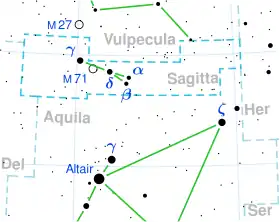  | |
| Observation data Epoch J2000 Equinox J2000 | |
|---|---|
| Constellation | Sagitta |
| Right ascension | 20h 20m 14.691s[1] |
| Declination | +21° 06′ 10.44″[1] |
| Apparent magnitude (V) | 8.6-13.9[2] |
| Characteristics | |
| Spectral type | B1[3] |
| Variable type | eclipsing and cataclysmic[2] |
| Astrometry | |
| Proper motion (μ) | RA: −2.133[1] mas/yr Dec.: −6.489[1] mas/yr |
| Parallax (π) | 0.3310±0.0206 mas[1] |
| Distance | 9,900 ± 600 ly (3,000 ± 200 pc) |
| Absolute magnitude (MV) | −2.2[4] |
| Orbit[5] | |
| Semi-major axis (a) | 4.36 R☉ |
| Inclination (i) | 71° |
| Semi-amplitude (K1) (primary) | 320 km/s |
| Semi-amplitude (K2) (secondary) | 85 km/s |
| Details | |
| White dwarf | |
| Mass | 0.9[5] M☉ |
| Radius | 1.2[5] R☉ |
| Luminosity | 30,000[5] L☉ |
| Temperature | 70,000[5] K |
| Donor | |
| Mass | 3.3[5] M☉ |
| Radius | 2.1[5] R☉ |
| Temperature | 12,000[5] K |
| Other designations | |
| AAVSO 1015+20, V Sge, GSC 01643-01764 | |
| Database references | |
| SIMBAD | data |
V Sagittae or V Sge is a cataclysmic variable in the constellation Sagitta. The system is composed of a main sequence star of about 3.3 solar masses and a white dwarf of about 0.9 solar masses; the fact that the white dwarf is less massive than its companion is highly unusual for a cataclysmic variable,[6] and V Sge is the only super soft X-ray source nonmagnetic cataclysmic variable found so far.
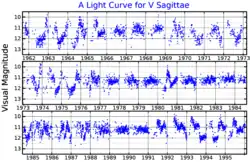
Material from the larger star is accreting onto the white dwarf at an exponentially increasing rate, generating a huge stellar wind. The doubling time for the accretion rate, and hence for the system luminosity, is about 89±11 years.[4] It is predicted that the system will erupt as a nova some time between 2067 and 2099, at which point it will become one of the brightest stars in the sky.[6][8]
References
- 1 2 3 4 5 Vallenari, A.; et al. (Gaia collaboration) (2023). "Gaia Data Release 3. Summary of the content and survey properties". Astronomy and Astrophysics. 674: A1. arXiv:2208.00211. Bibcode:2023A&A...674A...1G. doi:10.1051/0004-6361/202243940. S2CID 244398875. Gaia DR3 record for this source at VizieR.
- 1 2 Samus, N. N.; Durlevich, O. V.; et al. (2009). "VizieR Online Data Catalog: General Catalogue of Variable Stars (Samus+ 2007-2013)". VizieR On-line Data Catalog: B/GCVS. Originally Published in: 2009yCat....102025S. 1: B/gcvs. Bibcode:2009yCat....102025S.
- ↑ Iriarte, B.; Chavira, E. (1955). "Nuevas estrellas de tipos espectrales tempranos con Hα en emisión entre l=339° y l=33°". Boletin de los Observatorios Tonantzintla y Tacubaya. 2: 19. Bibcode:1955BOTT....2m..19I.
- 1 2 "V Sagittae technical details" (PDF). Retrieved 2021-10-03.
- 1 2 3 4 5 6 7 8 Smak, Jozef I.; Belczynski, K.; Zola, S. (2001). "V Sge: A Hot, Peculiar Binary System". Acta Astronomica. 51: 117. Bibcode:2001AcA....51..117S.
- 1 2 "Binary star V Sagittae to explode as very bright nova by century's end". phys.org. Retrieved 2020-01-09.
- ↑ Šimon, V.; Mattei, J. A. (October 1999). "The peculiar binary V Sagittae: Properties of its long-term light changes". Astronomy and Astrophysics Supplement Series. 139: 75–88. Bibcode:1999A&AS..139...75S. doi:10.1051/aas:1999381.
- ↑ "CNN - Breaking News, Latest News and Videos". m.cnn.com. Archived from the original on 2020-01-13. Retrieved 2020-01-09.
| |||||||||||
| Stars |
| ||||||||||
| |||||||||||
| |||||||||||
| Nebulae |
| ||||||||||
 Category Category | |||||||||||