Sibelius (crater)
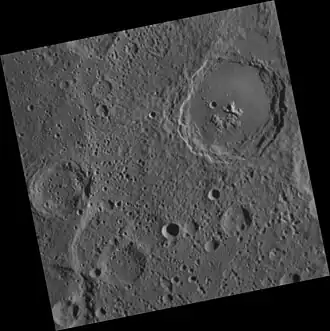 MESSENGER NAC | |
| Planet | Mercury |
|---|---|
| Coordinates | 49°30′S 145°22′W / 49.5°S 145.37°W |
| Quadrangle | Michelangelo |
| Diameter | 94 km (58 mi) |
| Eponym | Jean Sibelius |
Sibelius is a crater on Mercury.[1] It has a diameter of 94 kilometres (58 miles). Its name was adopted by the International Astronomical Union (IAU) in 1985. Sibelius is named for the Finnish composer Jean Sibelius.[2] The crater was first imaged by Mariner 10 in 1974.[3]
Sibelius has a complex central peak that is offset from the center to the southwest. Within the central peak complex is a dark spot of low reflectance material (LRM), closely associated with hollows.[4]
To the south of Sibelius is the crater Vincente, and to the east are Delacroix and Shelley. To the northwest is We’wha crater.
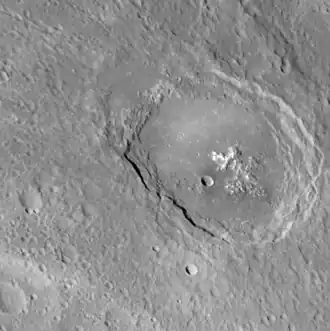 Highest resolution view obtained by MESSENGER
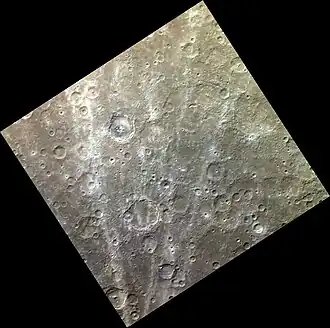 The region around Sibelius in exaggerated color. The rays of Han Kan crater cross the scene.
References
- ↑ "Sibelius". Gazetteer of Planetary Nomenclature. NASA. Retrieved 4 March 2022.
- ↑ Douglas Whittet (April 2015). "Sibelius and astronomy: beyond 'The Sky at Night'". Astronomy & Geophysics. 56 (2): 27–31. doi:10.1093/astrogeo/atv063. Retrieved 2 June 2022.
- ↑ Davies, M. E.; Dwornik, S. E.; Gault, D. E.; Strom, R. G. (1978). Atlas of Mercury. National Aeronautics and Space Administration. pp. 1–128. ISBN 978-1-114-27448-8. Special Publication SP-423.
- ↑ Zhiyong Xiao, Robert G. Strom, David T. Blewett, Paul K. Byrne, Sean C. Solomon, Scott L. Murchie, Ann L. Sprague, Deborah L. Domingue, Jörn Helbert, 2013. Dark spots on Mercury: A distinctive low-reflectance material and its relation to hollows. Journal of Geophysical Research Planets. doi.org/10.1002/jgre.20115


This article is issued from Wikipedia. The text is licensed under Creative Commons - Attribution - Sharealike. Additional terms may apply for the media files.