PSR B1509−58
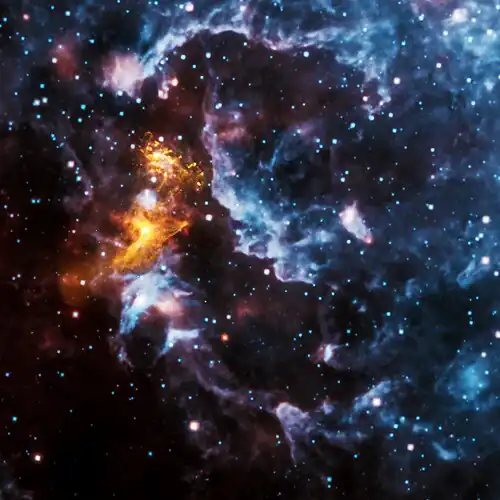 Composite image: X-rays are gold; infrared in red, green and blue/max. Credit: Chandra X-ray Observatory, WISE 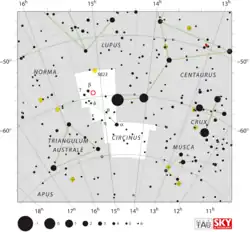 | |
| Observation data Epoch J2000 Equinox J2000 | |
|---|---|
| Constellation | Circinus |
| Right ascension | 15h 13m 55.52s[1] |
| Declination | −59° 08′ 08.8″[1] |
| Characteristics | |
| Spectral type | Pulsar |
| Astrometry | |
| Distance | 17,000 ly (5,200 ±1,400 pc) |
| Details | |
| Rotation | 0.1502 s[1] |
| Other designations | |
| PSR 1509-58[1] | |
| Database references | |
| SIMBAD | data |
PSR B1509−58 is a pulsar approximately at a distance of 17,000 light-years in the constellation of Circinus discovered by the Einstein X-Ray Observatory in 1982.[2] Its diameter is only 12 miles (19 km). It is located in a Pulsar wind nebula created by itself, that was caused as a remnant of the Supernova (SNR) MSH 15−52 visual approximately 1,700 years ago at the southern celestial hemisphere not visible in the northern hemisphere.[3][4] The nebula spans about 150 light years.[5] The 150 ms pulsations ("almost 7 times per second") are detected in the radio, X-ray, and γ-ray bands.[6]
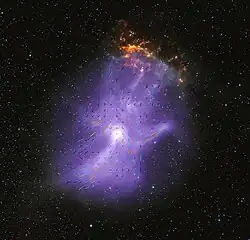
NASA described the star as "a rapidly spinning neutron star which is spewing energy out into the space around it to create complex and intriguing structures, including one that resembles a large cosmic hand".[7] It is also known by the name "Hand of God".[8] This phenomenon is called pareidolia.
Gallery
- Sequence of images of optical, X-ray, radio, and infra-red emission
- Tour of PSR B1509−58.
- Sequence of PSR B1509−58 images.
- Size comparisons: PSR B1509−58 and Crab Nebula.
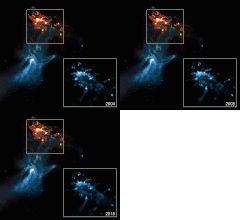 To track this motion, Chandra data is shown, from 2004, 2008, and then a combined image from observations taken in late 2017 and early 2018. These three epochs are shown in the inset of the main graphic.
See also
References
- 1 2 3 4 Caraveo, P. A.; Mereghetti, S.; Bignami, G. F. (1994). "An Optical Counterpart for PSR 1509-58". The Astrophysical Journal. 423: L125. Bibcode:1994ApJ...423L.125C. doi:10.1086/187252.
- ↑ Seward, F. D.; Harnden, F. R. Jr. (May 1982). "A new, fast X-ray pulsar in the supernova remnant MSH 15-52". The Astrophysical Journal. 256: L45. Bibcode:1982ApJ...256L..45S. doi:10.1086/183793.
- ↑ "How Old Is It?". Harvard–Smithsonian Center for Astrophysics. 2009-04-03. Archived from the original on 2014-01-10. Retrieved 2014-01-10.
- ↑ Oxford Academic: Modelling spectral evolution of pulsar wind nebulae inside supernova remnants | Monthly Notices of the Royal Astronomical Society | Oxford Academic, access-date 13. November 2024
- ↑ "PSR B1509-58: A Young Pulsar Shows its Hand". Harvard. 2009-04-03.
- ↑ Romani, Roger W, American Astronomical Society, et al. (1 November 2023). "The Polarized Cosmic Hand: IXPE Observations of PSR B1509-58/MSH 15-52". The Astrophysical Journal. doi:10.3847/1538-4357/acfa02.
- ↑ "A Young Pulsar Shows Its Hand". NASA. 7 March 2009. Retrieved 23 November 2024.
- ↑ "NASA photos show giant cosmic hand". CNN. 2009-04-14.
- ↑ Manuel Peitsch. "RCW 89". Manuel's Astrophotography. Retrieved 16 February 2025.
- ↑ Chandra (September 2005). "Chandra Observation of the Interaction between the Hot Plasma Nebula RCW 89 and the Pulsar Jet of PSR B1509-58". The SAO Astrophysics Data System. Retrieved 16 February 2025.
External links
 Media related to PSR B1509-58 at Wikimedia Commons
- Lee Mohon (24 June 2021). "MSH 15-52: Cosmic Hand Hitting a Wall". NASA. Retrieved 16 February 2025.
- Chandra X-ray Center (CXO): Young Pulsar Shows Its Hand, Science Daily, 5 May 2009, retrieved 15 November 2024
- Chandra X-ray Observatory blog
