NGC 2959
| NGC 2959 | |
|---|---|
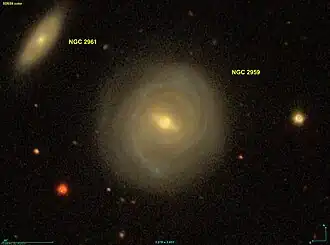 The intermediate spiral galaxy NGC 2959 | |
| Observation data (J2000 epoch) | |
| Constellation | Ursa Major |
| Right ascension | 09h 45m 08.9714s[1] |
| Declination | +68° 35′ 40.507″[1] |
| Redshift | 0.01482[1] |
| Heliocentric radial velocity | 4442 ± 3 km/s[1] |
| Distance | 217.7 ± 15.2 Mly (66.74 ± 4.67 Mpc)[1] |
| Apparent magnitude (V) | 12.8[1] |
| Characteristics | |
| Type | (R')SAB(rs)ab pec?[1] |
| Size | ~131,400 ly (40.28 kpc) (estimated)[1] |
| Apparent size (V) | 1.4′ × 1.4′[1] |
| Other designations | |
| IRAS 09409+6849, UGC 5202, MCG +12-09-062, PGC 27939, CGCG 332-061[1] | |
NGC 2959 is an intermediate spiral galaxy in the constellation Ursa Major. Its velocity relative to the cosmic microwave background is 4,525 ± 6 km/s, which corresponds to a Hubble distance of 66.7 ± 4.7 Mpc (~218 million light years.).[1] NGC 2959 was discovered by British astronomer John Herschel on 28 October 1831.
NGC 2959 has a luminosity class of I-II and a broad H I line.[1]
According to the Simbad database, NGC 2959 is a LINER galaxy, i.e. a galaxy whose nucleus has an emission spectrum characterized by broad lines of weakly ionized atoms.[2]
Supernovae
Two supernovae have been observed in NGC 2959:
See also
References
- 1 2 3 4 5 6 7 8 9 10 11 12 "Results for object NGC 2959". NASA/IPAC Extragalactic Database. NASA and Caltech. Retrieved 12 December 2024.
- ↑ "NGC 2959". SIMBAD. Centre de données astronomiques de Strasbourg. Retrieved 20 December 2024.
- ↑ "SN 2021bbm". Transient Name Server. IAU. Retrieved 12 December 2024.
- ↑ "SN 2023vog". Transient Name Server. IAU. Retrieved 12 December 2024.
External links
 Media related to NGC 2959 at Wikimedia Commons
- NGC 2959 on WikiSky: DSS2, SDSS, GALEX, IRAS, Hydrogen α, X-Ray, Astrophoto, Sky Map, Articles and images

This article is issued from Wikipedia. The text is licensed under Creative Commons - Attribution - Sharealike. Additional terms may apply for the media files.