May 1453 lunar eclipse
| Partial eclipse | |||||||||||||
| Date | 22 May 1453 | ||||||||||||
|---|---|---|---|---|---|---|---|---|---|---|---|---|---|
| Gamma | −0.6067 | ||||||||||||
| Magnitude | 0.7446 | ||||||||||||
| Saros cycle | 102 (56 of 84) | ||||||||||||
| Partiality | 178 minutes, 43 seconds | ||||||||||||
| Penumbral | 315 minutes, 27 seconds | ||||||||||||
| |||||||||||||
A partial lunar eclipse occurred on 1 June 1453.
Observations
It was seen during the Fall of Constantinople (the capture of the capital of the Byzantine Empire), during the siege that lasted from Thursday, 5 April 1453 until Tuesday, 29 May 1453), according to the Julian Calendar, after which the city fell to the Ottomans. The lunar eclipse was considered to be fulfilling a prophecy for the city's demise, which says a blood moon took place during the eclipse. The dates of the siege and the eclipse had both been recorded according to the Julian Calendar in the fifteenth century, and historian Marios Philippides points out that a simple calculation is needed to update the Julian dates to the Gregorian Calendar. A Full Moon started on 24 May (Julian), which corresponds to 1 June 1453 (Gregorian). The same applies to the date of the Siege as well, which ended on the Gregorian date of Thursday, June 6, 1453.
Visibility
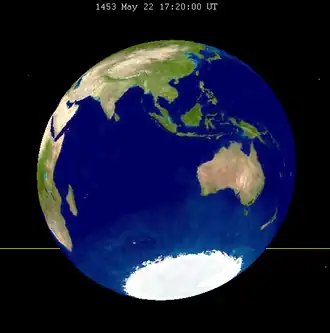
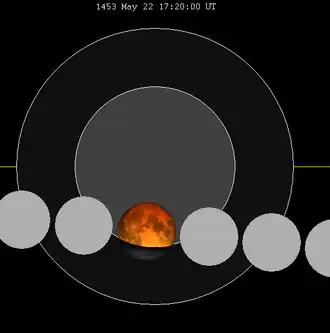
The partial eclipse was visible from Africa, Asia, Europe and Oceania.
References
External links
- www.economist.com The fall of Constantinople, Dec 23rd 1999
- www.wordinfo.info: A Lunar Eclipse that Contributed to the Fall of Constantinople

_(cropped).jpg)

