Crater illusion
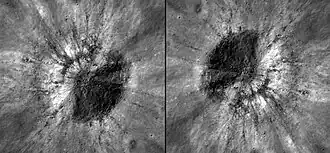
A geological feature that may appear to the view as a dome or mountain (left) can be read correctly as a crater (right) when the image is rotated
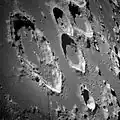
In astronomical imaging and Earth imaging, the crater illusion, also known as the dome illusion or crater/dome illusion, is an optical illusion which causes impact craters and other depressions to appear raised as domes or mountains.[1] It is believed to be caused by our being accustomed to seeing light from overhead.[2] When some images are taken from orbit, the light from the sun is nearly horizontal. This is the only time shadows are seen. Our brains are tricked into thinking that the interior of the crater is above the surrounding terrain instead of below it.[3]
Gallery
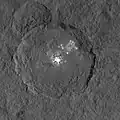
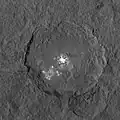 ...and rotated 180 degrees to eliminate the illusion
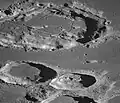 The Moon's crater Goclenius, rotated to show the illusion...
 ...and the original without the illusion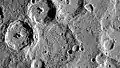
 ...and rotated to attempt to remove it
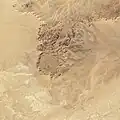 The Tin Bider crater in Algeria, producing the reverse illusion. The crater rises above the surrounding terrain, however the position of the sun makes it appear to be below it.[4]
 ...and rotated to remove the illusion
References
- ↑ "An Impact Melt Crater You'll Flip For". Slate.com Bad Astronomy. 28 July 2013.
- ↑ Crater Illusion by Paul Doherty, retrieved September 12, 2015
- ↑ "Do You See a Mountain or a Crater in this Picture?". Universe Today. 29 January 2015.
- ↑ Tin Bider Crater, Algeria from the NASA Earth Observatory, retrieved September 12, 2015
External links
This article is issued from Wikipedia. The text is licensed under Creative Commons - Attribution - Sharealike. Additional terms may apply for the media files.