Alpha Pictoris
  | |
| Observation data Epoch J2000 Equinox J2000 | |
|---|---|
| Constellation | Pictor |
| Right ascension | 06h 48m 11.45512s[1] |
| Declination | −61° 56′ 29.0008″[1] |
| Apparent magnitude (V) | 3.27[2] |
| Characteristics | |
| Spectral type | A8 Vn kA6[3] |
| U−B color index | +0.13[2] |
| B−V color index | +0.21[2] |
| Astrometry | |
| Radial velocity (Rv) | +20.6[4] km/s |
| Proper motion (μ) | RA: –66.07[1] mas/yr Dec.: +242.97[1] mas/yr |
| Parallax (π) | 33.78±1.78 mas[1] |
| Distance | 97 ± 5 ly (30 ± 2 pc) |
| Absolute magnitude (MV) | 0.86[5] |
| Orbit[6] | |
| Period (P) | 1,316±2 days |
| Semi-major axis (a) | 3.25 AU[a] |
| Eccentricity (e) | 0.29±0.02 |
| Inclination (i) | 121±2° |
| Longitude of the node (Ω) | 219±4° |
| Periastron epoch (T) | 2456390±13 BJD |
| Argument of periastron (ω) (secondary) | 353±4° |
| Details | |
| A | |
| Mass | 1.6±0.1[6] M☉ |
| Radius | 3.55[7] R☉ |
| Luminosity | 38.7+6.0 −5.2[8] L☉ |
| Surface gravity (log g) | 3.48[9] cgs |
| Temperature | 7,550±35[8] K |
| Metallicity [Fe/H] | –0.11[3] dex |
| Rotational velocity (v sin i) | 206[10] km/s |
| Age | 660[11][12] Myr |
| B | |
| Mass | 1.05±0.05[6] M☉ |
| Temperature | 5,068±91[6] K |
| Other designations | |
| CD-61°1478, Gl 248, HD 50241, HIP 32607, HR 2550, LTT 2656, SAO 249647.[13] | |
| Database references | |
| SIMBAD | data |
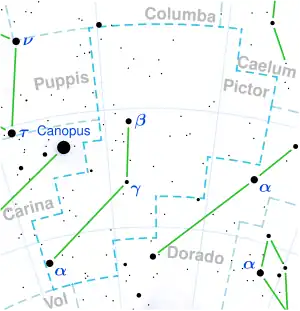
Alpha Pictoris (α Pic, α Pictoris) is the brightest star in the southern constellation of Pictor. It has an apparent visual magnitude of 3.27,[2] which is bright enough to be viewed from urban areas in the southern hemisphere. This is actually a binary star system, whose components complete an orbit every three years and seven months.[6] It is close enough for its distance to be measured using parallax shifts, which yields a value of roughly 97 light-years (30 parsecs) from the Sun, with a 5% margin of error.[1] Alpha Pictoris has the distinction of being the south pole star of the planet Mercury.[14]
Properties
With an estimated age of 660 million years,[11][12] the primary component is a relatively young Lambda Boötis star.[15] The stellar classification of A8 Vn kA6[3] shows this peculiarity, with the kA6 notation indicating weaker than normal calcium K-lines in the spectrum. The 'n' following the main sequence luminosity class of V indicates the absorption lines in the spectrum are broad and nebulous. This is caused by the rapid spin of the star, which has a high projected rotational velocity of 206 km/s.[10] Spectroscopy shows narrow, time-varying absorption features being caused by circumstellar gas moving toward the star. This is not the result of interstellar matter, but a shell of gas along the orbital plane. Alpha Pictoris is categorized as a rapidly rotating shell star that may have recently ejected mass from its outer atmosphere.[9][16]
Alpha Pictoris A is larger than the Sun, with a 60% greater mass and radius.[6] and 355% greater radius.[7] It is radiating 40 times as much luminosity as the Sun from its outer atmosphere at an effective temperature of 7,550 K.[8] At this heat, the star glows with the white hue of an A-type star.[17] It is also one of the brightest known Delta Scuti variables.[18] The space velocity components of this star in the galactic coordinate system are U = -22, V = -20 and W = -9 km/s.[19]
Data from the Hipparcos mission uncovered the presence of a binary companion[15] with a companion orbiting at a semimajor axis of around 3.25 AU, or three times the distance from Earth to the Sun.[6] Alpha Pictoris is an X-ray source, which is unusual for an A-type star since stellar models don't predict them to have magnetic dynamos. This emission may instead be originating from the companion.[9][20]
Notes
- ↑ Calculated using a3 = (M1 + M2) • P2,
where a is the semi-major axis in astronomical units, M1 and M2 are the primary and secondary's mass respectively, in M☉, and P is the period in years.
References
- 1 2 3 4 5 6 van Leeuwen, F. (November 2007). "Validation of the new Hipparcos reduction". Astronomy and Astrophysics. 474 (2): 653–664. arXiv:0708.1752. Bibcode:2007A&A...474..653V. doi:10.1051/0004-6361:20078357. S2CID 18759600.
- 1 2 3 4 Johnson, H. L.; Iriarte, B.; Mitchell, R. I.; Wisniewskj, W. Z. (1966). "UBVRIJKL photometry of the bright stars". Communications of the Lunar and Planetary Laboratory. 4: 99–110. Bibcode:1966CoLPL...4...99J.
- 1 2 3 Gray, R. O.; et al. (July 2006), "Contributions to the Nearby Stars (NStars) Project: Spectroscopy of Stars Earlier than M0 within 40 parsecs: The Northern Sample I", The Astronomical Journal, 132 (1): 161–170, arXiv:astro-ph/0603770, Bibcode:2006AJ....132..161G, doi:10.1086/504637, S2CID 119476992
- ↑ Wilson, R. E. (1953). "General Catalogue of Stellar Radial". Carnegie Institute Washington D.C. Publication. Washington D.C.: Carnegie Institution Publication 601. Bibcode:1953GCRV..C......0W.
- ↑ Pizzolato, N.; Maggio, A.; Sciortino, S. (September 2000). "Evolution of X-ray activity of 1-3 Msun late-type stars in early post-main-sequence phases". Astronomy and Astrophysics. 361: 614–628. Bibcode:2000A&A...361..614P.
- 1 2 3 4 5 6 7 Dholakia, Shishir; Murphy, Simon J; Huang, Chelsea X; Venner, Alexander; Wright, Duncan (2024-11-13). "A catalogue of binary stars from phase modulation in the first four years of TESS mission photometry". Monthly Notices of the Royal Astronomical Society. 536 (3): 2313–2323. doi:10.1093/mnras/stae2551. ISSN 0035-8711.
- 1 2 McDonald, I.; Zijlstra, A. A.; Watson, R. A. (2017-10-01). "Fundamental parameters and infrared excesses of Tycho-Gaia stars". Monthly Notices of the Royal Astronomical Society. 471: 770–791. arXiv:1706.02208. Bibcode:2017MNRAS.471..770M. doi:10.1093/mnras/stx1433. ISSN 0035-8711. Alpha Pictoris' database entry at VizieR.
- 1 2 3 Zorec, J.; Royer, F. (January 2012). "Rotational velocities of A-type stars. IV. Evolution of rotational velocities". Astronomy & Astrophysics. 537: A120. arXiv:1201.2052. Bibcode:2012A&A...537A.120Z. doi:10.1051/0004-6361/201117691. S2CID 55586789.
{{cite journal}}: CS1 maint: postscript (link) Alpha Pictoris' database entry at VizieR. - 1 2 3 Hempel, M.; Schmitt, J. H. M. M. (2003). "High resolution spectroscopy of circumstellar material around A stars". Astronomy and Astrophysics. 408 (3): 971–979. Bibcode:2003A&A...408..971H. doi:10.1051/0004-6361:20030946.
- 1 2 Royer, F.; Zorec, J.; Gómez, A. E. (February 2007). "Rotational velocities of A-type stars. III. Velocity distributions". Astronomy and Astrophysics. 463 (2): 671–682. arXiv:astro-ph/0610785. Bibcode:2007A&A...463..671R. doi:10.1051/0004-6361:20065224. S2CID 18475298.
- 1 2 Su, K. Y. L.; et al. (December 2006). "Debris Disk Evolution around A Stars". The Astrophysical Journal. 653 (1): 675–689. arXiv:astro-ph/0608563. Bibcode:2006ApJ...653..675S. doi:10.1086/508649. S2CID 14116473.
- 1 2 Song, Inseok; Caillault, J.-P.; Barrado y Navascués, David; Stauffer, John R. (January 2001). "Ages of A-Type Vega-like Stars from uvbyβ Photometry". The Astrophysical Journal. 546 (1): 352–357. arXiv:astro-ph/0010102. Bibcode:2001ApJ...546..352S. doi:10.1086/318269. S2CID 18154947.
- ↑ "LTT 2656". SIMBAD. Centre de données astronomiques de Strasbourg. Retrieved 2009-09-10.
- ↑ Moore, Patrick (2007), Moore on Mercury: the planet and the missions, Springer, p. 121, ISBN 978-1846282577
- 1 2 Goldin, A.; Makarov, V. V. (November 2007). "Astrometric Orbits for Hipparcos Stochastic Binaries". The Astrophysical Journal Supplement Series. 173 (1): 137–142. arXiv:0706.0361. Bibcode:2007ApJS..173..137G. doi:10.1086/520513. S2CID 119586069.
- ↑ Roberge, Aki; Weinberger, Alycia J. (March 2008). "Debris Disks around Nearby Stars with Circumstellar Gas". The Astrophysical Journal. 676 (1): 509–517. arXiv:0711.4561. Bibcode:2008ApJ...676..509R. doi:10.1086/527314. S2CID 18407657.
- ↑ "The Colour of Stars", Australia Telescope, Outreach and Education, Commonwealth Scientific and Industrial Research Organisation, December 21, 2004, archived from the original on February 22, 2012, retrieved 2012-01-16
- ↑ Antoci, V; et al. (11 December 2019). "The first view of δ Scuti and γ Doradus stars with the TESS mission". Monthly Notices of the Royal Astronomical Society. 490 (3): 4040–4059. arXiv:1909.12018. Bibcode:2019MNRAS.490.4040A. doi:10.1093/mnras/stz2787.
- ↑ Gliese, W. (1969). "Catalogue of Nearby Stars". Veröffentlichungen des Astronomischen Rechen-Instituts Heidelberg. 22: 1. Bibcode:1969VeARI..22....1G.
- ↑ Schröder, C.; Schmitt, J. H. M. M. (November 2007). "X-ray emission from A-type stars". Astronomy and Astrophysics. 475 (2): 677–684. Bibcode:2007A&A...475..677S. doi:10.1051/0004-6361:20077429.
| Stars |
| ||||||||||
|---|---|---|---|---|---|---|---|---|---|---|---|
| |||||||||||
| Galaxies |
| ||||||||||
 Category Category | |||||||||||