71 Aquilae
  | |
| Observation data Epoch J2000 Equinox J2000 | |
|---|---|
| Constellation | Aquila |
| Right ascension | 20h 38m 20.28206s[1] |
| Declination | −01° 06′ 18.4311″[1] |
| Apparent magnitude (V) | 4.33[2] |
| Characteristics | |
| Spectral type | G7.5 IIIa[3] |
| U−B color index | +0.68[2] |
| B−V color index | +0.96[2] |
| R−I color index | 0.46 |
| Astrometry | |
| Radial velocity (Rv) | −5.6[4] km/s |
| Proper motion (μ) | RA: +14.84[1] mas/yr Dec.: −16.45[1] mas/yr |
| Parallax (π) | 9.67±0.75 mas[1] |
| Distance | 340 ± 30 ly (103 ± 8 pc) |
| Absolute magnitude (MV) | −1.03[5] |
| Orbit[6] | |
| Period (P) | 205.2 days |
| Semi-major axis (a) | 3.82±0.81 mas |
| Eccentricity (e) | 0.000 |
| Inclination (i) | 147.70±5.90° |
| Longitude of the node (Ω) | 314.00±1.30° |
| Periastron epoch (T) | 2423358.0 HJD |
| Argument of periastron (ω) (secondary) | 0.00° |
| Details | |
| primary | |
| Mass | 3.6[7] M☉ |
| Radius | 16.7[8] R☉ |
| Luminosity | 162[8] L☉ |
| Surface gravity (log g) | 2.77[8] cgs |
| Temperature | 5,046[8] K |
| Metallicity [Fe/H] | −0.03[8] dex |
| Rotational velocity (v sin i) | 10[9] km/s |
| Age | 347[10] Myr |
| secondary | |
| Mass | 0.88[7] M☉ |
| Other designations | |
| BD−01 4016, HD 196574, HIP 101847, HR 7884, SAO 144649.[11] | |
| Database references | |
| SIMBAD | data |
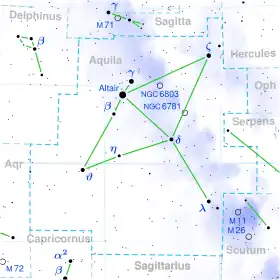
71 Aquilae (abbreviated 71 Aql) is a binary star in the equatorial constellation of Aquila. 71 Aquilae is its Flamsteed designation though it also bears the Bayer designation l Aquilae. The apparent visual magnitude of the system is 4.33,[2] making it bright enough to be viewed by the naked eye. It has an annual parallax shift of 9.67 mas,[1] which equates to a physical distance of 340 light-years (100 parsecs) from Earth, give or take a 30 light-year margin of error. At this distance, the brightness of the system is diminished by 0.065 in visual magnitude from extinction caused by interstellar gas and dust.[5]
This is a spectroscopic binary system where the presence of an orbiting companion is revealed by shifts in the spectral lines caused by the Doppler effect. The primary component is a giant star with a stellar classification of G7.5 IIIa and is listed as a standard star for that class.[3] The secondary is following a circular orbit with a period of 205.2 days.[6]
References
- 1 2 3 4 5 6 van Leeuwen, F. (November 2007), "Validation of the new Hipparcos reduction", Astronomy and Astrophysics, 474 (2): 653–664, arXiv:0708.1752, Bibcode:2007A&A...474..653V, doi:10.1051/0004-6361:20078357, S2CID 18759600.
- 1 2 3 4 Johnson, H. L.; et al. (1966), "UBVRIJKL photometry of the bright stars", Communications of the Lunar and Planetary Laboratory, 4 (99): 99, Bibcode:1966CoLPL...4...99J.
- 1 2 Keenan, Philip C.; McNeil, Raymond C. (1989), "The Perkins Catalog of Revised MK Types for the Cooler Stars", The Astrophysical Journal Supplement Series, 71: 245, Bibcode:1989ApJS...71..245K, doi:10.1086/191373.
- ↑ Wilson, R. E. (1953), "General Catalogue of Stellar Radial Velocities", Carnegie Institute Washington D.C. Publication, Carnegie Institute of Washington, D.C., Bibcode:1953GCRV..C......0W.
- 1 2 Ryon, Jenna; Shetrone, Matthew D.; Smith, Graeme H. (August 2009), "Comparing the Ca ii H and K Emission Lines in Red Giant Stars", Publications of the Astronomical Society of the Pacific, 121 (882): 842–856, arXiv:0907.3346, Bibcode:2009PASP..121..842R, doi:10.1086/605456, S2CID 17821279.
- 1 2 Jancart, S.; et al. (October 2005), "Astrometric orbits of SB^9 stars", Astronomy and Astrophysics, 442 (1): 365–380, arXiv:astro-ph/0507695, Bibcode:2005A&A...442..365J, doi:10.1051/0004-6361:20053003, S2CID 15123997.
- 1 2 Kraicheva, Z.; Popova, E.; Tutukov, A.; Yungelson, L. (1980), "Catalogue of physical parameters of spectroscopic binary stars", Bulletin d'Information du Centre de Donnees Stellaires, 19: 71, Bibcode:1980BICDS..19...71K.
- 1 2 3 4 5 Yu, Jie; Khanna, Shourya; Themessl, Nathalie; Hekker, Saskia; Dréau, Guillaume; Gizon, Laurent; Bi, Shaolan (2023), "Revised Extinctions and Radii for 1.5 Million Stars Observed by APOGEE, GALAH, and RAVE", The Astrophysical Journal Supplement Series, 264 (2): 41, arXiv:2206.00046, Bibcode:2023ApJS..264...41Y, doi:10.3847/1538-4365/acabc8.
- ↑ Bernacca, P. L.; Perinotto, M. (1970), "A catalogue of stellar rotational velocities", Contributi Osservatorio Astronomico di Padova in Asiago, 239 (1): 1, Bibcode:1970CoAsi.239....1B.
- ↑ Feuillet, Diane K.; Bovy, Jo; Holtzman, Jon; Girardi, Léo; MacDonald, Nick; Majewski, Steven R.; Nidever, David L. (2016), "Determining Ages of APOGEE Giants with Known Distances", The Astrophysical Journal, 817 (1): 40, arXiv:1511.04088, Bibcode:2016ApJ...817...40F, doi:10.3847/0004-637X/817/1/40.
- ↑ "* l Aql". SIMBAD. Centre de données astronomiques de Strasbourg. Retrieved 2012-07-23.
