241 Germania
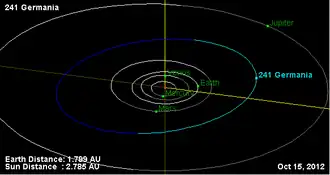 Orbital diagram | |
| Discovery | |
|---|---|
| Discovered by | Robert Luther |
| Discovery date | 12 September 1884 |
| Designations | |
| (241) Germania | |
| Pronunciation | /dʒərˈmeɪniə/[1] |
Named after | Germany |
| A884 RA, 1953 US, 1953 VK1 | |
| Main belt | |
| Adjectives | Germanian |
| Orbital characteristics[2] | |
| Epoch 31 July 2016 (JD 2457600.5) | |
| Uncertainty parameter 0 | |
| Observation arc | 131.40 yr (47993 d) |
| Aphelion | 3.35991 AU (502.635 Gm) |
| Perihelion | 2.73723 AU (409.484 Gm) |
Semi-major axis | 3.04857 AU (456.060 Gm) |
| Eccentricity | 0.10213 |
| 5.32 yr (1944.2 d) | |
Average orbital speed | 17.04 km/s |
| 277.959° | |
| 0° 11m 6.598s / day | |
| Inclination | 5.50482° |
| 270.362° | |
Argument of perihelion | 80.6364° |
| Physical characteristics | |
| Dimensions | 168.90±3.1 km[2] 181.55±6.81 km[3] |
| Mass | (7.386 ± 2.511/2.119)×1018 kg[3] |
Mean density | 2.357 ± 0.801/0.676 g/cm3[3] |
| 15.51 h (0.646 d)[2] | |
| 0.0575±0.002[2] | |
| CP/B[2] | |
| 7.81[2] | |
241 Germania is a very large main-belt asteroid. It is classified as a B-type asteroid and is probably composed of dark, primitive carbonaceous material.
It was discovered by Robert Luther on 12 September 1884 in Düsseldorf.
Germania is the Latin name for Germany.
References
- ↑ Noah Webster (1884) A Practical Dictionary of the English Language
- 1 2 3 4 5 6 "JPL Small-Body Database Browser: 241 Germania". Jet Propulsion Laboratory. Retrieved 12 May 2016.
- 1 2 3 Fienga, A.; Avdellidou, C.; Hanuš, J. (February 2020). "Asteroid masses obtained with INPOP planetary ephemerides". Monthly Notices of the Royal Astronomical Society. 492 (1): 589–602. doi:10.1093/mnras/stz3407.
External links
- The Asteroid Orbital Elements Database
- Minor Planet Discovery Circumstances
- Asteroid Lightcurve Data File
- 241 Germania at AstDyS-2, Asteroids—Dynamic Site
- 241 Germania at the JPL Small-Body Database
This article is issued from Wikipedia. The text is licensed under Creative Commons - Attribution - Sharealike. Additional terms may apply for the media files.