Psi Aquilae
  | |
| Observation data Epoch J2000 Equinox J2000 | |
|---|---|
| Constellation | Aquila[1] |
| Right ascension | 19h 44m 34.19086s[2] |
| Declination | +13° 18′ 10.0063″[2] |
| Apparent magnitude (V) | 6.25[3] |
| Characteristics | |
| Spectral type | B9 III-IV[4] |
| U−B color index | −0.22[5] |
| B−V color index | −0.04[5] |
| Astrometry | |
| Radial velocity (Rv) | −19.7±2.5[6] km/s |
| Proper motion (μ) | RA: +0.561 mas/yr[2] Dec.: −9.950 mas/yr[2] |
| Parallax (π) | 2.8253±0.0752 mas[2] |
| Distance | 1,150 ± 30 ly (354 ± 9 pc) |
| Absolute magnitude (MV) | −1.17[1] |
| Details | |
| Mass | 3.8[7] M☉ |
| Radius | 6.5[8] R☉ |
| Luminosity | 506[9] L☉ |
| Surface gravity (log g) | 3.41[7] cgs |
| Temperature | 10,167[7] K |
| Metallicity [Fe/H] | 0.21[7] dex |
| Rotation | 7.1[10] days |
| Rotational velocity (v sin i) | 20[11] km/s |
| Age | ~247[12] Myr |
| Other designations | |
| ψ Aql, 48 Aquilae, BD+12°4059, GC 27321, HD 186547, HIP 97139, HR 7511, SAO 105199, PPM 136885[3] | |
| Database references | |
| SIMBAD | data |
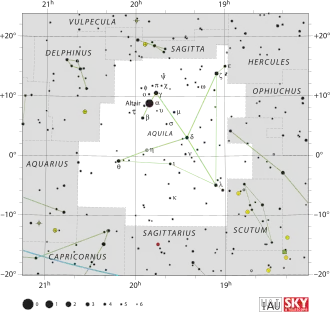
Psi Aquilae is a star in the equatorial constellation of Aquila. Its name is a Bayer designation that is Latinized from ψ Aquilae, and abbreviated Psi Aql or ψ Aql. This is a faint star with an apparent visual magnitude of 6.25,[3] which, according to the Bortle Dark-Sky Scale, can be seen with the naked eye in dark rural skies. The orbit of the Earth causes an annual parallax shift of 2.83 mas,[2] which indicates a distance of approximately 1,150 light-years (350 parsecs). It is drifting closer to the Sun with a radial velocity of −20 km/s.[6]
The spectrum of Psi Aquilae matches a stellar classification of B9 III-IV,[4] with the luminosity class of III-IV indicating the spectrum lies part way between that of a subgiant and a giant star. The effective temperature of the star's outer atmosphere is 10,167 K,[7] giving it the blue-white hue of a B-type star.[13] It has nearly four times the mass of the Sun,[7] 6.5 times its radius,[8] and has a projected rotational velocity of 20 km/s.[11]
References
- 1 2 Anderson, E.; Francis, Ch. (2012), "XHIP: An extended hipparcos compilation", Astronomy Letters, 38 (5): 331, arXiv:1108.4971, Bibcode:2012AstL...38..331A, doi:10.1134/S1063773712050015, S2CID 119257644.
- 1 2 3 4 5 6 Brown, A. G. A.; et al. (Gaia collaboration) (August 2018). "Gaia Data Release 2: Summary of the contents and survey properties". Astronomy & Astrophysics. 616. A1. arXiv:1804.09365. Bibcode:2018A&A...616A...1G. doi:10.1051/0004-6361/201833051. Gaia DR2 record for this source at VizieR.
- 1 2 3 "psi Aql", SIMBAD, Centre de données astronomiques de Strasbourg, retrieved 2012-07-21.
- 1 2 Cowley, A. (November 1972), "Spectral classification of the bright B8 stars", Astronomical Journal, 77: 750–755, Bibcode:1972AJ.....77..750C, doi:10.1086/111348.
- 1 2 Crawford, D. L. (February 1963), "U, b, v, and Hβ Photometry for the Bright B8- and B9-TYPE Stars", Astrophysical Journal, 137: 530, Bibcode:1963ApJ...137..530C, doi:10.1086/147526.
- 1 2 Gontcharov, G. A. (2006), "Pulkovo compilation of radial velocities for 35495 stars in a common system", Astronomy Letters, 32 (11): 759–771, arXiv:1606.08053, Bibcode:2006AstL...32..759G, doi:10.1134/S1063773706110065, S2CID 119231169.
- 1 2 3 4 5 6 Anders, F.; et al. (2022), "Photo-astrometric distances, extinctions, and astrophysical parameters for Gaia EDR3 stars brighter than G = 18.5", Astronomy and Astrophysics, 658: A91, arXiv:2111.01860, Bibcode:2022A&A...658A..91A, doi:10.1051/0004-6361/202142369.
- 1 2 Stassun, Keivan G.; et al. (2019), "The Revised TESS Input Catalog and Candidate Target List", The Astronomical Journal, 158 (4): 138, arXiv:1905.10694, Bibcode:2019AJ....158..138S, doi:10.3847/1538-3881/ab3467.
- ↑ Fouesneau, M.; et al. (2022), "Astrophysical parameters from Gaia DR2, 2MASS, and AllWISE", Astronomy and Astrophysics, 662: A125, arXiv:2201.03252, Bibcode:2022A&A...662A.125F, doi:10.1051/0004-6361/202141828.
- ↑ Oelkers, Ryan J.; et al. (2018), "Variability Properties of Four Million Sources in the TESS Input Catalog Observed with the Kilodegree Extremely Little Telescope Survey", The Astronomical Journal, 155 (1): 39, arXiv:1711.03608, Bibcode:2018AJ....155...39O, doi:10.3847/1538-3881/aa9bf4.
- 1 2 Abt, Helmut A.; et al. (July 2002), "Rotational Velocities of B Stars", The Astrophysical Journal, 573 (1): 359–365, Bibcode:2002ApJ...573..359A, doi:10.1086/340590.
- ↑ Gontcharov, G. A. (November 2012), "Spatial distribution and kinematics of OB stars", Astronomy Letters, 38 (11): 694–706, arXiv:1606.09028, Bibcode:2012AstL...38..694G, doi:10.1134/S1063773712110035, S2CID 119108982.
- ↑ "The Colour of Stars", Australia Telescope, Outreach and Education, Commonwealth Scientific and Industrial Research Organisation, December 21, 2004, archived from the original on March 18, 2012, retrieved 2012-01-16
