Phi Aquilae
  | |
| Observation data Epoch J2000 Equinox J2000 | |
|---|---|
| Constellation | Aquila[1] |
| Right ascension | 19h 56m 14.252s[2] |
| Declination | +11° 25′ 25.40″[2] |
| Apparent magnitude (V) | +5.28[3] |
| Characteristics | |
| Spectral type | A1 IV[4] + K1 V to M1 V[5] |
| U−B color index | −0.02[3] |
| B−V color index | +0.00[3] |
| Astrometry | |
| Radial velocity (Rv) | −27.2±0.9[6] km/s |
| Proper motion (μ) | RA: +32.745 mas/yr[2] Dec.: +5.630 mas/yr[2] |
| Parallax (π) | 14.7474±0.0869 mas |
| Distance | 221 ± 1 ly (67.8 ± 0.4 pc) |
| Absolute magnitude (MV) | +1.14[1] |
| Orbit[5] | |
| Period (P) | 3.320669±0.000017 d |
| Eccentricity (e) | 0 |
| Periastron epoch (T) | 2459445.0916±0.0011 JD |
| Argument of periastron (ω) (secondary) | 43[7]° |
| Semi-amplitude (K1) (primary) | 36.48±0.07 km/s |
| Details | |
| A | |
| Mass | 2.39[8] M☉ |
| Radius | 1.8–2.5[9] R☉ |
| Luminosity | 28.2+0.6 −0.7[5] L☉ |
| Surface gravity (log g) | 4.30[10] cgs |
| Temperature | 9,484±13[5] K |
| Metallicity [Fe/H] | +0.47[10] dex |
| Rotational velocity (v sin i) | 27[11] km/s |
| Age | 280[8] Myr |
| B | |
| Mass | 0.40[8] M☉ |
| Other designations | |
| φ Aquilae, φ Aql, 61 Aql, BD+11°4055, FK5 3590, GC 27604, HD 188728, HIP 98103, HR 7610, SAO 105438, PPM 137250, WDS J19562+1125AB[12] | |
| Database references | |
| SIMBAD | data |
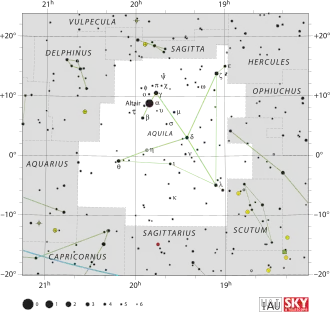
Phi Aquilae is a binary star[13] system in the equatorial constellation of Aquila. Its name is a Bayer designation that is Latinized from φ Aquilae, and abbreviated Phi Aql or φ Aql. The system has an apparent visual magnitude of +5.28[3] and is visible to the naked eye as a faint point of light. With an annual parallax shift of 14.7 mas,[2] this star is located at a distance of approximately 221 light-years (68 parsecs) from Earth. It is drifting closer with a radial velocity of −27 km/s.[6] Based on its motion through space, this system is a candidate member of the nearby Argus association of co-moving stars, although it may be too old.[14]
Phi Aquilae is a single-lined spectroscopic binary with an orbital period of 3.32067 days.[5] The pair have a projected separation of 190.4 AU as of 2008.[8] The primary component is a subgiant star with a stellar classification of A1 IV.[4] The star is around 280[8] million years old and is spinning with a projected rotational velocity of 27 km/s.[11] It has 2.39[8] times the mass of the Sun and somewhere in the range of 1.8–2.5[9] times the Sun's radius. The outer atmosphere has an effective temperature of 9,509 K,[10] giving it the white-hued appearance of an A-type star.[15] It is radiating 34[1] times the luminosity of the Sun.
The orbiting companion may be the source of the X-ray emission from this system, as stars similar to the primary component do not generally produce detectable levels of X-rays.[16] It has 40% of the mass of the Sun.[8] Based on photometric data from the TESS mission, the pair may undergo grazing eclipses. This implies an orbital inclination of at least 79°, and constrains the mass of the secondary to 0.5 M☉.[5]
A third component of this system was detected during the VAST survey. This faint component lies at an angular separation of 2.83 arcseconds, for a projected separation of 190 AU and an estimated orbital period of over 1,500 years.[5]
References
- 1 2 3 Anderson, E.; Francis, Ch. (2012), "XHIP: An extended hipparcos compilation", Astronomy Letters, 38 (5): 331, arXiv:1108.4971, Bibcode:2012AstL...38..331A, doi:10.1134/S1063773712050015, S2CID 119257644.
- 1 2 3 4 5 Vallenari, A.; et al. (Gaia collaboration) (2023). "Gaia Data Release 3. Summary of the content and survey properties". Astronomy and Astrophysics. 674: A1. arXiv:2208.00211. Bibcode:2023A&A...674A...1G. doi:10.1051/0004-6361/202243940. S2CID 244398875. Gaia DR3 record for this source at VizieR.
- 1 2 3 4 Oja, T. (April 1983), "UBV photometry of FK4 and FK4 supplement stars", Astronomy and Astrophysics Supplement Series, 52: 131–134, Bibcode:1983A&AS...52..131O.
- 1 2 Cowley, A.; et al. (April 1969), "A study of the bright A stars. I. A catalogue of spectral classifications", Astronomical Journal, 74: 375–406, Bibcode:1969AJ.....74..375C, doi:10.1086/110819.
- 1 2 3 4 5 6 7 Miroshnichenko, Anatoly S.; et al. (January 2023), "Refining Orbits of Bright Binary Systems", Galaxies, 11 (1), id. 8, Bibcode:2023Galax..11....8M, doi:10.3390/galaxies11010008.
- 1 2 Wilson, Ralph Elmer (1953), "General catalogue of stellar radial velocities", Carnegie Institute Washington D.C. Publication, Carnegie Institution of Washington, Bibcode:1953GCRV..C......0W.
- ↑ Lucy, L. B.; Sweeney, M. A. (August 1971), "Spectroscopic binaries with circular orbits", Astronomical Journal, 76: 544–556, Bibcode:1971AJ.....76..544L, doi:10.1086/111159.
- 1 2 3 4 5 6 7 De Rosa, R. J.; et al. (2014), "The VAST Survey - III. The multiplicity of A-type stars within 75 pc", Monthly Notices of the Royal Astronomical Society, 437 (2): 1216–1240, arXiv:1311.7141, Bibcode:2014MNRAS.437.1216D, doi:10.1093/mnras/stt1932.
- 1 2 Pasinetti Fracassini, L. E.; et al. (February 2001), "Catalogue of Apparent Diameters and Absolute Radii of Stars (CADARS) - Third edition - Comments and statistics", Astronomy and Astrophysics, 367 (2): 521–524, arXiv:astro-ph/0012289, Bibcode:2001A&A...367..521P, doi:10.1051/0004-6361:20000451, S2CID 425754.
- 1 2 3 Soubiran, C.; Le Campion, J.-F.; Cayrel de Strobel, G.; Caillo, A. (June 2010), "The PASTEL catalogue of stellar parameters", Astronomy and Astrophysics, 515: A111, arXiv:1004.1069, Bibcode:2010A&A...515A.111S, doi:10.1051/0004-6361/201014247, S2CID 118362423.
- 1 2 Royer, F.; et al. (February 2007), "Rotational velocities of A-type stars. III. Velocity distributions", Astronomy and Astrophysics, 463 (2): 671–682, arXiv:astro-ph/0610785, Bibcode:2007A&A...463..671R, doi:10.1051/0004-6361:20065224, S2CID 18475298.
- ↑ "phi Aql", SIMBAD, Centre de données astronomiques de Strasbourg, retrieved 2012-07-21.
- ↑ Eggleton, P. P.; Tokovinin, A. A. (September 2008), "A catalogue of multiplicity among bright stellar systems", Monthly Notices of the Royal Astronomical Society, 389 (2): 869–879, arXiv:0806.2878, Bibcode:2008MNRAS.389..869E, doi:10.1111/j.1365-2966.2008.13596.x, S2CID 14878976.
- ↑ Zuckerman, B. (January 2019), "The Nearby, Young, Argus Association: Membership, Age, and Dusty Debris Disks", The Astrophysical Journal, 870 (1): 8, arXiv:1811.01508, Bibcode:2019ApJ...870...27Z, doi:10.3847/1538-4357/aaee66, S2CID 119452542, 27.
- ↑ "The Colour of Stars", Australia Telescope, Outreach and Education, Commonwealth Scientific and Industrial Research Organisation, December 21, 2004, archived from the original on March 18, 2012, retrieved 2012-01-16
- ↑ De Rosa, R. J.; et al. (July 2011), "The Volume-limited A-Star (VAST) survey - I. Companions and the unexpected X-ray detection of B6-A7 stars", Monthly Notices of the Royal Astronomical Society, 415 (1): 854–866, arXiv:1103.4363, Bibcode:2011MNRAS.415..854D, doi:10.1111/j.1365-2966.2011.18765.x, S2CID 84181878.
