Phi Aquarii
  | |
| Observation data Epoch J2000 Equinox J2000 | |
|---|---|
| Constellation | Aquarius |
| Right ascension | 23h 14m 19.358s[1] |
| Declination | −06° 02′ 56.42″[1] |
| Apparent magnitude (V) | +4.223[2] |
| Characteristics | |
| Spectral type | M1.5 III[3] |
| U−B color index | +1.897[2] |
| B−V color index | +1.563[2] |
| Astrometry | |
| Radial velocity (Rv) | +2.48±0.32[4] km/s |
| Proper motion (μ) | RA: +36.575 mas/yr[1] Dec.: −195.441 mas/yr[1] |
| Parallax (π) | 14.3482±0.2594 mas[1] |
| Distance | 227 ± 4 ly (70 ± 1 pc) |
| Absolute magnitude (MV) | 0.30±0.120[5] |
| Details | |
| A | |
| Mass | 1.00±0.03[6] M☉ |
| Radius | 34.77+1.83 −2.04[6] R☉ |
| Luminosity | 207.7±25.2[6] L☉ |
| Surface gravity (log g) | 1.5[4] cgs |
| Temperature | 3,715±48[6] K |
| Rotational velocity (v sin i) | 6.7[4] km/s |
| Age | 10.97±0.83[6] Gyr |
| Other designations | |
| φ Aqr, 90 Aquarii, BD–06°6170, FK5 1607, GC 32346, HD 219215, HIP 114724, HR 8834, SAO 146585, PPM 207311[7] | |
| Database references | |
| SIMBAD | data |
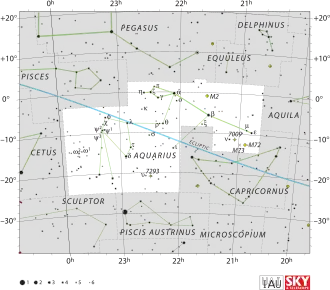
Phi Aquarii is a binary star[8] system in the equatorial constellation of Aquarius. Its name is a Bayer designation that is Latinized from φ Aquarii, and abbreviated Phi Aqr or φ Aqr. This system is visible to the naked eye as a point of light with a combined apparent visual magnitude of +4.223.[2] Parallax measurements indicate its distance from Earth is approximately 227 light-years (70 pc).[1] It is drifting further away with a radial velocity of +2.5 km/s.[4] The system is positioned 1.05 degrees south of the ecliptic so it is subject to lunar occultations.[9]
This is a spectroscopic binary star system with an estimated period of 2,500 days (6.8 yr).[10] The primary component is an aging red giant star with a stellar classification of M1.5 III.[3] At an estimated age of 11 billion years,[6] it has exhausted the supply of hydrogen at its core and evolved away from the main sequence. The star has the same mass as the Sun,[6] but has expanded to 35 times the Sun's girth.[6] It is radiating 208 times the luminosity of the Sun from its enlarged photosphere at an effective temperature of 3,715 K,[6] giving it the reddish hue of an M-type star.[11]
On 6 September 2019, it had a close conjunction (geocentric separation <1') with Neptune.[12] : 167
References
- 1 2 3 4 5 6 Vallenari, A.; et al. (Gaia collaboration) (2023). "Gaia Data Release 3. Summary of the content and survey properties". Astronomy and Astrophysics. 674: A1. arXiv:2208.00211. Bibcode:2023A&A...674A...1G. doi:10.1051/0004-6361/202243940. S2CID 244398875. Gaia DR3 record for this source at VizieR.
- 1 2 3 4 Gutierrez-Moreno, Adelina; et al. (1966), "A System of photometric standards", Publications of the Department of Astronomy University of Chile, 1, Publicaciones Universidad de Chile, Department de Astronomy: 1–17, Bibcode:1966PDAUC...1....1G.
- 1 2 Morgan, W. W.; Keenan, P. C. (1973), "Spectral Classification", Annual Review of Astronomy and Astrophysics, 11 (1): 29, Bibcode:1973ARA&A..11...29M, doi:10.1146/annurev.aa.11.090173.000333.
- 1 2 3 4 Massarotti, Alessandro; et al. (January 2008), "Rotational and Radial Velocities for a Sample of 761 HIPPARCOS Giants and the Role of Binarity", The Astronomical Journal, 135 (1): 209–231, Bibcode:2008AJ....135..209M, doi:10.1088/0004-6256/135/1/209.
- ↑ Park, Sunkyung; et al. (2013), "Wilson-Bappu Effect: Extended to Surface Gravity", The Astronomical Journal, 146 (4): 73, arXiv:1307.0592, Bibcode:2013AJ....146...73P, doi:10.1088/0004-6256/146/4/73, S2CID 119187733.
- 1 2 3 4 5 6 7 8 9 Baines, Ellyn K.; et al. (2018), "Fundamental Parameters of 87 Stars from the Navy Precision Optical Interferometer", The Astronomical Journal, 155 (1), 30, arXiv:1712.08109, Bibcode:2018AJ....155...30B, doi:10.3847/1538-3881/aa9d8b, S2CID 119427037.
- ↑ "* phi Aqr". SIMBAD. Centre de données astronomiques de Strasbourg. Retrieved 2012-07-05.
- ↑ Eggleton, P. P.; Tokovinin, A. A. (September 2008), "A catalogue of multiplicity among bright stellar systems", Monthly Notices of the Royal Astronomical Society, 389 (2): 869–879, arXiv:0806.2878, Bibcode:2008MNRAS.389..869E, doi:10.1111/j.1365-2966.2008.13596.x, S2CID 14878976.
- ↑ White, Nathaniel M.; Feierman, Barry H. (September 1987), "A Catalog of Stellar Angular Diameters Measured by Lunar Occultation", Astronomical Journal, 94: 751, Bibcode:1987AJ.....94..751W, doi:10.1086/114513.
- ↑ Famaey, B.; et al. (May 2009), "Spectroscopic binaries among Hipparcos M giants,. I. Data, orbits, and intrinsic variations", Astronomy and Astrophysics, 498 (2): 627–640, arXiv:0901.0934, Bibcode:2009A&A...498..627F, doi:10.1051/0004-6361/200810698, S2CID 18739721.
- ↑ "The Colour of Stars", Australia Telescope, Outreach and Education, Commonwealth Scientific and Industrial Research Organisation, December 21, 2004, archived from the original on March 18, 2012, retrieved 2012-07-02.
- ↑ Meeus, Jan (2002). "Mutual occultations of planets". More Mathematical Astronomy Morsels (PDF). pp. 174–185. ISBN 0943396743. Retrieved 2025-04-09.
