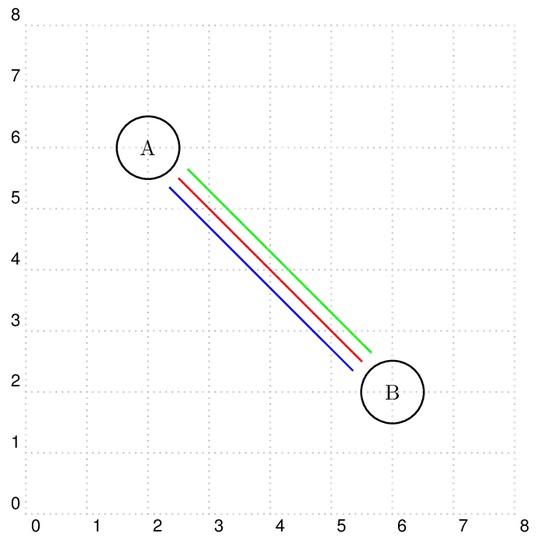
I know how to draw parallel lines between two nodes that are either aligned horizontally or vertically.
\documentclass{article}
\usepackage{tikz}
\usetikzlibrary{calc}
\begin{document}

\begin{tikzpicture}[myn/.style={circle,draw,inner sep=0.25cm,outer sep=3pt}]
  \node[myn] (A) at (0,0) {A};
  \node[myn] (B) at (5,0) {B};
  \node[myn] (C) at (5,3) {C};
  \node[myn] (Z) at (10,-5) {Z};

  \draw[->] (A.10) -- (B.170);
  \draw[<-] (A.-10) -- (B.190);

  \draw[->] (B.80) -- (C.-80);
  \draw[<-] (B.100) -- (C.-100);

\end{tikzpicture}

\end{document}

What I'd like to know is how to do something similar between nodes that are not so aligned such as between nodes A and Z in the above diagram where I don't necessarily know exactly where Z will be placed beforehand.
I'm able to get something like
  \path let \p1=($(Z)-(A)$),
            \n1={atan(\y1/\x1)},
            \n2={\n1+180},
            \n3={\n1+90},
            \n4={1ex*cos(\n3)},
            \n5={1ex*sin(\n3)}
        in
        [draw,blue] ([yshift=\n5,xshift=\n4]A.\n1) -- ([yshift=\n5,xshift=\n4]Z.\n2);
to work, but this just seems way more complicated than necessary (or, is it?).
Incidentally, though this is perhaps starting to look like a commutative diagram, that's not what it's supposed to be.