I'd like to define a set of adjusting bracket, called in physics Dirac brackets.
This brackets accept three arguments, separated by vertical lines, and all of them are enclosed by angles, e.g. in text format would by <a|b|c>.
MWE
A first try would be
\documentclass{article}
\usepackage{amsmath}
\usepackage{calc}

\newcommand\bkt[3]{\left< {#1} \left|{#2} \right| {#3} \right>}

\begin{document}

\begin{align}
  \bkt{a}{b}{c}
\end{align}

\begin{align}
  \bkt{a}{b}{\frac{c}{d}}
\end{align}

\end{document}
As can be seen in the picture, the middle brackets have not the desired size in the second case 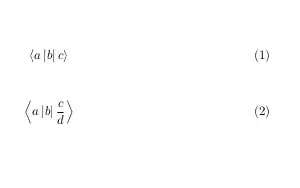
Attempt of a solution
Creating a box with height equal to the max. height of the three arguments, and place the second argument inside the box should solve the problem... but I don't know if doing that is possible.
Does anyone have an idea for solving my problem?
Thank you, and (almost) Merry Christmas.


\middlewill expand all three vertical bars. I guess that OP wants to expand only the nearest bar. – Sigur Dec 23 '13 at 16:09\langleinstead of<, and\rangleinstead of>for Bra-Ket notation... – Alex Nelson Dec 23 '13 at 16:31\Braketas in the cited answer solves the problem. – barbara beeton Dec 23 '13 at 16:55