Two other solutions, which IMO are neither better nor worse in the technical point of view, is the combination of \smash and \vphantom, or the \textsyle typesetting :
\[
\mathcal{F} \left\{ \vphantom{\sum}\smash{\sum_{j}} e^{-2i\pi\nu_j t} \right\}
\quad\text{or}\quad
\mathcal{F}\Big\{ \textstyle\sum_{j} e^{-2i\pi\nu_j t}\Big\}
\]
where the base line of \mathcal{F} remains the same as that of the \Sigma.

EDIT : If you are not happy with this, you can put j on the line by using \sum\nolimits_{j}.
For further fine tuning of the delimiter height and of the equation height, you can load the calc package and define the macro :
\newlength{\hhh}
\newcommand{\mstrut}[2][2]{%
\settototalheight{\hhh}{$\displaystyle #2$}%
\rule[-0.5\hhh*\real{#1}+0.5ex]{0pt}{#1\hhh}%
}
drawing an invisible rule the height of which is the one of the mandatory argument multiplied by optional one (set to 1 by default). With this macro, and the code
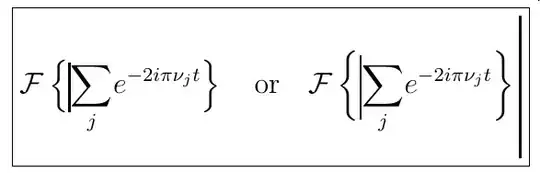
\[ \boxed{
  \mathcal{F} \left\{\mstrut[0.7]{\sum_{j}} \smash{\sum_{j}} e^{-2i\pi\nu_j t} \right\}
  \quad\text{or}\quad
  \mathcal{F} \left\{\mstrut[0.9]{\sum_{j}} \smash{\sum_{j}} e^{-2i\pi\nu_j t} \right\}
  \mstrut[2]{\sum_{j}}
} \]
we get:
 EDIT : suppressed the
 \vphantum in the above code, because it's super seeded by the \mstrut.
where the \mstrut thickness is set to 1pt for demonstration purpose, and the box materialize the upper and lower limits of the equation.
By this way, choosing the proper value int \mstrut[?]{} you control both the size of te delimiters and the verical spacing...




\leftand\rightdirectives; instead, he recommends using "manual" sizing via\biggland\biggrdirectives. – Mico Jul 13 '13 at 18:21