13

Apparantly there are some advances in converting heat to electricity such as here or here.

But are there any commercial solutions/devices/DIY projects or is this at the moment (as stated in the article) only available in large scale industrial facilities?

nairboon
  • 492
  • 3
  • 12
  • 7
    This question could be improved by specifying what waste heat you have available (temp, power, how often/what times) to guesstimate what might be worthwhile. – mart May 06 '13 at 15:40
  • 1
    Saying "here or here" seems inaccurate to me. Can you summarize the referenced articles to have this question complete? – Peter Ivan May 10 '13 at 22:00

2 Answers2

9

Unfortunately I (still!) have no first-hand experience with this, but I've been thinking about recovering heat from plain household waste water for a while now.

Basically, you can only generate electricity if you have a temperature difference, that is, you need both a heat source and a heat sink. Now I assume this is no problem in your case, since you speak of waste "heat", hinting that the rest of the environment is colder, so you have a difference. Nevertheless, it is something to consider during construction of any such device.

In the case of waste water: the most obvious solution would be to let cold water flow through the (hot) waste water, thus allow the cold water to heat up. The cold water (now warmer) is then used as new clean hot water in the appliance. In the case of showers (or comparable), this would mean you'd have to add less hot water from the boiler, thus saving energy.

For other applications, you could use thermoelectric generators (or more general, this link, which will convert heat directly into electricity. You can buy such things pretty much everywhere; they're pretty cheap and come in all sorts of shapes and sizes, allowing you to effectively utilize many sources of waste heat as power source.

These are however not very efficient. A much more efficient approach seems to be the Stirling engine. Granted, it's not as elegant as thermoelectric generators:

  • it has moving parts, therefore, it sustains losses due to friction
  • has steeper maintenance requirements
  • it's more complicated so has a steeper learning curve to build yourself
  • it needs to be attached to a generator since it doesn't generate electricity itself

However, it is so much more efficient that if ever I have the time and money, I'd put my money on these things.

Also interesting: the vortex tube. This thing allows you to split a stream of gas into hot and cold components, with 100% efficiency (provided you have a pressurized waste product :). A version for fluids exists as well, which, when used with waste water, would allow you to increase the temperature difference. But again, I haven't calculated anything; I'm not sure whether this would increase the total power output by the Stirling engine + turbine contraption. Still, it's an interesting thing to keep in mind.

Rody Oldenhuis
  • 840
  • 6
  • 16
  • The Vortex tube takes mechanical energy (pressure) as input, and produces the most expensive form of heat - coldness. That's the opposite of heat recovery. Coll device, though. – mart May 07 '13 at 07:41
  • @mart: True. But another way of seeing this is that it removes the cold part at the expense of pressure, leaving you with the hot part. Pressure is easy enough to create; water's pretty heavy so you could just use its own weight in some sort of vertical shaft, or build something around the fact that pressures in regular water taps are already in the order of ~10 bars. – Rody Oldenhuis May 07 '13 at 08:18
  • I don't believe 20% at "a few degrees" - a CArnot efficiency of 20% would equate a Temp diff between 0°C and 68°C - more than a few degrees. Mind that that's the limit case for any heat engine, stirling engines often fare worse because of dead spaces, insufficient heat storage within and other engineering difficulties. – mart May 07 '13 at 08:19
  • Still no heat recovery. Creating pressure almost always involves expending (high grade) mechanical work. the 20-50 bar pressure at the inlet for water, mentioned in the wiki article translate to 200-500m height! – mart May 07 '13 at 08:22
  • And using the work done by the water works to pump the water and maintain pressure to drive a refridgerator hardly seems sustainable? BTW, where does the claim com from that the vortex tube is particular efficient? I've seen nothing of the sort in the linked literature. – mart May 07 '13 at 08:23
  • I think there's a misconception on your side re. what the vortex tube does. I'll see if I can bang up a good question for the physics SE. – mart May 07 '13 at 08:29
  • @mart: You are absolutely right, and I do not know how I can have seen 20% efficient engines. I'll remove that statement. – Rody Oldenhuis May 07 '13 at 08:43
  • @mart: the claim that a vortex tube is efficient stems from the fact that you need not insert any external energy for it to work provided you already have a pressurized waste product. The objective here is to regain at least some heat that would otherwise be lost in the sewer, by (slightly) modifying existing household systems. I'm not saying you should build a 500m tall tower, I'm saying you could use any pressure that's already there to try and improve the efficiency of the heat engine. – Rody Oldenhuis May 07 '13 at 08:50
  • If you have a pressurized waste product (excess compressor air), build a turbine. – mart May 07 '13 at 08:53
  • @mart: I'd rather not; with the exception of high-end (and completely unaffordable) models, turbines tend to be noisy, complicated, maintenance-hungry devices (yes, also the Tesla ones). I'd rather sacrifice some efficiency in favor of a no-moving-parts solution. I have to sleep next to it, mind you! – Rody Oldenhuis May 07 '13 at 08:56
  • Any way, talking about using waste pressure is completely off the question. – mart May 07 '13 at 09:14
  • About the vortex tube. It means that if I collect rain water at the second floor, I can get hot and cold water for free at floor level, right? Gravity providing the pressure. – Madlozoz May 21 '14 at 12:06
  • see this physics SE question and answers for more on Vortex tubes: http://physics.stackexchange.com/questions/63626/how-can-i-understand-a-vortex-tube-and-its-efficiency – mart May 26 '14 at 10:45
1

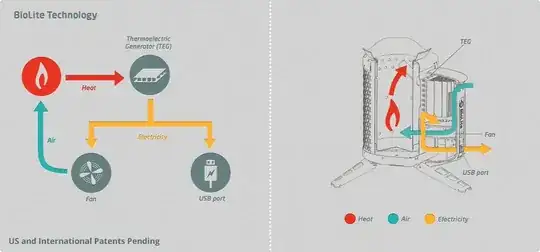
enter image description hereI would check out biolite. I know this isn't a complete answer. https://www.kickstarter.com/projects/biolite/biolite-basecamp-stove-turn-fire-into-electricity http://www.biolitestove.com/

The heat is generated in the "Heat" chamber(right pic) usually with burning wood/twigs. You can only charge usb devices while the pot is burning. There is an external fan,that I first assumed generated the electricity. However that is used to help generate the heat by moving oxygen.

DTDev
  • 71
  • 4
  • 2
    Please could you make it into a complete answer? At least add some more information about what it is, how it converts heat to electricity? – 410 gone May 21 '14 at 05:10
  • Thermoelectric modules have ridiculously low efficiency. Waste heat is usually in the levels where thermoelectric modules would provide no useful power. – Tomáš Zato Nov 19 '19 at 15:20