This is a bit specific to each solar PV installation, but I'll give it a shot.
Short Answer
For a 4kW array, the actual power output you see is likely to be around 3kW if your system is operating properly, assuming the array isn't too old. For more, read on ...
Proprietary Monitoring Software
First of all, many home solar installations now are done by companies that specialize in putting together packages of the solar panels, the inverter, and a control panel to monitor the system. If you're in that situation, then you basically get what the company who wrote the control panel's software decides to give you. It's unlikely that building your own monitoring circuitry or software would be a good use of time, although if you're a DIY type, I might suggest looking at LabView or OpenEnergyMonitor to create your own monitoring system.
It's also unlikely that the software features that come with your system are going to be (or should be) a primary factor in picking the system. I personally would rank the kind of panels, the inverter hardware, the experience of the installers, the price, and specific tax incentives as more important than the amount and kind of data you can see on the control panel, or web interface that the system supports.
Here are a few examples from some systems available where I live:
Metrics
In terms of what you should watch, I think solar panels are a bit like a car. If you only want to watch one thing to assess a car engine's health, watch your fuel consumption (e.g. miles per gallon, km/l, etc.). With solar panels, kWh produced per month is probably the equivalent metric. That number can be affected by a few different factors, but if the number is close to the output when your panels were first installed (adjusted for expected degradation ‡), that's a good indication that the whole system is functioning reasonably well.
Some systems allow you to see the production per module, which can help identify one bad module in your array. Having electronics on each module helps both with fine-grained monitoring, but also allows micro-inverters or DC-DC converters to tune each's module's performance independently.
Another metric that may be available to you is panel temperature. Excessive temperature can be a sign of problems, and high temperatures can damage photovoltaics, like many electronics.
You may also be able to see the panel output voltage, or the frequency (Hz) of the power your inverter is producing. Familiarize yourself with the normal values for your system, and note any deviations from that baseline.
Finally, your system may have a separate status output that indicates that a particular module's health is Ok, Failed, Degraded, or Unknown.
Sunshine
Keep in mind that the solar panels can only convert energy from what the sun gives them. Variations in weather do make a difference, so if your panel output this month is 5% lower than the output from the same month last year, that doesn't necessarily mean there's a problem.
Take a look at the climate data aggregated at the US National Climatic Data Center (Note: this isn't just US data ... it's global). If you open up the PDF file for a given month (there's a couple month delay in the published data), find a city near you, and look at the far right column to see total hours of sunshine:
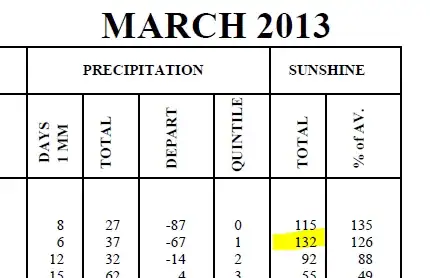
In the row I highlighted, the monthly sunshine was 26% higher than average for that month. So, in that case, you'd expect your monthly output to be higher than most years. This is a rough way to assess performance, but it's better than simply comparing to the same month last year, without adjusting for sunshine.
Some off-the-shelf software monitoring systems do interface with weather and climate data services, and show some measure of sunshine. The ones I've seen show instantaneous solar irradiance, which I don't think is as useful as longer term sunshine data.
(‡) Expected Performance Loss
It's important to know what to expect from a solar PV system. Panel performance will degrade slowly, and smoothly, over time, so that's to be anticipated. From the US National Renewable Energy Lab, 2010:
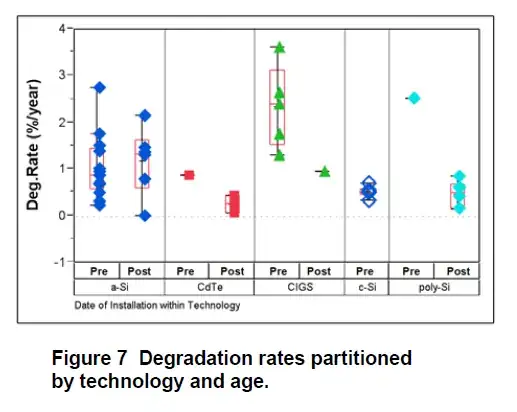
So, depending on the kind of photovoltaics you use, and when they were built, you might expect a 1/2% loss in output per year, or it might be 2% per year.
Inverter problems may show up more abruptly, and before the photovoltaics reach their end of life. Of course, physical damage to your panels can instantly affect their performance, too.
Finally
If you haven't already had your system installed, or have a maintenance visit coming up, ask this question of your installer, who will likely have important experience with the specific failure modes of your hardware.


