2

I was browsing the Unicode 6.1 core specification chapter on Symbols, and found that there exist many specialized semantic symbols, such as plastics recycling:

The seven numbered logos encoded from U+2673 to U+2679, ♳♴♵♶♷♸♹, are from “The Plastic Bottle Material Code System,” which was introduced in 1988 by the Society of the Plastics Industry (SPI). This set consistently uses thin, two-dimensional curved arrows suitable for use in plastics molding. In actual use, the symbols often are combined with an abbreviation of the material class below the triangle.

and combinable symbols for musical notes:
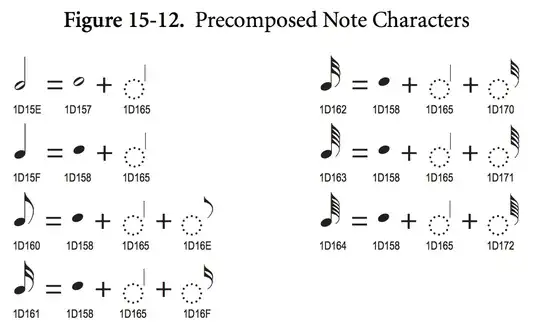
But I have a hard time envisioning any software in the plastics industry that would internally store U+2673–U+2679, or any musical software that would parse and/or emit composed sequences of characters to represent notes. Are these symbols really used anywhere for their semantic meaning?

Oliver Salzburg
  • 87,539
  • 63
  • 263
  • 308
jtbandes
  • 8,870
  • More off-topic follow-up: given their limited use, and likely also limited software support, why would the Unicode Consortium choose to include such characters in the standard? – jtbandes Jul 14 '14 at 06:38

1 Answers1

3

Yes, they are. Generally, demonstrated use in texts is required for adoption of symbols as Unicode characters, though exceptions can be made e.g. due to strong need for use in texts. See the old document Criteria for Encoding Symbols, which is cited in the offical document Submitting Character Proposals, even though the policy has become some more permissive.

In chapter Symbols, the Unicode standard says: “Musical notation—particularly Western musical notation—is different from ordinary text in the way it is laid out, especially the representation of pitch and duration in Western musical notation. However, ordinary text commonly refers to the basic graphical elements that are used in musical notation, and it is primarily those symbols that are encoded in the Unicode Standard.”

Thus, e.g. the musical symbols in Unicode are not primarily meant for use in musical notation (though they could be used there), but in text when referring, say, to note “”.