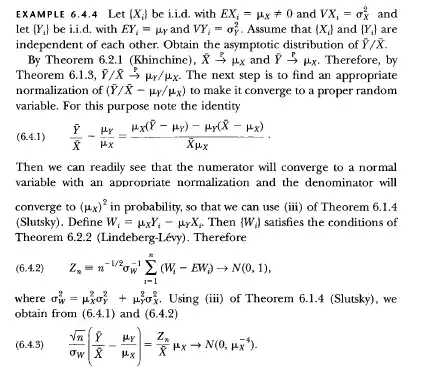
The book does not "get to" but defines $W_i \equiv \mu_xY_i - \mu_yX_i$ because it is useful to obtain the results. We then have, in sample means,
$$\bar W = \mu_x\bar Y - \mu_y \bar X$$
The book wants to study the random variable
$$\frac {\bar Y}{\bar X} - \frac {\mu_y}{\mu_x} = \frac {\mu_x\bar Y - \mu_y \bar X}{\mu_x\bar X} \equiv \frac {\bar W}{\mu_x\bar X}$$
or what transformation of it leads to an asymptotic result.
We note that
$$E(W_i) = 0,\;\;\; Var(W_i) \equiv \sigma^2_w = \mu_x^2\sigma^2_y + \mu_y^2\sigma^2_x$$
and so the sequence $\{W_i\}$ is an i.i.d. r.v. sequence of finite and constant mean and variance. So its sample mean does satisfy the Central Limit Theorem meaning
$$Z_n \equiv \sqrt n \frac {\bar W}{\sigma_w} \xrightarrow{d} Z \sim N(0,1)$$
which is $(6.4.2)$ of the book written with the terms re-arranged.
Moreover, we have that $\bar X \xrightarrow{p} \mu_x$, and so by the continuous mapping theorem we obtain $\mu_x\bar X \xrightarrow{p} \mu_x^2$
Applying Slutsky's Theorem (or lemma) for the convergence of the product of two random variables, where the one converges in distribution to a random variable and the second to a constant in probabilty, we have that
$$Q_n \equiv \sqrt n \frac {\bar W}{\sigma_w}\cdot \frac 1{\mu_x\bar X} \xrightarrow{d} \frac 1{\mu_x^2}Z \sim N\left(0, \frac 1 {\mu_x^4}\right)$$
But
$$Q_n \equiv \sqrt n \frac {\mu_x\bar Y - \mu_y \bar X}{\sigma_w}\cdot \frac 1{\mu_x\bar X} = \frac {\sqrt n}{\sigma_w}\left(\frac{\mu_x\bar Y - \mu_y \bar X}{\mu_x\bar X}\right) = \frac {\sqrt n}{\sigma_w}\left(\frac {\bar Y}{\bar X} - \frac {\mu_y}{\mu_x}\right) $$
QED.
Note that eq. $(6.4.3)$ has a typo - the term $\mu_x$ in the quotient after the $=$ sign, should be in the denominator, not in the numerator -but it is an obvious typo.
 .
.