0

Main questions are in bold but feel free to correct me if I'm wrong somewhere else. As far as possible, I need both intuition and formal explanation.

Let $X \sim Uniform(a,b)$ and $Y \sim Uniform(c,d)$ be two independent random variables and $Z=X-Y$ be the difference of these variables.

I need to compute $P(\mathbf{Z} \le z) = F_\mathbf{Z}(z)$ which I suppose is the PDF of a symmetric triangular distribution with support $[a-d,b-c]$. (a) Is this correct?

We know:

$$ f_\mathbf{X}(x) = \frac{1}{b-a} \ \ \ \ \ \ \ \ x \in [a,b] \\\\ f_\mathbf{Y}(y) = \frac{1}{d-c} \ \ \ \ \ \ \ \ y \in [c,d] $$

Let $Y' = -Y$, with:

$$ f_\mathbf{Y'}(y') = f_\mathbf{Y}(-y') = \frac{1}{d-c} \ \ \ \ \ \ \ \ y' \in [-d,-c] $$

(b) Is the above equation correct? Why?

We now have $Z=X+Y'$ and we know that the convolution/sum of random variables is as follows:

$$ f_\mathbf{Z}(z) = \int_{-\infty}^\infty f_\mathbf{X}(x)\ f_{Y'}(z-x)\ \ dx $$

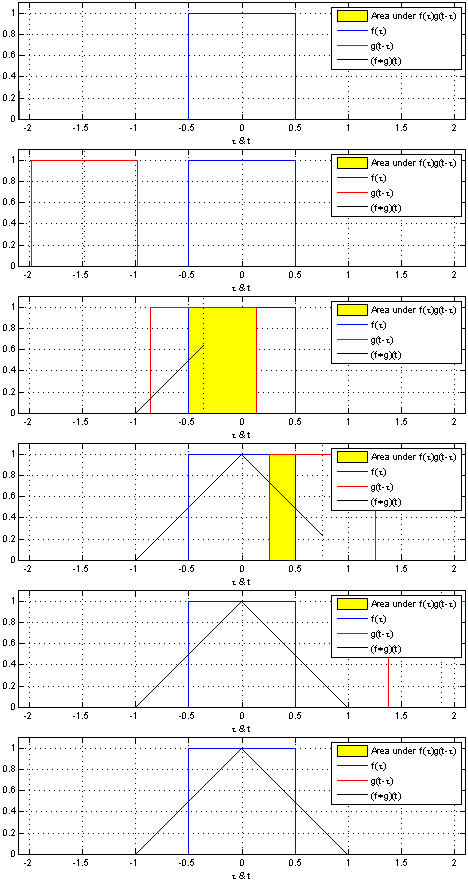
I understand the convolution is the evolution in the common area below two functions where one is slipped on the x-axis (example). However, I don't understand (c) why it is equivalent to the addition of random variables.

I know how to draw the convolution graphically (example), from which I can deduce the analytic form. But (d) how can I compute $f_\mathbf{Z}(z)$ analytically?

White1Hun
  • 1
  • 1
  • Why bother defining and obtaining density for $-Y$? To obtain CoV densities, you typically use Jacobian method or CDF method. Jacobian is a good choice. You are correct we can use heuristic arguments to establish the range/continuity of the densities. If your change of variable function is $f(x,y) = x-y$ calculate the gradient, and place the multivariate densities in vector form, etc. etc. to obtain the answer. So a, b look correct but c does not look correct. – AdamO Feb 29 '24 at 18:18
  • 1
    I've taken liberty to add the self-study tag since I'd wager dollars-to-doughnuts this is a homework question. It will also garner a bit more patience from answerers who agree to provide didactic answers, rather than their own work. – AdamO Feb 29 '24 at 18:21
  • Four different methods to compute this difference are described in detail at https://stats.stackexchange.com/questions/41467, thereby answering (a), (b), and (d). A specific example of this question is answered at https://stats.stackexchange.com/questions/545409, again answering (a), (b), and (d). (b) is answered generally at https://stats.stackexchange.com/questions/192807. Finally, the duplicate answers (c). – whuber Feb 29 '24 at 18:30
  • @AdamO That's not a homework, but what I really need is intuition, so the tag seems appropriate :) – White1Hun Feb 29 '24 at 19:05
  • @whuber I haven't seen your last two links before and they helped me. I just will add this post to further complete the answer with an example. – White1Hun Feb 29 '24 at 19:05
  • It comes down to the algebraic rules of working with inequalities. It can help to resort to the basic definitions of integration and to define a density function over the entire real line. Thus, for instance, the density of a Uniform$(a,b)$ distribution is fully and correctly written as $$f_{a,b}(x)=\frac{1}{b-a}\mathcal I(a\lt x \lt b).$$ When you use this approach, the double integral for the convolution ranges over the entire plane. But to evaluate it, it helps to break it into regions where the densities are nonzero: that's where the limits of integration come from. – whuber Feb 29 '24 at 19:08

0 Answers0