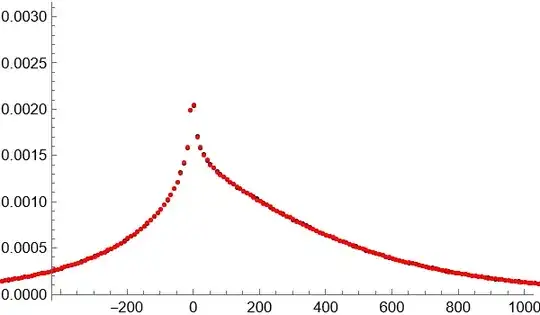
This problem is initially written as the difference in the squares of two correlated normals.
$$Z=(X_1-X_2+X_3+X_4)^2-(-X_1+X_2+X_3+X_4)^2$$
where all of the $X_i$ are independent random variables with potentially different means and variances: $X_i \sim N(\mu_i,\sigma_i^2)$.
The request is to re-write $Z$ in terms of the difference in two independent noncentral chisquare random variables times some constant:
$$Z=s(W_1-W_2)$$
where $W_i\sim \chi^2(1,m_i)$. To do so we do something similar to the idea presented in @whuber 's comment: The characteristic functions are found for both characterizations of $Z$ and then we equate all of the coefficients for the characteristic function argument $t$.
To have a less cluttered expression for
$$Z=(X_1-X_2+X_3+X_4)^2-(-X_1+X_2+X_3+X_4)^2$$
we first re-write $Z$ as follows:
$$Z=(Z_{12}+Z_{34})^2 - (-Z_{12}+Z_{34})^2$$
where $Z_{12}=X_1-X_2$ and $Z_{34}=X_3+X_4$. $Z_{12}$ and $Z_{34}$ are independent normals with respective means and variances $\mu_{12}=\mu_1-\mu_2$, $\mu_{34}=\mu_3+\mu_4$, $\sigma_{12}^2=\sigma_1^2+\sigma_2^2$, and $\sigma_{34}^2=\sigma_3^2+\sigma_4^2$.
Written this way the characteristic function of $Z$ is found with
Format[μ[i_]]:=Subscript[μ,i]
Format[σ[i_]]:=Subscript[σ,i]
dist = TransformedDistribution[(z[12] + z[34])^2 - (-z[12] + z[34])^2,
    {z[12] \[Distributed] NormalDistribution[μ[12], σ[12]],
     z[34] \[Distributed] NormalDistribution[μ[34], σ[34]]}];
cf = CharacteristicFunction[dist, t]
$$\frac{e^ {-\frac{4 t \left(-i \mu _{12} \mu _{34}+2 \mu _{34}^2 \sigma _{12}^2 t+2 \mu _{12}^2 \sigma _{34}^2 t\right)}{16 \sigma _{12}^2 \sigma _{34}^2 t^2+1}}}{\sqrt{16 \sigma _{12}^2 \sigma _{34}^2 t^2+1}}=\frac{e^{\frac{-t^2 \left(8 \mu _{34}^2 \sigma _{12}^2+8 \mu _{12}^2 \sigma _{34}^2\right)+i 4 \mu _{12} \mu _{34} t}{16 \sigma _{12}^2 \sigma _{34}^2 t^2+1}}}{\sqrt{16 \sigma _{12}^2 \sigma _{34}^2 t^2+1}}$$
The characteristic function for the alternate formulation is found with the following:
Format[m[i_]]:=Subscript[m,i]
dist2 = TransformedDistribution[s (w[1] - w[2]),
   {w[1] \[Distributed] NoncentralChiSquareDistribution[1, m[1]],
    w[2] \[Distributed] NoncentralChiSquareDistribution[1, m[2]]}];
cf2 = CharacteristicFunction[dist2, t];
$$\frac{e^{-s t \left(\frac{m_1}{2 s t+i}+\frac{m_2}{2 s t-i}\right)}}{\sqrt{4 s^2 t^2+1}}=\frac{e^{\frac{-2 \left(m_1+m_2\right) s^2 t^2+i \left(m_1-m_2\right) s t}{4 s^2 t^2+1}}}{\sqrt{4 s^2 t^2+1}}$$
We can find the matching terms of $t$ and $t^2$ in the exponents to determine $m_1$, $m_2$, and $s$. This means we need to simultaneously solve
$$16 \sigma^2_{12} \sigma^2_{34}=4s^2$$
$$8 \mu^2_{34}\sigma^2_{12}+8\mu^2_{12}\sigma^2_{34}=2s^2(m_1+m_2)$$
$$4\mu_{12}\mu_{34}=s(m_1-m_2)$$
sol = Solve[{16 σ[12]^2 σ[34]^2 == 4 s^2,
  8 μ[34]^2 σ[12]^2 + 8 μ[12]^2 σ[34]^2 == 2 s^2 (m[1] + m[2]),
  4 μ[12] μ[34] == s (m[1] - m[2])}, {s, m[1], m[2]}]
This results in two solutions:
$$s= \pm 2 \sigma _{12} \sigma _{34}$$
$$m_1= \frac{\left(\mu _{34} \sigma _{12}\pm\mu _{12} \sigma _{34}\right){}^2}{2 \sigma _{12}^2 \sigma _{34}^2}$$
$$m_2= \frac{\left(\mu _{34} \sigma _{12}\mp\mu _{12} \sigma _{34}\right){}^2}{2 \sigma _{12}^2 \sigma _{34}^2}$$
Finally, we can plug in the original parameters:
parms = {μ[12] -> μ[1] - μ[2], μ[34] -> μ[3] + μ[4], σ[12] -> Sqrt[σ[1]^2 + σ[2]^2],  σ[34] -> Sqrt[σ[3]^2 + σ[4]^2]}
sol = sol //. parms
$$s= \pm 2 \sqrt{\sigma _1^2+\sigma _2^2} \sqrt{\sigma _3^2+\sigma _4^2}$$
$$m_1= \frac{\left(\left(\mu _2-\mu _1\right) \sqrt{\sigma _3^2+\sigma _4^2}\pm\left(\mu _3+\mu _4\right) \sqrt{\sigma _1^2+\sigma _2^2}\right){}^2}{2 \left(\sigma _1^2+\sigma _2^2\right) \left(\sigma _3^2+\sigma _4^2\right)}$$
$$m_2= \frac{\left(\left(\mu _1-\mu _2\right) \sqrt{\sigma _3^2+\sigma _4^2}\mp \left(\mu _3+\mu _4\right) \sqrt{\sigma _1^2+\sigma _2^2}\right){}^2}{2 \left(\sigma _1^2+\sigma _2^2\right) \left(\sigma _3^2+\sigma _4^2\right)}$$
As a check consider one of the given examples.
parms = {μ[1] -> 2, μ[2] -> -11, μ[3] -> -1, μ[4] -> 4, σ[1] -> 5,
  σ[2] -> 4, σ[3] -> 3, σ[4] -> 2};
parms1 = {μ[12] -> μ[1] - μ[2], μ[34] -> μ[3] + μ[4], σ[12] -> Sqrt[σ[1]^2 + σ[2]^2],
  σ[34] -> Sqrt[σ[3]^2 + σ[4]^2]};
z1 = RandomVariate[dist /. parms1 /. parms, 1000000];
dist2 = TransformedDistribution[
  s (w[1] - w[2]) /. sol[[2]] /. parms1 /. parms,
  {w[1] [Distributed] NoncentralChiSquareDistribution[1, m[1]],
   w[2] [Distributed] NoncentralChiSquareDistribution[1, m[2]]} /. sol[[2]] /. parms1 /. parms];
z2 = RandomVariate[dist2 /. parms, 1000000];
Histogram[z1, "FreedmanDiaconis", "PDF"]

Histogram[z2, "FreedmanDiaconis", "PDF"]

We can also check on the corresponding sample means and variances:
{Mean[#], Variance[#]} & /@ {z1, z2}
(* {{156.019, 49649.8}, {156.27, 49587.}} *)
The pdf can also be easily found numerically using the characteristic function for specified values of the parameters.
Answer to a comment below:
It was asked to find the distribution and characteristic function of a more complicated random variable:
$$X=(z_5-z_3)(z_2-z_4)-(z_1-z_3)(z_6-z_4)$$
Rather than directly using that definition, it appears that Mathematica needs a little help.
First determine the multivariate normal distribution of the 4 differences in normal random variables.
dist = TransformedDistribution[{z[5] - z[3], z[2] - z[4], z[1] - z[3], z[6] - z[4]},
  {z[1] \[Distributed] NormalDistribution[μ[1], σ[1]],
   z[2] \[Distributed] NormalDistribution[μ[2], σ[2]],
   z[3] \[Distributed] NormalDistribution[μ[3], σ[3]],
   z[4] \[Distributed] NormalDistribution[μ[4], σ[4]],
   z[5] \[Distributed] NormalDistribution[μ[5], σ[5]],
   z[6] \[Distributed] NormalDistribution[μ[6], σ[6]]}]
(*  MultinormalDistribution[{-μ[3] + μ[5], μ[2] - μ[4], μ[1] - μ[3], -μ[4] + μ[6]},
  {{σ[3]^2 + σ[5]^2, 0,               σ[3]^2,           0},
   {0,               σ[2]^2 + σ[4]^2, 0,                σ[4]^2},
   {σ[3]^2,          0,               σ[1]^2 + σ[3]^2,  0},
   {0,               σ[4]^2,          0,                σ[4]^2 + σ[6]^2}}]*)
Now set up rules such that the parameters in the above distribution each have a single symbol. This seems to be necessary for Mathematica to complete in a reasonable amount of time.
parms1 = {-μ[3] + μ[5] -> μ1, μ[2] - μ[4] -> μ2, μ[1] - μ[3] -> μ3, -μ[4] + μ[6] -> μ4,
  σ[3]^2 + σ[5]^2 -> v1, σ[2]^2 + σ[4]^2 -> v2, σ[1]^2 + σ[3]^2 -> v3,
  σ[4]^2 + σ[6]^2 -> v4, σ[3]^2 -> v5, σ[4]^2 -> v6};
(* Find distribution and characteristic function of the simplified difference
   of the products of normally distributed random variables *)
dist2 = TransformedDistribution[x[1] x[2] - x[3] x[4],
  {x[1], x[2], x[3], x[4]} [Distributed] dist] /.parms1;
AbsoluteTiming[cf = CharacteristicFunction[dist2, t]]
The result is messy and takes about 4 minutes to run. Now replace with the original parameters:
parms2 = parms1 /. {Rule[a_, b_] -> Rule[b, a]}
cf = cf /. parms2
That result is even messier so I won't show it here.