I am wondering what is best practice for reporting a chi-square goodness-of-fit test. Should a result be significant, would a follow up of an Odds Ratio be required if there are more than 2 categories?
Asked
Active
Viewed 61 times
2

-
1What to do after chi-square? Some earlier posts: https://stats.stackexchange.com/questions/135052/post-hoc-test-for-chi-square-goodness-of-fit-test?rq=1, https://stats.stackexchange.com/questions/468406/post-hoc-test-after-chi-square-please-advise, Also https://scholarworks.umass.edu/pare/vol20/iss1/8/ – kjetil b halvorsen Mar 01 '23 at 16:59
-
1See also, for the use of Cohen's w as an effect size statistic for the chi-square goodness-of-fit test: stats.stackexchange.com/questions/607040/what-is-the-advantage-if-any-of-using-cohens-w-instead-of-cramers-v-for-effe/ – Sal Mangiafico Mar 01 '23 at 19:16
2 Answers
2
It will depend very much on your specific question and dataset. You may want different ORs (which ones to report is a question in itself if you have more than two categories), or it may be useful to show plots, or you may want to report tests on specific regression parameter estimates, or specific linear contrasts. There is no one-size-fits-all answer, you will need to consider your context.

Stephan Kolassa
- 123,354
-
If I have 4 categories where observed frequencies are n = 64, 52, 44, 20 respectively with expected frequencies being equal, how would I perform Odds ratio for a cat 1 v cat 4 comparison (after a GOF test) for example? – Chris_F Mar 02 '23 at 19:00
1
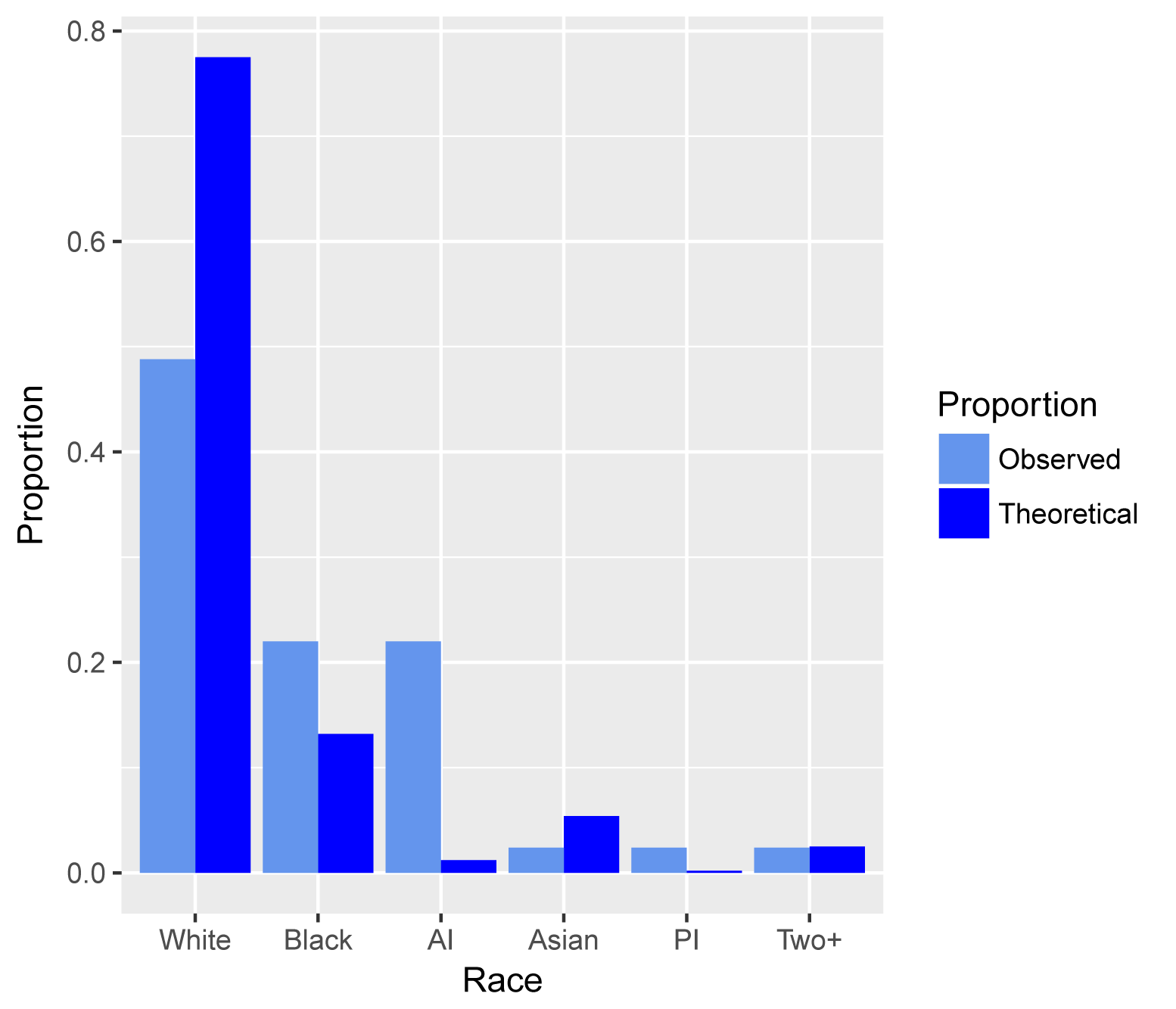
Often, presenting the observed proportions and the theoretical proportions conveys the important information, akin to effect size, to the reader. For example, as a plot: rcompanion.org/handbook/images/image301.png

Sal Mangiafico
- 11,330
- 2
- 15
- 35