Say we have a random variable
$$
X = A_0 A_1 + A_0 A_2 + A_1 A_2,
$$
which consists of normally distributed independent random variables $A_0, A_1, A_2 \sim \mathcal{N}(0,1)$ with probability density function (PDF)
$$
f_{A_i}(x) = \frac{1}{\sqrt{2 \pi}} e^{-\frac{x^2}{2}} .
$$
How do I derive the PDF of $X$ ?
So far I have been able to express the PDF of $Y = A_i A_j$ for $i \neq j$ which yields
$$
f_Y(y) = \frac{1}{\pi \sigma_{i} \sigma_{j}} K_0\Big(\frac{|y|}{\sigma_{i} \sigma_{j}} \Big) = \frac{1}{\pi} K_0\Big(|y| \Big),
$$
where $K_0(.)$ is the second kind modified Bessel function.
I also tried to factorize $X$ into
$$
X = A_0 (A_1 + A_2) + A_1 A_2 = Y_0 + Y_1,
$$
where there is a sum of two Bessel distributions $Y_0$ and $Y_1$, however, I learned that I cannot just use convolution of their marginal PDFs due to their correlation.
I have done some simulations in MATLAB and obtained the following graphs of PDF and CDF:
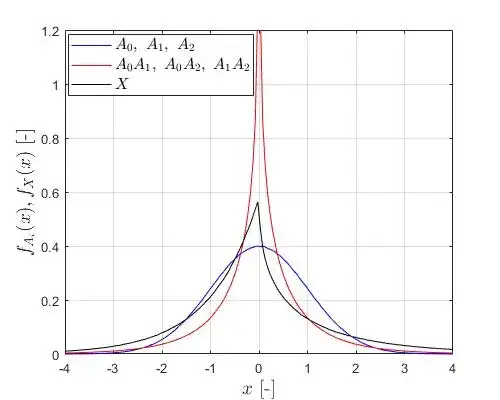
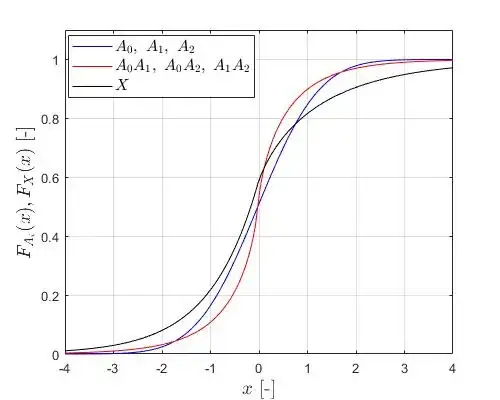
Basically, I am looking for a mathematical representation of the black curve in the above PDF graph. I cannot help myself but it seems very counter-intuitive that $X$ has a nonsymmetric PDF.
I think that first I have to obtain the joint probability density function $f_{Y_0, Y_1}(y_0, y_1)$ so I can use it in
$$
f_{X}(x) = \int f_{Y_0, Y_1}\big(s, x-s \big)\ ds,
$$
but I dont know how to get $f_{Y_0, Y_1}(y_0, y_1)$. In similar threads I saw people mentioning copula but I cannot see how it helps me in my situation...
Is there any area of mathematics that deals with this sort of problems ?
