Given the support vectors of a linear SVM, how can I compute the equation of the decision boundary?
Asked
Active
Viewed 2.4k times
20


2 Answers
30
The Elements of Statistical Learning, from Hastie et al., has a complete chapter on support vector classifiers and SVMs (in your case, start page 418 on the 2nd edition). Another good tutorial is Support Vector Machines in R, by David Meyer.
Unless I misunderstood your question, the decision boundary (or hyperplane) is defined by $x^T\beta + \beta_0=0$ (with $\|\beta\|=1$, and $\beta_0$ the intercept term), or as @ebony said a linear combination of the support vectors. The margin is then $2/\|\beta\|$, following Hastie et al. notations.
From the on-line help of ksvm() in the kernlab R package, but see also kernlab – An S4 Package for Kernel Methods in R, here is a toy example:
set.seed(101)
x <- rbind(matrix(rnorm(120),,2),matrix(rnorm(120,mean=3),,2))
y <- matrix(c(rep(1,60),rep(-1,60)))
svp <- ksvm(x,y,type="C-svc")
plot(svp,data=x)
Note that for the sake of clarity, we don't consider train and test samples. Results are shown below, where color shading helps visualizing the fitted decision values; values around 0 are on the decision boundary.
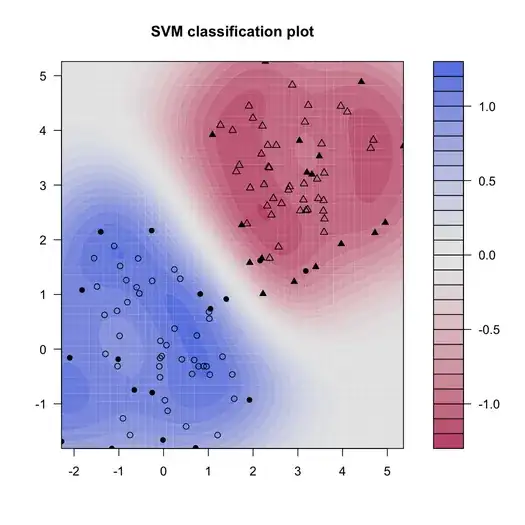
Calling attributes(svp) gives you attributes that you can access, e.g.
alpha(svp)  # support vectors whose indices may be
            # found with alphaindex(svp)
b(svp)      # (negative) intercept
So, to display the decision boundary, with its corresponding margin, let's try the following (in the rescaled space), which is largely inspired from a tutorial on SVM made some time ago by Jean-Philippe Vert:
plot(scale(x), col=y+2, pch=y+2, xlab="", ylab="")
w <- colSums(coef(svp)[[1]] * x[unlist(alphaindex(svp)),])
b <- b(svp)
abline(b/w[1],-w[2]/w[1])
abline((b+1)/w[1],-w[2]/w[1],lty=2)
abline((b-1)/w[1],-w[2]/w[1],lty=2)
And here it is:


-
4Beautiful, exactly what I was looking for.
The two lines:
w <- colSums(coef(svp)[[1]] * x[unlist(alphaindex(svp)),]) b <- b(svp)
were a godsend. Thank you!
– dshin Dec 06 '10 at 21:54 -
@chi: it may be interesting to take a look at my answer to "how to compute the decision boundary of an SVM": http://stats.stackexchange.com/questions/164935/how-to-calculate-decision-boundary-from-support-vectors/167245#167245 – Aug 15 '15 at 15:44
4
It's a linear combination of the support vectors where the coefficients are given by the Lagrange multipliers corresponding to these support vectors.

ebony1
- 2,203
[ASK QUESTION]at the top of the page & ask it there, then we can help you properly. Since you are new here, you may want to read our tour page, which contains information for new users. – gung - Reinstate Monica Jan 30 '14 at 23:30