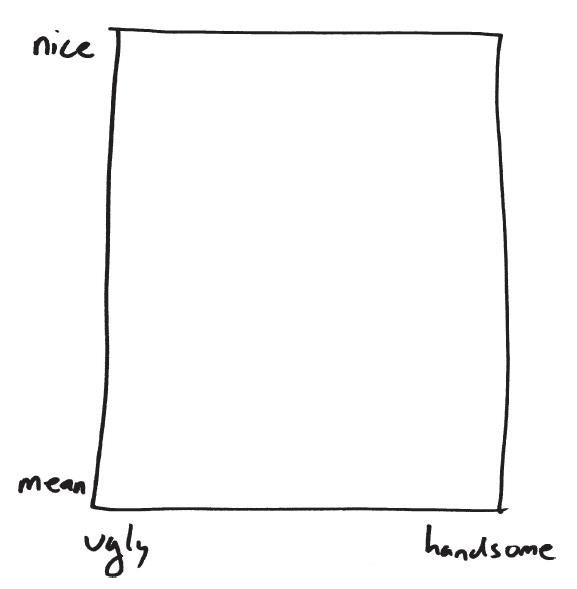
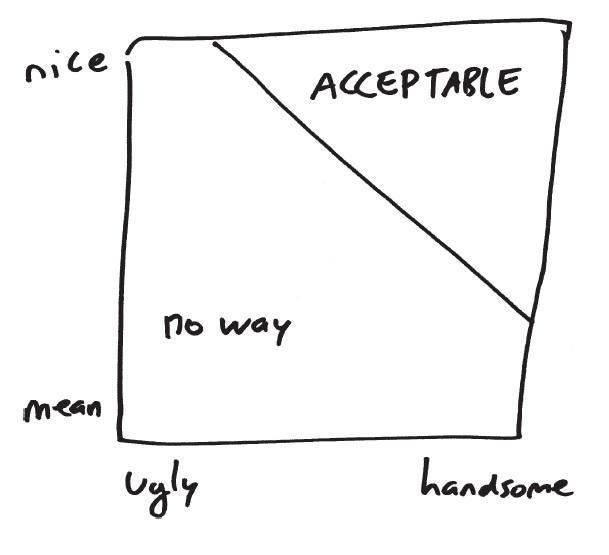
I don't grasp the bolded sentence beneath from Jordan Ellenberg's article. His diagram no longer renders, so I use these.

How can the nicest men in the green triangle be as nice as the whole population's average man? Wouldn't they be NICER than the whole population's average person? $\color{#c033ff}{\text{Average niceness in green triangle} =\dfrac{0.4 + 1}{2} = 0.7.}$
But $\color{#a96f63}{\text{average niceness in population} =\dfrac{0 + 1}{2} = 0.5.}$
This outcome is intuitive, because the green triangle excludes the louts with $0 \le niceness \le 0.4$.
Now the source of the phenomenon is clear. The handsomest men in your triangle, over on the far right, run the gamut of personalities, from kindest to (almost) cruelest. On average, they are about as nice as the average person in the whole population, which, let’s face it, is not that nice. And by the same token, the nicest men are only averagely handsome. The ugly guys you like, though—they make up a tiny corner of the triangle, and they are pretty darn nice. They have to be, or they wouldn’t be visible to you at all. The negative correlation between looks and personality in your dating pool is absolutely real. But the relation isn’t causal. If you try to improve your boyfriend’s complexion by training him to act mean, you’ve fallen victim to Berkson’s fallacy.