3

In soccer (or any discipline with similar scoring rules), is there statistically equal chance for win, loss and tie?

So, there are 3 possible outcomes, but are all 3 outcomes equally possible?

This does not take into account better/worse teams, so teams are equal for the chances... So ranking, player setup or physique, etc, should not be taken into account. Also, neither should any external condition (quality of playing field, weather, ...).

The reason I thinks so, is because a win is everything where scoreA > scoreB, which seems (intuitively) more likely to happen than scoreA = scoreB.

If scoreB is 1, then a tie is only possible when scoreA is also 1. However when scoreB is 1, a win for A is any possible combination where scoreA > scoreB. Which is much more than the 1 single option for a tie...

Bertvan
  • 139
  • Do you mean for two teams that are equally good? – rbm Jun 16 '14 at 08:17
  • 2
    I see no reason to think so. – Glen_b Jun 16 '14 at 08:19
  • 1
    A good assumption would probably be a Poisson distribution underlying the number of goals for each team. Equally good teams can then have the same rate parameter $\lambda$. Depending on $\lambda$, the odds between draws and non-draws changes. There is presumably (at least one) lambda, where a draw is equally likely as one of the two teams winning. – ziggystar Jun 16 '14 at 08:29
  • 1
    For some intuition, consider two extreme scenarios. In the first, two equally-matched teams both have terrible offenses and great defenses, and so most of their games end scoreless. The chance of a tie when these teams meet will be very high. In the second, both teams have terrible defenses and typically score extraordinary numbers of goals. Since that number is subject to random variation, the chance that the game ends with both teams scoring the same is low--that is, the chance of a tie becomes small. – whuber Jun 16 '14 at 14:16
  • @Glen_b the reason I thinks so, is because a win is everything where scoreA > scoreB, which seems (intuitively) more likely to happen than scoreA = scoreB. If scoreB is 1, then a tie is only possible when scoreA is also 1. However when scoreB is 1, a win for A is any possible combination where scoreA > scoreB. Which is much more than the 1 single option for a tie... – Bertvan Jun 17 '14 at 08:12
  • 1
    It may be miscommunication. I responded to this "there are 3 possible outcomes, but are all 3 outcomes equally possible?". I see no reason - even from a situation of ignorance of which team might be better - to regard the tie option as being as probable as the other two. – Glen_b Jun 17 '14 at 08:34
  • Indeed miscommunication, sorry – Bertvan Jun 17 '14 at 08:35

2 Answers2

3

First of all, it only makes sense to consider a situation in which both teams are equally good. Then, losses and victories are equally probable, so consider the comparison between winning and drawing for illustrative purposes. Then outcomes for which the two teams draw are for instance 0-0, 1-1, 2-2, ..., whereas outcomes for which team 1 wins are for instance 1-0, 2-0, 3-0, 4-0,..., 2-1, 3-1, 4-1,... As you can see, the number of outcomes for draws and the number of winning outcomes is not equal (and hence the probabilities are also unequal). You could formalize this idea by assuming that team $X$ and team $Y$ both score a number of goals in a time period of for instance 90 minutes that is Poisson distributed with a certain parameter $p$. Then you could compute the probabilities that $X-Y>1$ (so that team one wins) and that $X=Y$, so that the teams draw.

rbm
  • 993
2

This is not a question that can resolved using statistics or stochastics. First off, it obviously depends on the player of each team, of the conditions on the field, etc.

Let's make an easy scenario: We have two duplicates of exactly the same team playing against each other, with sides of the field determined by random choice. In this case, it would follow by symmetry that each team is equally likely to win.

These assumptions do not suffice to determine the likelihood of a draw - there are psychological factors at play. For example, depending on the team they might become especially motivated or demotivated if they are behind.

Sure, as @rbm could you might model the number of goals as Poisson-Distributed, but this would assume that the performance of the teams would be unaffected by the current score and the time remaining. That wouldn't be soccer anymore. If you would go that route, it would depend on the lambda parameter (which roughly described the rate of goals per team). Depending on lambda a tie become more or less likely. My intuition is that the higher lambda is the less likely a win becomes - if both team tends to score many goals it becomes unlikely that they end up at the exact same number. If both tend to not score any goal at all it is likely the game will end 0:0.

I then tested my intuition with some simulation code in R:

lambda <- seq(0, 30, by = 0.1)
draws <- rep(0, length(lambda))


for (i in 1:length(lambda)) {
lamb <- lambda[i]
team1 <- rpois(1e6, lamb)
team2 <- rpois(1e6, lamb)
draws <- team1 == team2
draw.likelihood[i] <- sum(draws)/length(draws)
}

plot(draw.likelihood ~ lambda, type = "l", lwd = 2)
grid()

You can interpret lambda as average goals per side per game. The results look like this and matches my intuition:
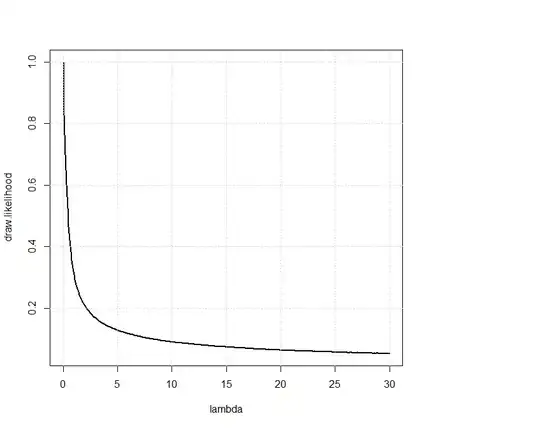
Draw Likelihood as function of lambda

Since even good teams seldom score more than three goals per game you get a substantial draw rate. At least it matches real observations so far. For reference for lambda = 0, 1, 2, 3 the draw rates are 100%, 31%, 21% and 17% respectively.

Erik
  • 7,249