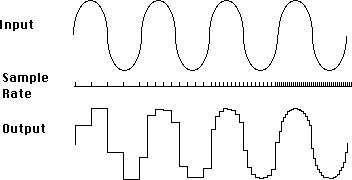
I realize this is an old thread, but perhaps I can add to the discussion.
To properly understand how greater sampling rates works, an understanding of how analog to digital conversion works is necessary. Fundamentally, when you record something (at least these days on "Digital" Recording Equipment) what you are doing is making a sound (Analog and Audible) and capturing a picture of it if you will, using a bunch of 1's and 0's. Analog sounds (like made by your instruments or voice) can be simplified for our understanding as sine waves at different frequencies, and they usually occur in combinations of frequencies and magnitudes (volumes).
Now, Sine waves are measured in cycles per second. A sine wave has peaks with respect to a certain reference point on the positive side and negative side of the reference (see picture at http://en.wikipedia.org/wiki/File:Waveforms.svg). So when the wave starts at the middle, goes up and then down, and then back to the middle, that is one cycle. The measurement of cycles per second is called Hertz or Hz. The lower the Hz, the deeper the sound (bass), the higher the Hz, the higher the sound (treble). That is a simplified way to think of it. The Human ear generally cannot pick-up frequencies above the 22,000 or 22KHz threshold, so for our intents and purposes, anything above that does not need to be captured in the recording.
Okay, so now I've just regurgitated a bunch of scientific mumbo-jumbo about frequencies and Hertz and the like, but how does that relate to the 192 KHz sampling frequency?
Here is why this is important. A sampling rate is quite simply, the rate at which a "sample" of the incoming signal (audio) is taken and "recorded" or represented with a series of 1's and 0's. So what does that mean? In the picture of the sine wave in the link above, imagine the wave form from the first middle starting point to the second middle crossing point (where it crosses middle on the upswing) occurs over the course of one second, if you sampled that waveform at 4Hz, or 4 times in one second, you would have a reasonable, but rather choppy representation of that wave form. If you increased the sampling rate, you would have more samples at shorter time intervals, which means a more accurate picture of the original waveform you are trying to capture. See the following link for an example http://artsites.ucsc.edu/ems/music/tech_background/TE-16/teces_164.gif as you can see in the picture, the waveform becomes smoother as the sampling rate increases (which means the nuances of how the audio sounds is much closer to the real deal then if the sampling rate were lower). Someone in a previous post said that you can "perfectly" represent a sine wave using just 2 samples. This is not true as stated, however you can reasonably represent a sine wave but it all depends on the frequency you are trying to capture and your sampling rate.
The commonly used sampling rate for audio has been for the most part 44.1 KHz, which is twice the 22.5 KHz that is at the top range of audible frequencies for humans. The reason for it being twice the amount is due to something developed by Nyquist-Shannon. Feel free to do your own research on that, but essentially, the 2x sampling frequency is to stop distortions to the signal waveform from occurring. Using a 44.1 KHz sampling rate will quite reasonably represent frequencies up to 22.5 KHz without Aliasing (a type of distortion) occurring. I won't go into Aliasing as thats another couple of pages I just don't have the desire to get into now. Just know that aliasing is bad!
In short the 192 KHz sampling rate will help in capturing frequencies above the 22.5 KHz range, but those are not particularly useful as we generally cannot hear them anyways :) The increased sample rate captures the audio with a way better resolution that represents the original audio much more accurately (or warmly for lack of better words). It's kind of like Digital Cameras, if you had the exact same cameras side by side, but one camera had the capability of 2.1 Mega-Pixels, and the other one had 5.1 Mega-Pixels, and they took the same picture, the 5.1 Mega pixel would capture more in-depth detail and if zoomed in on the screen when looking at it after, the 5.1 or "higher resolution" picture would prove to be better. This is much the same principle, as the increased sampling rate is increasing the resolution of the recording. Essentially higher sampling rate in recording = better quality of recording, but this means larger files on the back end requiring more hard drive space, and more Memory for processing the file prior to saving. This does not address however the audio playback of said file, which is another "long" post that again I just don't want to do right now. Ugh, I'm such a geek... :)
Hope this helps.
Fred