I record and produce as a hobby, so funds are limited. What are some nice do it yourself solutions people have found.
As an example, you can line the walls with egg cartons instead of paying for expensive soundboards.
I record and produce as a hobby, so funds are limited. What are some nice do it yourself solutions people have found.
As an example, you can line the walls with egg cartons instead of paying for expensive soundboards.
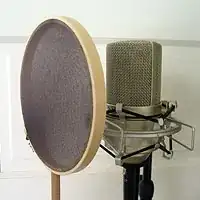
The pantyhose pop filter. So simple, so helpful, and so cheap.
Seriously, I can't believe they charge 30 bucks and up for these.
Bring every sofa pillow you have in the house into the room and line the walls with them!

FYI, egg cartons, at best, eat the high end. They do almost no soundproofing and don't control bass at all.
To make cheap mic stands a little more stable attach some velcro ankle weights or a barbell weight around the base.



The key thing to remember is that your studio needs to be balanced.
For example, there is no point in having Neumann microphones if your preamps are buzzy!
So the first thing I would recommend is to build a minimal studio and move on from that. In practice one could start with a computer and a 2 line soundcard, together with a cheap microphone. That's all that is needed to have a minimal studio setup.
From there, you would basically fix issues as they arise:
Then expand your set up and fix again:
From that stage you can start considering to buy a good "strip", like a good preamp-compressor combo so that for important tracks you get better quality - like vocals.
If you need soundproofing, do get that in place before doing this investment though. What kinds of sound do you need to dampen? Only spend money to fix real problems: not all rooms have bad sounding reverbs, not all kinds of studios need to record loud instruments, etc. In particular, before aiming to have a dead monitor room, I would make sure that my monitors are precise enough to tell the difference :-)
Another key thing to keep in mind is that many tools trade time for money. This only makes real sense if you are running a business. Do you really need to buy a hardware autotune if you can simply repeat the take? Do you really need to have a good sounding hardware compressor to avoid clips in recording? In many cases, it's a trade off between the money you are prepared to spend and the time you are prepared to spend on something.

A lot of acoustic treatment companies charge you a premium for wrapping a large pillow case over Owens Corning 703 rigid insulation.
The stuff is so cheap, you can just order it online or special order it from Home Depot and mount it on your walls. It is the industry standard sound absorption material.
Keep a soldering gun around and learn to use it. Even if you don't ever crack an equipment case, it'll pay for itself when you fix 1/4" cables that are getting noisy because the ends are damaged. You can also add ground leads to patch cables to reduce noise.

A closet with clothes in it can be a great vocal recording booth.
My band lined a 18'x10' garage with (free, reclaimed, clean) mattresses (two deep, walls and ceiling) that fitted behind a rudimentary inner wall (not that expensive - chipboard with a decent frame will do).
We shoved two mattresses in the door cavity and jammed another piece of chipboard over it (stuffing a few bits of rag into the remaining gap above the mattresses) and the room was VERY well soundproofed.
That setup dampened the noise of two 100W 4 x 12 Marshall guitar cabs, a 300W Trace Elliot bass cab, a full drum kit and a 200W PA (three vocalists) to an extent that we could play rather loud (all wearing expensive earplugs, deafening without) till 11pm at night in a quiet residential area without complaint.

It really depends what type of sound you are trying to record. If you just need to reduce the natural echo of a room, hang blankets on the walls, and drape sheets from the ceiling. I used this method, plus a couple large pillows in the corner where I was recording a person speaking, and had the person face the corner. This worked very well for a clear and consistent recording, but of course you will need a different solution if you are recording, for instance, a guitarist, drums, flute, etc.
There's always the SoS bible: http://www.soundonsound.com/sos/feb98/articles/soundproofing.html
Just google studio soundproofing and you'll get plent of resources that are cheap and/or free if you happen to have the tools and materials available. For example, diffusors are easy to make with some wood, and some hour or so put into it.
Basstraps are similar. Google is your friend.
