This is a common prejudice in my social environment, but is it true?
Are educated people more likely to vote for a social/left wing party?
This is a common prejudice in my social environment, but is it true?
Are educated people more likely to vote for a social/left wing party?


TL;DR:
To answer the question title, people with no higher education at all in USA voted 51%/47% (+4% margin for Obama) for D/R in 2012 Presidential election. So no, they are not tending "more" to conservative based on Exit Polls in US Presidential election.
For educated (college+postgrad), they voted virtually identical with total population averages (51% D/ 48.8% R), with college education being slightly correlated to be pro-R (-4% margin, 47%D/51%R) and postgrad education more so (but not overwhelmingly) with pro-D (13% margin, 42R/55%D)
If we do restrict ourselves to people who were mostly educated in the West?
There, there is some correlation at postgraduate level, and no correlation at all below it, but nowhere as strong as a typical "common prejudice" among liberals would have you believe. Stolen shamelessly from Sven Clement's Politics.SE answer, NY Times demo breakdown from 2012 election exit polls shows:
| Who                                    | % Population | Obama | Romney | Obama's Margin |
===========================================================================================
| People with no higher education at all | 53%          | 51%   | 47%    | 4%             |
| People with some college               | 29%          | 49%   | 48%    | 1%             |
| College educated                       | 29%          | 47%   | 51%    | -4%            |
| Postgraduate                           | 18%          | 55%   | 42%    | 13%            |
Note that while Postgraduates did break for Obama, they did not do so in an overwhelming manner - 42% postgrads voted "R"; and people with a college degree voted "R" at slightly over 50%.
In my defense of stealing, I contributed significantly to helping format that answer :)
Even more significantly, "education" by itself doesn't mean much without taking a major/concentration into account. Courtesty of SamIAm's answer on Politics.SE:
This looks like a pretty decent study as far as studies found on the internet go. It measures liberalism vs conservatism as opposed to Democrat/Republican, but it's close to what you're looking for. (pdf)
In addition, merely "a level of education" does NOT make one vote for a social/left wing party. There's a correlation (see the second part of the answer) with "education obtained at liberal-leaning Western universities", but not "a level of education" per se.
A very clear experiment showing this to be true has been historically run in USA since 1990s, with a large demographics of highly educated people who have NOT been subjected to Western universities immigrated to USA, as part of 4th wave of Russian/Soviet emigration.
Let's see how that demographic breaks out:
60% of the demographics holds 5+ years of higher education.
This compares to 27% US overall and ~60% of all American Jews (src) (the latter serve as a good control group since 4th wave of USSR immigrants are similar in ethnic/religious composition - being overwhelmingly Jewish - AND similar education level).
American Jews tend to vote 70-90% Democrat in Presidential elections.
An overwhelming majority of educated immigrants from former Soviet Union are hard-anti-liberal (technically speaking, they usually vote "R", but if you go into nuance, most are libertarianish politically - most of them not so much as vote "for Republicans", as "against Democrats").
2004: 77% of Russian-speaking Jews in New York voted for the Republican incumbent GW Bush over his Democratic challenger John Kerry who got 9% (src)
Similar pattern in 2008: McCain 65%, Obama 10%
In 2011, in special Congressional election to replace Anthony Wiener (NY Congressman who resigned prematurely due to a sex scandal), Russian Jews voted 90% for the Republican candidate (Note: "D" candidate was Jewish; "R" candidate was not).
This clearly shows that mere "level of education" is in no way predictive of political leanings, although the source of education is a different story.
The simple answer is: no they don't
Andrew Gelman has addressed this issue several times in his blog and his book Red State, Blue State, also has a lot of related electoral statistics.
In responding to statements like this (in William Saletan's review of Jonathan Haidt's book, The Righteous Mind), my emphasis :
You’re smart. You’re liberal. You’re well informed. You think conservatives are narrow-minded. You can’t understand why working-class Americans vote Republican. You figure they’re being duped. You’re wrong.
he responds:
...So, without disagreeing with Haidt (whose book I have not seen) or with Saletan (who may simply be reacting to things he read in Haidt’s book), let me just point out two facts that might clarify the above-quoted discussion:
Most working-class American voters vote for Democrats, not Republicans.
Richer people are more likely to vote Republican, in the country as a whole, within each racial group, and, among whites, within each level of education (except possibly at the lowest education level, where low sample sizes leave the pattern unclear).
He gives a more detailed answer in another post (where he was addressing the sort of inverse fallacy that educated people are a liberal elite that vote democrat):
Within any education category, richer people vote more Republican. In contrast, the pattern of education and voting is nonlinear. High school graduates are more Republican than non-HS grads, but after that, the groups with more education tend to vote more Democratic. At the very highest education level tabulated in the survey, voters with post-graduate degrees lean toward the Democrats. Except for the rich post-graduates; they are split 50-50 between the parties.
What does this say about America’s elites? If you define elites as high-income non-Hispanic whites, the elites vote strongly Republican. If you define elites as college-educated high-income whites, they vote moderately Republican...
...The patterns are consistent for all three of the past presidential elections. (The differences in the higher-income low-education category should not be taken seriously, as the estimates are based on small samples, as can be seen from the large standard errors for those subgroups.)
These charts clarify some of the patterns:
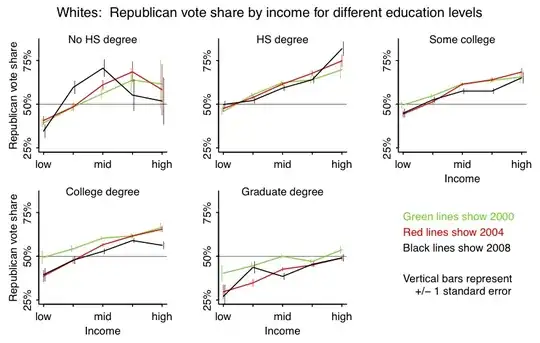
The key point here is that even the poor uneducated are more likely to vote democrat. Education may have some tendency to make people more democrat-voting, but this pattern is dominated by wealth, where the wealthy are much more likely to vote republican. Education makes you more democrat-leaning; wealth makes you more republican. But, while postgraduates may be more strongly democrat, the working classes (defined by education and wealth) are not a republican block.
Update
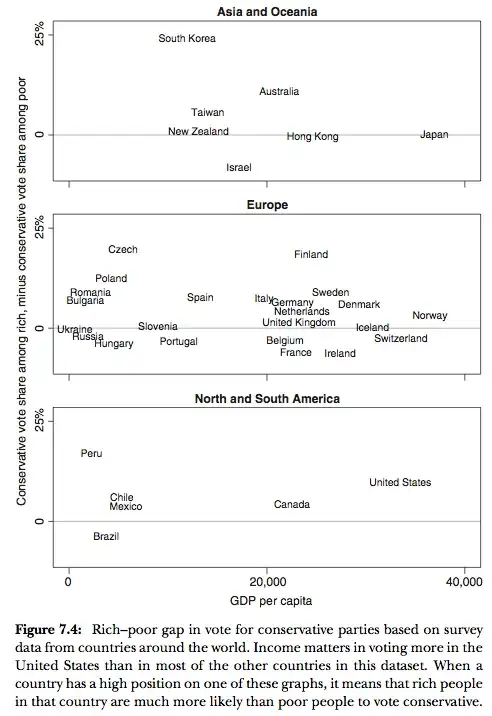
As comments have raised this issue is different in different countries. The following chart (also based on Andrew Gelman's analysis) summarises the situation for many. The chart y-axis is the difference between rich and poor conservative vote share (that is, the higher up the axis the larger the conservative voting is skewed to the rich). The US shows the most pronounced tendency for the rich to be more conservative than the poor, but it is far from alone.

I've heard the claim often myself, but it is not easy to find any backing research or statistics and I would assume that there will be great variations in the answers, depending on which country or geographic region you look at.
I managed to find statistics from the last parliament election in Norway (2009), where voter's education and political preference is examined closer. The relevant data is found in the second block of table A.1, page 28 (Utdanning).
The level of education has been split into three groups:
The political parties (R, SV, Ap, ..., H, FrP, Andre = others) are roughly arranged from left to right in the same order you would arrange them on a political left/right wing scale.
If we first take a look at the most leftish and rightish parties, your claim first seem to be backed up by the statistics. At the far-left, we find The Red Party (R) and the Socialist Left Party (SV) with a much higher support among the better educated voters (0/1/2% and 4/5/12% for the three education level groups). At the far right, we find the Progress Party (FrP) with a much higher support among the less educated voters (31/26/9%).
If we however look at the two larger "traditional" left/right wing parties in Norway, the Labour Party (Ap) and the Conservative Party (H), the distribution is opposite (46/35/32% for the Labour Party and 7/17/27% for the Conservative Party).
The last three parties, the Liberal Party (V), the Christian Democratic Party (KrF) and the Centre Party (Sp) are usually categorized as centrist parties without any clear left/right wing classification.
If we group the parties as well in left wing (R, SV, Ap), centrist (V, KrF, Sp) and right wing (H, FrP), the support cross-referenced with the education level group adds up to 50/41/46% (left wing), 11/16/18% (centrist) and 38/43/36% (right wing). Even if these numbers indicate a slight skew in one or another direction, they can at least not be used to backup your original claim. If at all, they seem to indicate the well-educated people tend to prefer centrist parties.

In addition to DVK's numbers, ARAcontent list about 25% of graduate degrees are in education (170K out of 700K) - those are going overwhelmingly liberal. And about 20% MBA's (150K out of 700K) - those are going conservative, but much less powerfully so. ARAcontent is renamed since the 2010 article in Ozark County Times. I added the 77K professional/doc degrees to the 605K Masters. That's only two years, and I'm sure there are trends, but that breakdown is a start. You will note that Education grad students have considerably lower GRE's.


- John Stuart Mill, circa 1868
– Brian M. Hunt Feb 14 '13 at 17:39