12

In this line:

он сел наземь между мною и Верой

Quassnoi
  • 53,460
  • 4
  • 94
  • 183
Lawrence DeSouza
  • 1,527
  • 1
  • 9
  • 19

4 Answers4

13

Both forms stand for Instrumental case of the 1st person singular pronoun я.

The form мною is an older variant of мной, it fades away now as the second option becomes more popular. You can see the distribution of the two forms over years here.

Reference service of gramota.ru sometimes calls both variants equivalent and sometimes recommends to use мной, because мною is considered obsolete.

Another reason why мною may be used is that in poetic texts the author wants to keep the correct metre or rhyme (but also for some other, maybe personal reasons). For example, Pushkin usually uses мной, but in the following poem he writes мною:

Алина! сжальтесь надо мною.
Не смею требовать любви.
Быть может, за грехи мои,
Мой ангел, я любви не стою!

Finally, the form мною can be used in modern texts that for stylistic reasons have to look like old texts.

I don't know what is the exact reason why it is used in your phrase. Maybe it is an text from 18th century.

Olga
  • 6,558
  • 4
  • 30
  • 68
  • This is the first time I see the Russian corpora used and I love it! Thanks for the link! – texnic Jul 17 '12 at 16:50
  • Quassnoi uses them here and there =) I learned about this function thanks to him. – Olga Jul 17 '12 at 16:55
  • He always writes very academic answers, I cannot read them and if I do, I already over-trust him and do not check the links :) – texnic Jul 17 '12 at 17:04
  • This does look like an old text. наземь is also archaic. – Dima Jul 17 '12 at 21:38
  • Occasionally мною can be seen in modern contexts: «Мною сегодня подписан указ о назначении вас исполняющим обязанности главы Чеченской Республики...» (source). – ghostarbeiter Mar 29 '16 at 19:28
7

The modern form мной (or any other sg. inst. ending on -ой, -ей) is quite a recent apocope of мною which had been a norm till the late XVIII.

You may observe it on this graph.

Russian tends to reduce ending vowels in weak position which can also be observed in particles like -бы/-б, -же/-ж, -ли/-ль etc. (reflected by the orthography) and also -то/-т, -ка/-к etc. (which are not yet reflected). The difference between the sg. inst. in declension I is a part of the same process.

Currently, the latter form is considered archaic, but may be still used in poetic, high style speech or just for euphonic purposes. The two forms are rhythmically different so interchanging them can help in composing a verse.

In your case, it is most probably used to avoid й-и cluster which is somewhat hard to pronounce without omitting the й.

Quassnoi
  • 53,460
  • 4
  • 94
  • 183
  • One could make a "liaison" between "и" and "й", pronouncing it as ['mnoji 'verъj] – Olga Jul 17 '12 at 17:00
  • @Olga: this is not typical for Russian speech, that's why we have don't have an iotized ы. Many Russians are not even able to pronounce Ukrainian ї without prior training. – Quassnoi Jul 17 '12 at 17:04
  • I'm not sure that I understand what an iotacized ы is. We need only an iotacized и, don't we? – Olga Jul 17 '12 at 18:39
  • @Olga: we don't need any of these, there is no such sound in the language. My point is that the complement of the open ы is not iotized (unlike complements of all other open vowels). – Quassnoi Jul 17 '12 at 20:20
  • I still don't understand. How is an iotacized "o" pronounced, for example? If is it the sound that is similar to German ö, then of course there is no such thing as iotacized и\ы. If the iotacized o is pronounced like [jo], then there is the iotacized и\ы sound in the language, for example, in word "его" [jivo]. However, there is no special letter to denote [ji] in the beginning of the word. I don't know why it is so. I maybe should ask this question on the forum =) – Olga Jul 17 '12 at 21:23
  • @Olga: you cannot pronounce an open vowel after a palatal or palatalized consonant and vice versa (not without a hiatus). In fact, the distinguishing feature of лук vs. люк is not the vowel openness but rather the palatalization of the preceding consonant. So the more logical way to write лот / лёт / льёт would be лот / льот / льйот or even лот / льöт / льйöт, but this takes more letters. The word его you mentioned is just a subject of vowel reduction, the same vowels in strong position are clearly distinct: ива / Ева. – Quassnoi Jul 17 '12 at 22:04
  • My point: there is such combination of sounds as [ji] and it is widely used in Russian, although it is only a positional variant of [je]. – Olga Jul 17 '12 at 22:08
  • @Olga: could you please provide a native or naturalized word with this sound in a strong position? – Quassnoi Jul 17 '12 at 22:10
  • Sure. for example, Ильи. – Olga Jul 17 '12 at 22:11
  • @Olga: yes, you're right. I just asked my mother (a Belorussian) to pronounce it and she did not voice the й, but I do voice it. – Quassnoi Jul 17 '12 at 22:22
  • Currently, the latter form is considered archaic, but may be still used in poetic, high style speech or just for euphonic purposes. - strongly disagree. This form is quite alive and still used heavily. "Записано мной", "Про то, как со мною связаться", "Вышел из созданного мною проекта" - those are from googling blogs. This is far from archaic, though less popular form. Check this out - http://bit.ly/N4T0Z1

    – shabunc Jul 26 '12 at 11:47
  • @shabunc: you have read the part about "euphonic purposes", haven't you? – Quassnoi Jul 26 '12 at 14:04
  • @Quassnoi, sorry if I've misunderstood you. I've read it, but nevertheless though that by archaic you mean "мною" as well. – shabunc Jul 26 '12 at 14:08
  • @Quassnoi - More examples with [ji] in a strong position: муравьи, воробьи, чьи, свиньи (Gen. sg.), семьи (Gen. sg.), попадьи. – Yellow Sky Feb 22 '13 at 14:43
0

“Он сел между мной и Верой” и “Он сел между мною и Верой” are quite different in meaning. While first is neutral, the second suggests antipathy between me and him, one who sat between us. That is why this form is used. The form мною suggests firm interest involved.

theUg
  • 1,584
  • 11
  • 29
Serge
  • 31
  • 1
  • 1
    Please, provide some reference, if you can. – theUg Feb 19 '13 at 01:49
  • @Serge Why does it especially antipathy? I think, initially that was a some kind of emotional connection. Feelings were clarified by context. – Kyrill Feb 19 '13 at 15:42
0

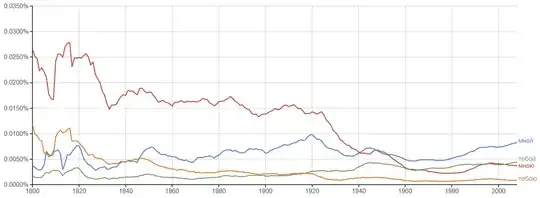
Here is the distribution chart including the comparison of the 2nd person singular

мной - blue
мною - red
тобой - green
тобою - orange
enter image description here