6

I'm trying to use a dual quaternion Hand Eye Calibration Algorithm Header and Implementation, and I'm getting values that are way off. I'm using a robot arm and an optical tracker, aka camera, plus a fiducial attached to the end effector. In my case the camera is not on the hand, but instead sitting off to the side looking at the arm.

The transforms I have are:

  • Robot Base -> End Effector
  • Optical Tracker Base -> Fiducial

The transform I need is:

  • Fiducial -> End Effector

HandEyeCalibrationQuestion

I'm moving the arm to a series of 36 points on a path (blue line), and near each point I'm taking a position (xyz) and orientation (angle axis with theta magnitude) of Camera->Fiducial and Base->EndEffector, and putting them in the vectors required by the HandEyeCalibration Algorithm. I also make sure to vary the orientation by about +-30 degrees or so in roll pitch yaw.

I then run estimateHandEyeScrew, and I get the following results, and as you can see the position is off by an order of magnitude.

[-0.0583, 0.0387, -0.0373] Real [-0.185, -0.404, -0.59] Estimated with HandEyeCalib

Here is the full transforms and debug output:

# INFO: Before refinement: H_12 =
-0.443021 -0.223478  -0.86821  0.321341
 0.856051 -0.393099 -0.335633  0.470857
-0.266286 -0.891925   0.36546   2.07762
        0         0         0         1
Ceres Solver Report: Iterations: 140, Initial cost: 2.128370e+03, Final cost: 6.715033e+00, Termination: FUNCTION_TOLERANCE.
# INFO: After refinement: H_12 =
  0.896005   0.154992  -0.416117  -0.185496
 -0.436281    0.13281  -0.889955  -0.404254
-0.0826716   0.978948   0.186618  -0.590227
         0          0          0          1


expected RobotTipToFiducial (simulation only):   0.168   -0.861    0.481  -0.0583
expected RobotTipToFiducial (simulation only):   0.461   -0.362    -0.81   0.0387
expected RobotTipToFiducial (simulation only):   0.871    0.358    0.336  -0.0373
expected RobotTipToFiducial (simulation only):       0        0        0        1


estimated RobotTipToFiducial:   0.896    0.155   -0.416   -0.185
estimated RobotTipToFiducial:  -0.436    0.133    -0.89   -0.404
estimated RobotTipToFiducial: -0.0827    0.979    0.187    -0.59
estimated RobotTipToFiducial:       0        0        0        1

Am I perhaps using it in the wrong way? Is there any advice you can give?

Andrew Hundt
  • 506
  • 1
  • 4
  • 14

3 Answers3

14

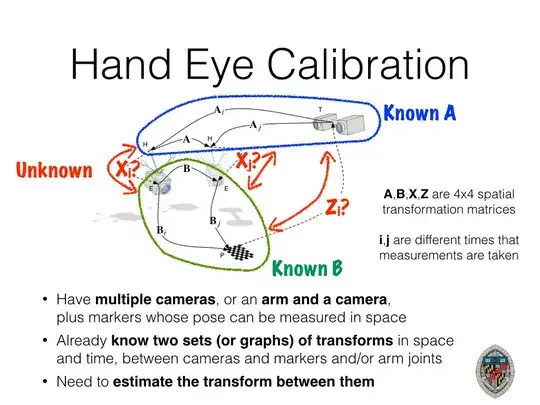
After solving the problem, I created a keynote presentation explaining many details about hand eye calibration for those that are interested. Practical code and instructions to calibrate your robot can be found at handeye-calib-camodocal.

I've directly reproduced some key aspects answering the question here.

Hand Eye Calibration Basics

Two Common Solutions to Hand Eye Calibration

AX=XB Hand Eye Calibration Solution

AX=ZB Hand Eye Calibration Solution

Camodocal

Camodocal is the library I'm using to solve the problem. It is a well written C++ library that includes hand eye calibration, though documentation is extremely sparse.

Camodocal includes implementations of:

Relevant Papers

  • CamOdoCal: Automatic Intrinsic and Extrinsic Calibration of a Rig with Multiple Generic Cameras and Odometry, In Proc. IEEE/RSJ International Conference on Intelligent Robots and Systems (IROS), 2013.
  • Lionel Heng, Mathias Bürki, Gim Hee Lee, Paul Furgale, Roland Siegwart, and Marc Pollefeys, Infrastructure-Based Calibration of a Multi-Camera Rig, Submitted to IEEE International Conference on Robotics and Automation, 2014.

Feeding data into CamOdoCal

  1. Each measurement taken at a different time, position, and orientation narrows down the possible transforms that can represent the unknown X

  2. Record a list of many transforms A and B taken between different time steps, or relative to the first time step

    • Rotations are in AxisAngle = UnitAxisAngle format, or [x_axis,y_axis,z_axis]_angle
      • ||UnitAxis||=1
      • || AxisAngle || = _angle
    • Translations are in the normal [x,y,z] format
  3. Pass both vectors into EstimateHandEyeScrew()
  4. Returns X in the form of a 4x4 transform estimate

Camodocal Hand Eye Calibration Details

ROS Integration

There is a package that implements a solver for this using camodocal + ROS called handeye_calib_camodocal. It also includes detailed troubleshooting instructions.

References

  • Strobl, K., & Hirzinger, G. (2006) . Optimal hand-eye calibration. In 2006 IEEE/RSJ international conference on intelligent robots and systems (pp. 4647–4653), October 2006.
  • Technical University of Munich (TUM) CAMP lab wiki

  • K. Daniilidis, “Hand–Eye Calibration Using Dual Quaternions,” Int. Journal of Robs. Research, vol. 18, no. 3, pp. 286–298, June 1999.
  • E. Bayro–Corrochano, K. Daniilidis, and G. Sommer, “Motor–Algebra for 3D Kinematics: The Case of Hand–Eye Calibration,” Journal for Mathem. Imaging and Vision, vol. 13, no. 2, pp. 79–100, Oct. 2000.
  • F. Dornaika and R. Horaud, “Simultaneous Robot–World and Hand– Eye Calibration,” IEEE Trans. on Robs. and Aut., vol. 14, no. 4, pp. 617–622, August 1998.
  • Note: figures and text are from mixed sources including the presentation author, the various papers referenced, and the TUM wiki.
Andrew Hundt
  • 506
  • 1
  • 4
  • 14
  • 2
    For those that come across this in the future, now there is a package using camodocal + ROS: https://github.com/jhu-lcsr/handeye_calib_camodocal – Andrew Hundt Apr 11 '16 at 06:38
  • the link to your keynote is broken: "Versions of the presentation are out of sync. As soon as the owner picks a version, you’ll be able to open it." – Paul Du Bois Apr 05 '20 at 21:04
1

The library you are using (and papers it is based on) seem to be for a different use case than what you are doing. They have a camera rig moving around a world with fiducials pulled out of a SLAM map, whereas you have a static camera and a moving arm holding fiducials. Fundamentally, yes they are the same, but i wonder if you used a different library that is more suited to a robot arm, if you would have better results. This is a paper you might consider: Calibrating a multi-arm multi-sensor robot: A Bundle Adjustment Approach. I don't know if there is source code. But it is ROS, so odds are good.

Ben
  • 5,855
  • 3
  • 28
  • 48
0

I agree with Ben, your situation is eye-to-hand(camera outside robot) and AX=XB,the X is pose between camera and the robot base(but you get the fucucial with the end-effector). And in eye-in-hand(camera bind to robot tip) the X is the pose between camera and the robot's end-effector. There is another Matlab code (Dual Quaternions)in http://math.loyola.edu/~mili/Calibration/index.html

Yake
  • 1