I need an equation or a some hints to solve the following problem.
Imagine a roller screw drive. I apply a torque of T to translative move my load mass M. I assume my screw has an efficiency of 90%. Now an additional axial force affects my mass in the opposite moving direction. Is this force completely transformed into torque (of course considering the efficiency) or is it possible, that my whole roller screw is moving, because it is not fixed? I just found papers/books/articles for movable slides/loads, but fixed shafts. But in my case motor and shaft are part of an osciallation system.
I'm not a mechanical engineer, so I'm sorry if the answer may is trivial.
I made a little sketch now 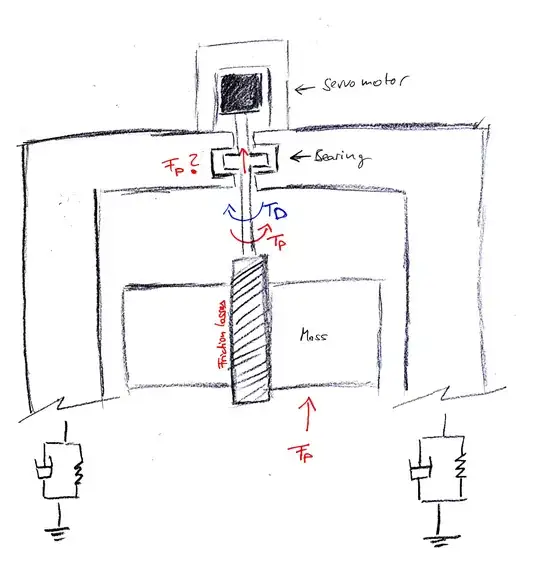
The process force Fp is pushing my mass, most of the force is transformed into a load torque Tp which acts against my drive torque TD. Some of the energy is lost by friction. The question is, if there is also a partial force Tp? which is affecting the bearing and therefore exciting my chassis.


Fpand how. – Robert Seifert Sep 09 '13 at 08:13Fpis affecting the bearing. But we weren't sure, whether the screw is self-inhibiting or not, but that would make a huge difference right? Actually a document which shows me the complete force and torque balance of screw would already help me a lot. And if this document would also explain the differences between self-inhibited to uninhibited - perfect! Already thank you to everybody participating! – Robert Seifert Sep 09 '13 at 16:43