5

So i got this idea waay back when i was in highschool as a kind of electromagnetic analogue to a biological muscle. it is basically a long stack of thin electromagnets connected in parallel. (the picture). when current is applied gaps between electromagnets shrink thus providing contraction of the whole chain.
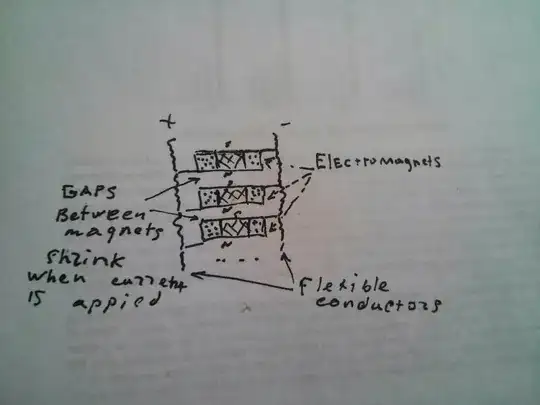
I am pretty sure it can work. It can't offer great contraction range (up to 50% i would guess) but it has potential to provide good speed and be compact so that multiple chains can be combined to form stong and fast linear actuators. The thing is, i never heard of this type of actuator being used. so what is the catch? is there a better alternative? is there a design flaw? too much heat generated making them unpractical?

Ian
  • 11,013
  • 2
  • 23
  • 65

1 Answers1

4

This design is definitely plausible, but there are some problems I can see.

  • The maximum length is defined by the force the magnets can lift, since the ones lowest in the stack won't push the other ones up after some amount of them.
  • The magnets will want to get as far from the force as possible, so they will most definitely not go straight up. This calls for a use of something like a flexible tube. This may mean the design won't be as space-efficient as it seems (if it is even possible).
  • The stack won't keep it's shape if the magnets are not energized all the time, so the current consumption may be bigger than readily-available parts.

It is an interesting concept, but I can't see using it to lift any significant load to a reasonable distance.

Plecharts
  • 419
  • 2
  • 8
  • I didn't consider added weight of all the magnets down the chain. that is obviously an issue. I neglected to mention that initial idea included some sort of compressible spongy material between magnets so the chain stays together. – Andrew Butenko Aug 28 '13 at 14:55