There's a lot of things that this could be.
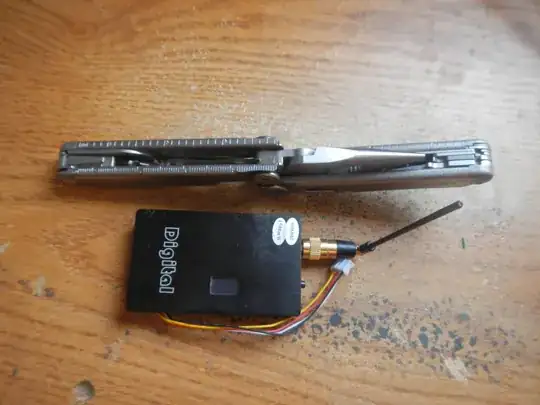
The transmitter could be faulty, and transmitting considerable power close enough to 2.4GHz to be directly interfering with the receiver. Yes, the receiver is spread-spectrum, but interference to such a receiver will generally raise its noise floor, which will reduce its range.
The receiver could be faulty; it's front end could be getting swamped by the 910MHz. This would reduce the effective gain of the receiver front end, which would also result in low range.
There's even a slight chance that the problem is neither one, but some other bit of electronics: the 910MHz signal could be getting rectified by some component in a servo or other bit of electronics. This would generate signal at 1.82GHz, 2.73GHz and more -- that 2.73GHz signal, if it's strong enough, could cause issues with your 2.4GHz receiver.
A rough test of which is which would be to unhook one or the other from the quadcopter, then increase the separation between them while you see how the signal strength, or range, looks on the 2.4GHz receiver. If the range of the 2.4GHz receiver rises rapidly with separation, or shows some threshold effect where it is low, low, low, HIGH, then there's a good chance that the problem is that the 2.4GHz receiver is allowing itself to be stomped on by the out-of-band energy from the transmitter. If the range of the 2.4GHz receiver rises gradually and smoothly as you back away from the video transmitter, then the problem could be in either radio but is most likely in the transmitter.
In an ideal world both the receiver and the video transmitters would be inside of metal boxes, with bandpass filters right at the point of entry or exit for the RF signal that only let the correct frequencies through. Those metal boxes would weigh nothing, of course.
Alas, this is the real world. I'm not sure if it'd be worthwhile to try the metal box idea -- the required filters are hard to debug without a spectrum analyzer; you can put one together and see if it works, but if it doesn't you still won't know for sure if a filter isn't the answer, or if that particular filter didn't do the job for you.
The (US) Amateur Radio Relay League has a book called the "Radio Interference Handbook". The book is aimed at amateur radio operators who are having problems with their neighbors -- but much of what it'll have to say should be pertinent to your case.