14

Anyone that's seen an Atari 400/800 next to a VIC-20 or C64 will know what I'm talking about - the Atari display was much, much sharper. It had a similar advantage over the Apple II, and I seem to recall the CoCo being somewhere between the Atari and C64s.

Does anyone know why? I suspect it might have something to do with all the shielding, which would imply later models in the XL series would lose some of the sharpness, but I did not use those machines either.

user3840170
  • 23,072
  • 4
  • 91
  • 150
Maury Markowitz
  • 19,803
  • 1
  • 47
  • 138
  • As here? https://www.youtube.com/watch?v=UNf8OQaud2M&t=7m51s That's exactly the same quality the C64 reaches on a TV set. If you wanted better quality, you had to connect a good monitor to both. – Janka Dec 21 '18 at 22:55
  • 1
    I have no idea what's going on in that video, but I assure you the normal output of the machines was dramatically better than shown. Dramatically. And that is a monitor. – Maury Markowitz Dec 23 '18 at 00:27
  • The video output of a C64 on a monitor is also not that bad. Not even with composite. The TV modulators Commodore used are crap, yes. – Janka Dec 23 '18 at 00:29
  • This is very interesting. In Germany the "Stiftung Warentest" (an organization testing products of any kind) tested home computers in 1984. The computers tested were: C64, TI-99, 600XL, CoCo, Dragon 32, Spectrum, Color Geny. (PAL versions, not NTSC) Their result was that only C64, Spectrum and TI-99 had a "good" picture on the TV set. 600XL was the only machine with the result "bad picture". – Martin Rosenau Dec 23 '18 at 09:42
  • Well that's why I added the comment about the XLs, these were cost-reduced machines so I'm not surprised if the video was not the same quality. – Maury Markowitz Dec 23 '18 at 16:50
  • Interestingly, "page showing the circuitry" below confirms this, the XL's video was crap compared to the originals. – Maury Markowitz Dec 27 '18 at 19:56
  • The normally worse C64 display on a quality monitor rises to match the Atari's better display when the "Luma Fix" is added to the C64. See https://retrocomputing.stackexchange.com/questions/7676/why-did-certain-color-combinations-look-terrible-on-the-commodore-64/7679?r=SearchResults&s=1|23.5328#7679 – Brian H Jan 05 '20 at 15:35
  • @MartinRosenau do you have references? I would like to see those tests. – cbmeeks Jan 06 '20 at 16:05
  • @cbmeeks The test is available under this link. Unfortunately, in German language only. – Martin Rosenau Jan 06 '20 at 16:57
  • I'd say a lot of the "low video quality" impression on the C64 actually stems from the (very) poor selection of mushy palette colours, IMHO the worst in the industry. – tofro Apr 01 '21 at 11:23
  • @tofro: Compared to the PC color set, the C64 trades light magenta for purple, and light cyan for an extra gray level. IMHO, it's better than the VIC-20 color set which replaces the two grays with orange, and brown/dark yellow with a very bright yellow. – supercat Apr 01 '21 at 15:05
  • @supercat What exactly do you assume to be "the PC colour set"? There's simply too many of them. Note that, being European, I refer to the C64 PAL palette (which I have just learned is different from NTSC) – tofro Apr 01 '21 at 16:59
  • @tofro: The color set used by RGBI monitors, which would have been contemporaneous to the VIC-20 and C64. – supercat Apr 01 '21 at 17:16

1 Answers1

17

Why did the Atari's have such clear displays?

I suspect it might have something to do with all the shielding

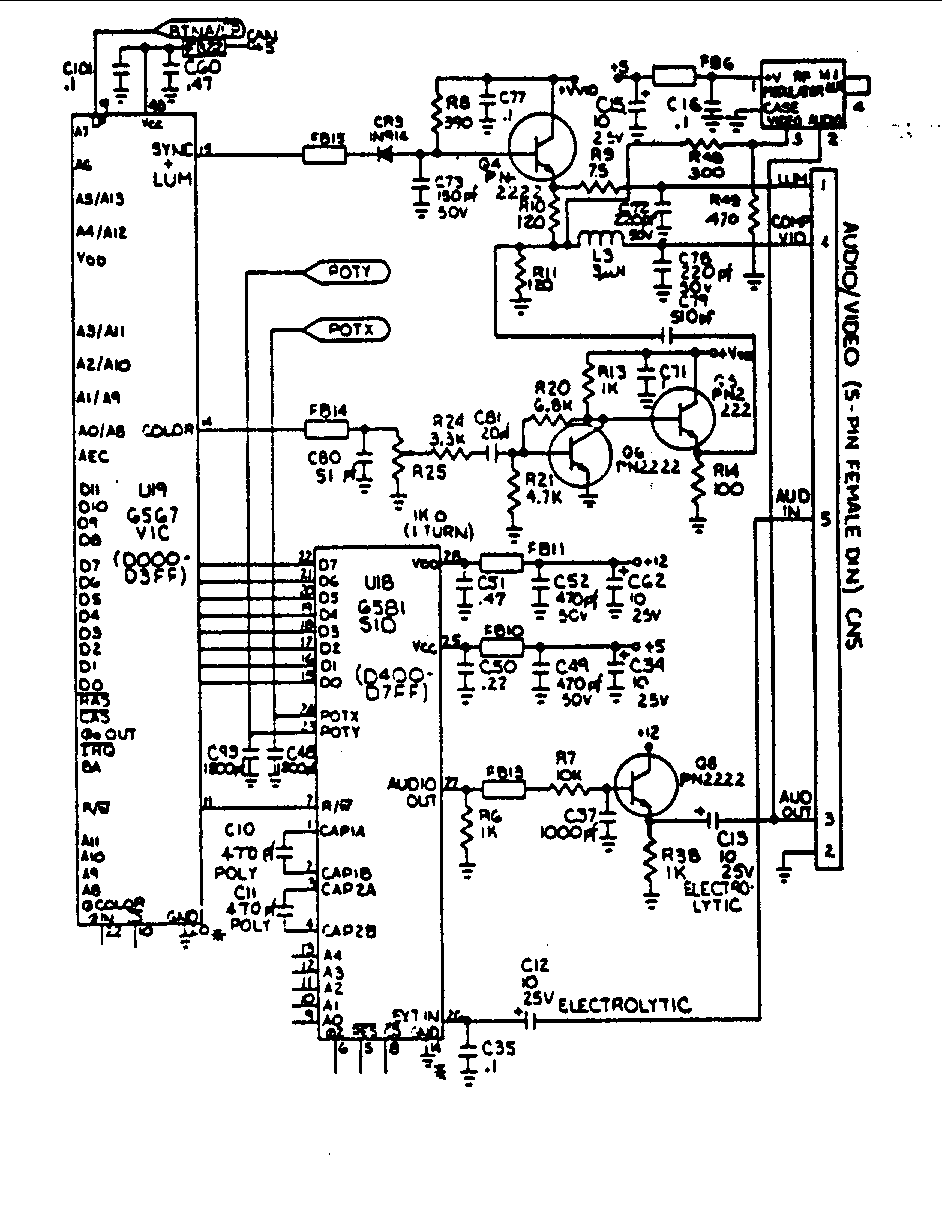
No. As usual it's about the effort the designers did put into the display. To reduce cost, the VIC-II outputs an already internally mixed B&W signal and chroma. While this is basically like S-Video, the quality is defined by the internal generator - and doing analogue on a primary digital process is always a challenging task - especially if one want's to save money like Commodore did. In addition the external circuit is rather frugal.

In contrast the Atari's CTIA/GTIA output is fully digital and gets further 'sharpened' by a 4050 CMOS inverting buffer. Thus these signals are already way more 'clean' before geting mixed in a somewhat more elaborate diskrete analogue section. Here is a nice page showing the circuitry in detail for the purpose of an easy modification to get an S-Video compatible output.

Also the modulator used, at least for the 800 is of a better quality than the one for the C64 - but that's only relevant for TV, which is less than desirable anyway - still, here the Atari outperforms the Commodore as well.

I guess it pays out that Atari designers had quite some experience with TV/colour when creating the 400/800 output circuit.

Raffzahn
  • 222,541
  • 22
  • 631
  • 918
  • 1
    Honestly, the only major difference I can make out is the resistor ladder for the luma not being present in the VIC-II schematic. That makes total sense as the VIC does only employ four levels of luminance – black, dark, light and white. I can't see how this affects signal sharpness. – Janka Dec 22 '18 at 02:17
  • A fine answer as always Raff. I can't speak to the internal signal because I only ever used it on a TV. The Atari's TV output was basically the equivalent quality of the C64 on a 1701. I wonder if that's the reason Atari never released their own monitor, simply that it didn't make enough of a difference? I saw an 800 on a monitor, and it was better, but not a lot better. – Maury Markowitz Dec 23 '18 at 00:26
  • Oh yeah, were you ever able to grab pix of the Sol-20 expansion bus? – Maury Markowitz Dec 23 '18 at 00:31
  • Yes. I totally forgot about them. sorry. Let me search and send them. ok? – Raffzahn Dec 23 '18 at 00:46
  • @MauryMarkowitz Looking at the signal with a scope will show the quite obvious difference. Fro the mintor I guess Atari always thought of home consumers using a TV as their main target market. – Raffzahn Dec 23 '18 at 00:48
  • Also keep in mind the time frames here. The Atari chips were designed and released in the late 70's. A good 4-5 years or so before the VIC-II came to market. In the late 70's, computer monitors were not a standard in the home. Even the "monitors" used by the TRS-80 was essentially a TV with the tuner removed (plus it was B/W which doesn't have the chroma interference). The Apple II color monitor is actually pretty good. I wonder what it would look like with a C64 or Atari 800? Maybe I should setup some examples and take pics?? I have all of those computers and monitors. – cbmeeks Jan 06 '20 at 16:14
  • @cbmeeks: I wonder at what point it became common for television sets to have a floating chassis? If a TV just has RF input, a hot-chassis set can transformer-couple the input to avoid feeding AC120 out the antenna leads. Adding a composite input to some older sets would have required adding an isolation transformer for the mains supply, which is a lot more expensive than an RF transformer. – supercat Apr 01 '20 at 20:26