At one time bubble memory was advertised as being able to store huge amounts of data in the size of a sugar cube. I don't remember what the memory density was compared to today's SD cards. What happened to bubble memory - is it still being sold?
Asked
Active
Viewed 4,337 times
22

-
A quick read of the bubble memory article in Wikipedia indicates that it just couldn't keep up with price & density of newer technologies, particularly flash memory. – manassehkatz-Moving 2 Codidact Feb 02 '18 at 05:14
-
If there is any still being sold (or even made), that would be as spare parts for long lifecycle military, industrial control, or telecomms gear. – rackandboneman Feb 05 '18 at 10:29
2 Answers
13
I don't remember what the memory density was compared to today's SD cards.
No, today's flash offers a way (several magnitudes) denser storage, but it is also way less reliable.
What happened to bubble memory - is it still being sold?
It might be still around. Today bubble memory is a rather special niche market with most uses in military and space applications, due to its extreme ruggedness and reliability in harsh environments.
The former bubble memory division of Intel has been spun off as MemTech Technologies and continued development and sales maybe until the early 2000s. The company was active at least until the late 2000s, but seems to be defunct now (See below).
Development continues today. Maybe search for Vertical Bloch Line Technology.
Information found about MemTech:
Scruss did uncover some additional information about MemTech. According to a text to a video about bubble development from 2011 by AT&T they actively offered bubble memory at least until the mid 2000s. Similar with a 2005 article. But here the term Flash is used several times to describe the technology and it's a bit unclear, as at the same time they refer back to prior use in military devices. So maybe they've started kind of transition around that time frame.
He also pointed out a blogpost by John Dvorak fittingly titled "Whatever Happened to Bubble Memory?" from November 2006, basically a 'reprint' of his column from the September 1991 issue of Computer Shopper, mentioning MemTech and Bubbles as present (in 1991).

Nisse Engström
- 253
- 2
- 7

Raffzahn
- 222,541
- 22
- 631
- 918
-
2"Way less reliable" suggests unreliable, but isn't it really "reliable enough for ordinary (but not exceptional) uses?" Cheap flash drives might as well be flash paper, but I expect my SSD to outlive my computer. – Robert Harvey Feb 02 '18 at 16:03
-
2@RobertHarvey This depends a lot on your usage profile. Modern 3D multi level flash is by now down to an average of a few hundret write cycles before a cell malfunctions. And that's a statisical value. Within an office/home profile Flash works by humungos overprovision and more important a negelctable write usage. It's rather the other way arround. Flash works great in this narrow, specialized usage than for general purpose. Buble can be reliable continous rewritten for decades. – Raffzahn Feb 02 '18 at 16:23
-
@RobertHarvey I've had two SSDs fail on me. In practice they aren't actually that more reliable than hard drives. They're less likely to fail completely, but more likely lose data. http://www.zdnet.com/article/ssd-reliability-in-the-real-world-googles-experience/ – Feb 02 '18 at 17:11
-
2@RossRidge: How long ago? Endurance experiments have been performed on these drives as recently as two years ago. It takes 2 petabytes of continuous writes 24 hours a day over an 18 month period to get the best of these drives to fail. 99 percent of all users will never get even close to this level of abuse. I think the reliability "problems" of SSD are overstated, mostly due to bad experiences with earlier drive technologies. – Robert Harvey Feb 02 '18 at 17:15
-
3That said, the web page you linked cites age, not write cycles, as the determining factor. I'll have to read more about that. May need to replace my drives earlier than I thought. – Robert Harvey Feb 02 '18 at 17:21
-
Real world usage is always a complex arrangement of various factors. There isn't 'the' right storage for everyone. And having the biggest market share doesn't realy tell about the use cases a technology can cover. Let's not forget, tapes are still a thing! – Raffzahn Feb 02 '18 at 17:26
-
@RobertHarvey They failed about a year ago, locking up when reading certain sectors. I don't believe my SSDs failed because of Flash endurance problems, at least not directly, but either because of some other electronic failure or a firmware bug. – Feb 02 '18 at 17:34
-
1
-
@RobertHarvey Mind to explain? I use them daily but haven't wasted a minute. – Raffzahn Feb 02 '18 at 21:55
-
1@Raffzahn: I have yet to see one successfully restore data. Granted, none of these companies were doing simulated restores, and unless you're doing those, you might as well not be making backups at all. – Robert Harvey Feb 02 '18 at 22:08
-
@RobertHarvey I had to search thru archives more than just a few times. Automated archives are a true marvel of conveniance. – Raffzahn Feb 02 '18 at 22:28
-
1@Raffzahn - Memtech stopped selling bubble technologies decades ago. The article that might have suggested that they still were is the undated Dvorak piece Whatever Happened to Bubble Memory?. The latest this could have been is from 1999, when Computer Shopper stopped carrying the series. – scruss Feb 03 '18 at 16:52
-
@scruss Interesting article (including his freudian typo Bloch/Block), but no, My last contact with MemTech moduls was some 10 years ago in a replacement project, where they where used again in the new device. – Raffzahn Feb 03 '18 at 18:06
-
1It really looks like they stopped producing them by about 2005. That's not to say that NOS devices weren't being supplied. Citations: “… as did switching from a technology called bubble memory to flash memory” (2005); “Memtech continued producing bubble memory until the mid-2000s …” (2011). – scruss Feb 03 '18 at 21:47
-
the Dvorak article's from 99; edited in your post. Also, MBM wasn't particularly reliable: the large sticker on Intel modules showed the bad blocks map as shipped new, and they could degrade further. Modern flash memory is orders of magnitude more reliable, mainly due to its small size allowing massive over-provisioning. I mean, since MBM is so incredibly slow, you probably could rewrite it for decades … – scruss Feb 04 '18 at 01:14
-
@scruss please check again. the Blogpost is from Nov.26. 2006. The link you provided states that these blogposts are based on certain older articles, but have been updated with new information. Therefore 1999 can't be stated as date of publication - unless you got the original article at hand. Also, Having bad blocks doesn't give any information about reliability. It is part of the bubble technology that not all domains will work out and be markes as such as part of production. – Raffzahn Feb 04 '18 at 01:20
-
1There are no updates to the article (apart from minor typos), which was originally from 1991. If you have Academic OneFile access, you can read it here: Dvorak, John. "What ever happened to ... bubble memory?" Computer Shopper, Sept. 1991, p. 694. Academic OneFile, http://link.galegroup.com/apps/doc/A11210891/AONE?u=tplmain&sid=AONE&xid=119a1d03. Accessed 3 Feb. 2018. – scruss Feb 04 '18 at 01:40
-
@scruss Well, thanks for finding that source, then we should link this one and attribute it to 1991, not 1999 right? – Raffzahn Feb 04 '18 at 01:50
-
2yup. You might want to rethink the “it's still around” para, as it's only of historical interest. No-one makes it any more. – scruss Feb 04 '18 at 01:53
-
@Raffzahn Silly question: Do smartphones not use flash/"a SSD" as their only "hard drive" - thus, it must tolerate writing many times to certain places unless the files are moved around physically? I'd also mention that I compile and run programs on a (seemingly good quality) removable flash drive and have my development database schema on an SSD, now for 2 years. In fairness I have had a couple of times where Windows needed a restart to release locks on a file on the flash drive, I suppose that could be because it reacted incorrectly or slowly in such a way to confuse the OS disk drivers..(?) – nsandersen Feb 28 '18 at 18:25
-
@nsandersen Nop. The logical blocks a Programm/OS writes are not (direct) related to specific flash areas. Where information gets stored is decided by the flash controler. It tracks what physical areas have been used ho often and tries to level out usage by shovling the data around. Keep in mind, some modern high density flash chips can only be written a few hundret times. If the assignemnt would be fixed, installing the OS would already kill a drive. That's why SSDs are defined in data written per day (etc.). It's much like quantum physics: al statistics, no hard facts. – Raffzahn Feb 28 '18 at 19:04
-
Fair enough - the numbers and real-world experience make a lot more sense if the controller can actually move a file that is rewritten to a different physical place in the SSD. Thanks. – nsandersen Mar 01 '18 at 13:18
13
Magnetic Bubble Memory (MBM) was a technology that never found a sustained market, and was only briefly in vogue a couple of times in the 1970s and 1980s when market and technical issues hit other storage technologies.
While MBM is non-volatile and fairly rugged, it has a few show-stopping disadvantages, including:
It needs to be heated to over 30 °C before it will operate. Consequently, it is slow to start, has special power requirements and the thermal jacket on top of MBM's complicated structure makes bubble memory quite bulky.
MBM is serial: the ‘bubbles’ race round loops, so memory can only be read or written as the right bubbles come round the loops. In order to speed up access, manufacturers tried many loops in parallel, which added complexity to the MBM module. Even with 512× 8192-bit storage loops, Intel's 7114A from the early 1980s only managed an average access time of 40 ms. This might have been better than hard drives of the time, but MBM was touted as a RAM replacement.
MBM is a complex sandwich made up of a semiconductor substrate layered between precisely-aligned magnetic coils and permanent magnets. Consequently, it would have been challenging to manufacture and likely far less mechanically shock-proof than its lack of moving parts might suggest.
MBM, despite its expected ruggedness, could still develop bad blocks like any other magnetic storage medium. I've heard anecdotal reports of the block remapping process being quite time consuming, and booting machines from MBM could be a slow and not always reliable process.
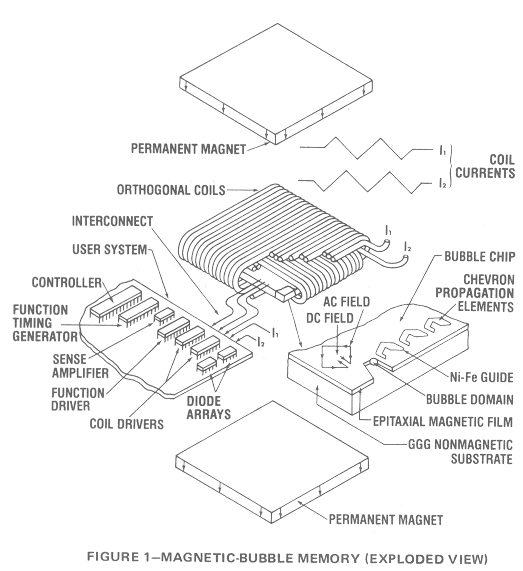
I remember industry pundits of the time being very keen on pushing MBM as a successful technology, perhaps fuelled by over-optimistic PR from manufacturers such as Intel.

scruss
- 21,585
- 1
- 45
- 113
-
What does "average access time" mean here? From what I understand, sequential reads (such as a program's inner loop or string copy) should run much faster, since the next data is recalled as each word is read. – Omar and Lorraine Aug 02 '23 at 15:57
-
Your guess is as good as mine with 1980s advertising copy. If this were an engineering definition, "average access time" might indicate that it would take 80 ms to read a whole bubble loop, so would take typically between 0 and 80 m/s to access any data: hence 40 ms. Sequential reads are as fast as the media could be read (which was only up to 50 KB/s), but seeking was tremendously slow – scruss Aug 02 '23 at 18:57