32

I can imagine the following situation 20 to 40 years ago inside a working office between two colleagues:

  • "Can I have a copy?"
  • "Sure, wait a moment....done! [eject] I'll pass that floppy disk onto your table."
  • "Got it. I also need that other file."
  • "Oh, well. It is too large. >7 MB!"

How was this situation dealt with decades ago?

neverMind9
  • 1,749
  • 2
  • 14
  • 24
  • 24
    Users still experienced this issue in the late 90s/early 2000s. A Windows XP variant shipped on 250+ floppies. Microsoft Office Professional 97 shipped on 55. – JAL Jan 17 '18 at 23:17
  • 18
    Before there was Ethernet, there was sneakernet... As in walking over (in your sneakers) to the other computer with a bunch of floppies in hand. This is why split ZIP files were invented. – Wes Sayeed Jan 18 '18 at 04:55
  • 3
    @JAL yeah, I remember using floppies and split archives in around 2000 to move files between my school friends. The situation in question is more about 20 years ago than 40. – Spc_555 Jan 18 '18 at 08:04
  • 1
    The last version of Borland (Turbo) Pascal 6.0 that was shipped on 3.5" disks came on 11 + (I think 4 additional for some specific version I had) floppy disks. That definitely was some sort of "copy protection". After that, they changed to CR-ROM. – tofro Jan 18 '18 at 08:36
  • 26
    40 years ago? 40 years ago, if there was one computer in an office, it was space age. 40 years ago, business computers were quite big (physically) and often had special purpose buildings built to house them in. Copying files between machines wasn't an issue because everybody used the same machine. – JeremyP Jan 18 '18 at 09:52
  • 4
    Also 7Mb would have been astronomical. – JeremyP Jan 18 '18 at 09:54
  • 15
    40 years ago thinking about how to move 7Mb of data from one computer to another in an office would have been quite unlikely. In the rare offices that had a computer, there was only one, and everybody was working on the same machine. – tofro Jan 18 '18 at 10:08
  • 1
    In the 80's and early 90's it was extremely common for a single video game to come in a stack of floppy discs. Even as late as the mid-2000's, there were many PS2 games that came on multiple DVDs. However since the era of blu-ray and rampant DLC, this has gone away. – BlueRaja - Danny Pflughoeft Jan 18 '18 at 13:00
  • 20
    ... and the last floppy was always the one that was corrupt. – elzell Jan 18 '18 at 15:41
  • 1
    A mere 25 years ago, I had the job of exporting a file (in sylk format - anyone remember that) onto a 3.5 inch disk, copying it to another computer so that I could export it onto a 5.25 inch disk, which I could then copy to the target computer – Alchymist Jan 19 '18 at 11:07
  • 2
    @JeremyP Apple II was introduced in 1977 so it was possible to have more than one computer in the office. – Jakub Kania Jan 19 '18 at 11:34
  • @JakubKania Possible, sure. But common? I doubt it. – David Richerby Jan 19 '18 at 11:51
  • @JakubKania Sure it was possible. If you want to bet $1,000 that you picked any one random office 40 years ago there will be any computers at all in it, I'll take that bet. – JeremyP Jan 19 '18 at 15:02
  • 3
    My first Linux distro had to be distributed on a shoebox of 5" disks, I think around 50 of them. – Bill K Jan 19 '18 at 23:13
  • 1
    In the mid 80's, I used to share a big dataset with my boss using "Fastback Pro" floppy backup software - we had a huge 8MB dataset (which nearly filled my equally huge 10MB hard drive), and it took a stack of about 30 floppies fed in one after another, IIRC it took less than 10 minutes to back up the data, and a bit longer to restore (I guess due to the time for the HD to write the data). It sucked to have a bad floppy in the middle and have to start over. The Exabyte drive released a few years later was a godsend - up to 2GB per cartridge (though smaller 250MB cartridges were cheaper) – Johnny Jan 21 '18 at 01:11
  • 1
    PKZIP "the compressor of choice" – Mazura Jun 01 '18 at 22:34
  • I remember this being an annoying problem well into the early 2000's, before USB flash drives became cheap and ubiquitous. CD-R and CD-RWs became an option at some point but were still cumbersome to use compared to the instant read/write of a floppy disk. This is why ZIP drives had a brief era of popularity. (It probably would have lasted longer had Iomega not price gouged on ZIP disks, those suckers were expensive!) – masospaghetti Aug 26 '20 at 18:18
  • @JeremyP While I don't question the lack of need to transfer files between computers, I do question the need for separate building - by 1978 there were multiple pretty compact S-100-based systems available for businesses from the manufacturers like Chromeco, for almost three years by that time since the introduction of S-100 and multiple CPUs. – moonwalker Jan 08 '22 at 15:34

12 Answers12

70

Forty years ago, a 7MB file would be unheard of, at least in contexts where floppies would be the only available means of transferring it. (Tapes were commonly used for large transfers on minis and mainframes.)

In slightly more recent times (even thirty-odd years ago, and then as long as floppies were still useful), we used archiving tools with support for splitting archives over multiple floppies (on the PC, ARJ was particularly good at this, PKZIP not so much; tar and cpio deal with this too), or one of the numerous splitting utilities. In the latter case restoring the file at the other end was as easy as COPY PART1+PART2+PART3 FILE /B under DOS...

I remember in extreme cases splitting a large file, and using a single floppy shuttled back and forth to get all the parts across to another computer!

As others have mentioned, micro computer users could also have transferred files over null-modem serial or parallel cables, using tools such as LapLink or uucp, and some could have used their network (which was probably more common in schools and universities than in offices until the 90s).

Stephen Kitt
  • 121,835
  • 17
  • 505
  • 462
  • 1
    Comments are not for extended discussion; this conversation has been moved to chat. – Chenmunka Jan 18 '18 at 16:10
  • 3
    Later versions (I think from 2.0 upwards) of PKZIP did support disk spanning. pkzip a:\archive.zip bigfile.dat -& was the appropriate command line IIRC. – Jules Jan 18 '18 at 21:02
  • 4
    @Jules yes, PKZIP 2 was the long-awaited version that brought tons of improvements including disk-spanning (even on some tapes!); its disk-spanning support wasn’t as nice as ARJ’s though. – Stephen Kitt Jan 18 '18 at 21:47
  • @tofro Having worked for a mainframe manufacturer arround 1980, Id' say there wheren't many organisations with just one mainframe. Standard was at least two so development and other services could be seperated from production. In fact I remember only two customers in all of Munich with only one mainframe each. And in both cases it was the smales machine available. And both rather problematic installations. – Raffzahn Jan 18 '18 at 22:40
  • @StephenKitt: PKZIP's (v2+) disk-spanning worked just fine, and it was by far the most common utility for this task. – smci Jan 19 '18 at 22:52
  • 2
    @smci nowhere did I say it didn’t work, I’m just saying it wasn’t as good as ARJ’s multi-volume support. I used both extensively back then, and still do on occasion. – Stephen Kitt Jan 19 '18 at 23:00
  • I just had a look at a bunch of 50 document files written using Ashton Tate FrameWork in 1991 - the average size was 7 KB. – RedGrittyBrick Jan 20 '18 at 21:40
  • One of rar's biggest features was the ability to do file splitting; Incidentally, rar is STILL used to split files on Usenet (and sometimes those files end up on various p2p networks). – fluffy Jan 21 '18 at 09:18
31

40 years ago - 1978 - there was no home/hobbyist/small office computing to speak of. Maybe a few hundred people altogether. So you must be talking about commercial/industrial computing.

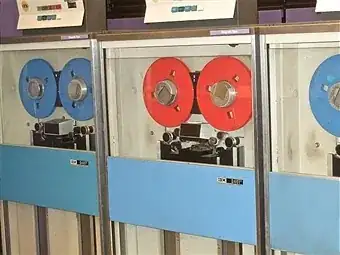
For large files we used 1/2" mag tape:1/2" mag tape

You've seen drives like this in older movies:

You've seen drives like this in older movies.

These tapes could hold one hell of a lot of data: Maybe 50Mb. (Really high density tapes could go up to ~200Mb.) But the capacity actually depended on the record format because individual records were separated on tape by a 1/2 inch "inter record gap" - so if you wrote small records (and didn't write them in blocks) you couldn't fit as many records on the tape. By the way, these suckers were heavy. Not quite break a toe if you dropped one on it heavy, but pretty nearly. (I owned 4 or 5 of these in my college days.)

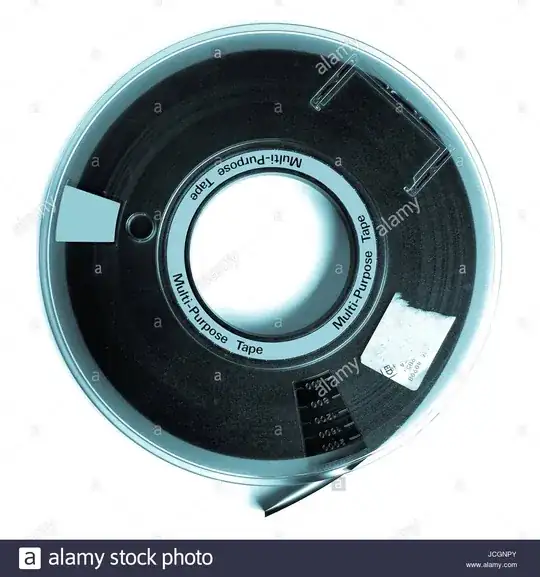
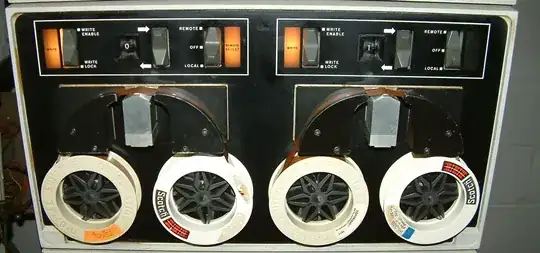
There were a few other form factors, e.g., Digital Equipment Corporation had small reels called DECTape:

DECTape

DECTapes were about the size of the palm of your hand and were, amazingly enough - random access! (Really really slow random access.) And also they were much lower capacity, less than 1Mb total. (I owned about 10 of these in my college days.)

(Actually, even talking about the capacity of this media in terms of "megabytes" is fairly anachronistic.)

davidbak
  • 6,269
  • 1
  • 28
  • 34
30

As well as splitting across multiple floppy disks, there were several cabled communication options available ranging from your basic serial cables and sending data over via X/Y/ZMODEM or Kermit, but there was also specialized parallel cables (like printer cables) that could be used that facilitated even faster transfers.

I think "LapLink" was a such a product (I never used it), typically employed to transfer large files and programs to lap tops and other portable computers.

Apple also had it's Appletalk network fairly early (mid-80s) to enable file transfers as well.

Obviously outside of PCs, tapes where often used. In the Alpha Micro world, they had the ability to transfer data using an off the shelf VCR and VHS tapes.

It was certainly some time before ubiquitous networking was in place. I didn't have networking at our offices until the early 90's.

Will Hartung
  • 12,276
  • 1
  • 27
  • 53
  • 3
    MS-DOS contains interlnk.exe and intersvr.exe to setup a point-to-point network between two computers for the purpose of transferring files. It can use a null modem cable or a "laplink" cable for faster transfer rates through the parallel ports. – snips-n-snails Jan 18 '18 at 05:19
  • 3
    afaik interlink was a long younger than "40 years ago" ;-) – Tommylee2k Jan 18 '18 at 07:13
  • 2
    Yes, it was released with DOS 6 in 1993. Still very useful! – Stephen Kitt Jan 18 '18 at 08:00
  • I remember using LapLink, but the drawback was that the computers had to be physically close to one another. – Phil N DeBlanc Jan 19 '18 at 14:30
  • The BBC Micro also had econet in the early 80's – Neuromancer Jan 19 '18 at 16:45
  • 1
    Linux still has support for TCP/IP over parallel port. Linux's PLIP driver supports a couple different transfer modes, 8 bits at a time with bidirectional cables, or 4 bits at a time with a normal printer cable that connects the data pins on one end to various signals on the other. In the 8-bit at a time mode, it might even support EPP / ECP parallel ports (i.e. hardware buffering, and even DMA with ECP) instead of a CPU interrupt or polling for every transfer. I got a cable at a yard sale, and used it a few times. – Peter Cordes Jan 20 '18 at 02:01
  • And we used regular audio cassette tapes and a regular tape recorded hooked up to RCA ports to save/load data/programs on our TRS-80s. And in the mid-90s I recall a product that would let you save ~2.5gb of data on a VHS tape, from a PC. – ivanivan Jan 22 '18 at 14:08
16

Do have a 7 MiB file, you would need a HD at least that size. In reality even a manyfold thereof, as usually one won't have a HD with just one file.

Now, in the real early times, lets say 70s, home users wouldn't have disks at all - not even floppies, and professional users with minis would use disk packs (exchangeable hard disks) and maybe fixed disks of the same or similar size. So file exchange wasn't a big deal as the disk pack could be just mounted on another machine. In fact, it would be more of a challenge to find another user to exchange files in the first place:)

Now, 40 years ago, that would be the end of the 70s (1978). If at all, SOHO users would have a disk drive. And while HDs where already available, one would rather invest in a second or third FD than putting up the same amount of cash as a small car to get a HD. In that time-frame a professional disk drive was good for anywhere between 200 and 600 KiB So a 5 MiB HD was barely more than a dozen floppies. Again, not worth it.

The situation stayed the same throughout the majority of the 80s. Hard disks where only available at high end machines out of reach for most users. Also Floppies reached 600 to 800 KiB. Quite a lot. Keep in mind that back then most applications didn't store a lot of meta data, and if at all, they did it in rather efficient way. So instead of adding like up to 300 bytes to a text file for making one word underlined in MS-Word, WordStar just added two bytes (well, 7 in some cases). Thus text files didn't require much more space than the amount of letters typed.

An average business letter back then was often less than 2 KiB on disk. So having a hundred letters on one FD wasn't anything unusual. Even a large thesis could fit on a single disk. Serious, I have a hard time to imagine larger databases on micros back them

Just an example, on mainframe system I worked on in the first half of the 1980 got all databases stored on two 144 MiB drives (plus another for the OS). That was the only IT system for a company with about 1500 employees and storing next to everything on these two disks.

In the micro range the need for archives spread out over multiple floppies didn't emerge before the late 80s/early 90s, when average HD size grew beyond 40 MiB and more important data processed moved away from simple text and numbers to more complex objects that could produce files in the MiB range.

And users growing into this range didn't use floppies for data exchange. The mid 80s to late 90s were the heydays of changeable hard disks (Syquest et al) and more important QIC streamer. I still remember, when I ordered a first 486 (with a 170 MiB ESDI) or later a dual Pentium II, I took care to include a QIC streamer for backup and data exchange. Many may also remember the surge for ZIP drives during the late 90s, for exactly the same reason: Data exchange and backup.

This is also the idea where SuperDisk / LS 120 originated. A way to exchange larger fines in a floppy like format. They did get some foothold, but where ultimately killed by a throw away solution, the writable CD. Cheap drive and dirt cheap media.

JCRM
  • 103
  • 2
Raffzahn
  • 222,541
  • 22
  • 631
  • 918
  • 2
    The PC/XT (10 MiB HDD) came out in 1983, and I purchased the Zenith version of it (20 MiB HDD) sometime around 1985, so I wouldn't say that hard disks were out of reach for most users for most of the 1980s. – Dave Tweed Jan 18 '18 at 02:00
  • 1
    @DaveTweed Well, I had a 5 MiB HD already in 1980, and a 130 MiB SCSI drive in 1985, but I wouldn't considere myself an average user. And 'not out of reach' doesn't mean it was average. A Mecdeses E-Class isn't out of reach for most people, still they are not the majoriy. And still today, neitehr you nor me are average users. Don't you think so? – Raffzahn Jan 18 '18 at 02:09
  • According to the Wikipedia article, the XT was selling just as fast as the PC within 2 years, so I wouldn't call them rare, either. – Dave Tweed Jan 18 '18 at 02:15
  • 8
    @DaveTweed you are a sample size of one. Just because you could afford a hard disk for your PC (lucky you), doesn't mean everybody could. I bought an Atari ST in 1986. I managed without a hard disk until the mid 90's when I bought my first PC compatible. – JeremyP Jan 18 '18 at 09:58
16

Your timescales are out. Floppies might have just existed 40 years ago, but your average office worker never saw one. More to the point, office workers didn't pass machine-readable data around the office to each other, the only equipment they had that could read the data was a shared mainframe, so they would both access the same copy.

From Gio Wiederhold, Database Design, ISBN 0-07070130 (1977): "Disk drives are now available which can contain 200M characters per pack"; cost was quoted as $600 per million characters; transfer rate was quoted as 312K characters per second. So 7Mb of data required a $4.2K investment (which was about a year's salary); at that level, you don't make multiple copies without a very good reason.

(For amusement: "Magnetic devices are nearing their limits of storage capacity because of the size of the magnetizable area, which is determined by the surface coating and the physical dimensions of the read-write heads")

7Mb in those days was vast. Who needs that much? You can store the entire works of Shakespeare in 5Mb.

Michael Kay
  • 569
  • 2
  • 6
  • 2
    Yeah, and by the way: those packs, though removable, were fragile and heavy both. You didn't just go carrying them about the office. Too much was at stake! It required trained computer operators! – davidbak Jan 18 '18 at 19:55
  • 4
    Probably comparable to using naked SATA harddrives as a sneakernet medium today: Routinely done among tech/dev/devops staff and enthusiast consumers. Will end in a mess if done involving anyone not computer savvy. – rackandboneman Jan 19 '18 at 21:34
  • @davidbak - not carry them around the office - I carried a 40MB RP03 10-platter pack from the UK to Toronto to do some on-site system testing. (Amusingly, I was writing X.25 networking software at the time, thus contributing in some small way to not having to carry disk packs on airplanes). – dave Jan 08 '22 at 22:20
9

Which OS?

Using a Unix or variant, we used cpio, which would detect end of media (tape or floppy) and prompt to replace and continue onto (or from) another volume.

The media was just treated as a sequence of blocks of data.

If using MSDOS, there was BACKUP and RESTORE commands that spanned floppies but I’m not sure if they were in DOS exactly 40 years ago.

mannaggia
  • 3,264
  • 2
  • 16
  • 15
  • BACKUP and RESTORE were awkward - but one of the most common tools to solve such problems... – rackandboneman Jan 18 '18 at 12:40
  • Agreed. When we had customers use BACKUP, we just prayed that they never had to RESTORE because it was a crap shoot as to whether or not it would work or if they did it right. – mannaggia Jan 18 '18 at 14:02
  • 1
    Early versions of cpio had a nasty "bug" where if it encountered a bad block on the disk in a file it was reading to write it to the output - it reported it to stderr but just kept on going. If you missed it or didn't log stderr, your cpio archive would be unreadable at that point. Each file in the archive was prefixed with its size and it wrote less bytes than expected, so it would overshoot the next file. Later versions of cpio added a "recovery" switch to scan forward for the next file header. We almost lost a customer's entire database due to this. Good old days. – mannaggia Jan 18 '18 at 14:06
  • @mannagia this seems like something that could be solved in an emergency with a lot of dd skip=/count= maneuvering? – rackandboneman Jan 18 '18 at 15:21
  • That’s exactly how we solved it. We pulled an all nighter and did lots of dd’s and od’s and some quick and dirty C programs to find file headers. – mannaggia Jan 18 '18 at 16:30
  • We always used backup/restore to move big files. It was simple and reliable (unless a disk failed of course). – Brian Knoblauch Jan 22 '18 at 17:51
8

40 years takes us back to the dawn of "Personal Computing". In June 1978 Apple released the Disk II for its Apple II computer. It was based on the Shugart SA-400, the first widely available 5.25" drive. Prior to that there were only 8" floppy drives. That would take up quite a bit of desk space. There weren't many files larger than a disk at that time because they all had to fit on a floppy disk. Hard drives were only used by large businesses. They would use big bulky and slow tape drives to move the large files.

Later on in the 90s things changed and files had gotten bigger. To get around the size problem we would use file splitters to spread it out over a bunch of disks. I used pkzip to 'span' disks a few times. Usually one of the disks would go bad of course, so we had to account for that.

Often times we would just connect another hard drive. In the 90s they were usually 40-pin IDE drives and we would connect one to the secondary IDE channel and it would dangle there while the files were copied over. In the unlucky event that there was only 1 IDE channel we would have to connect it as a slave drive and hope the two drives played nice together. Sometimes they didn't.

In the late 90s and early 2000s there were higher density floppy formats becoming available such as the Zip, Jaz, and SuperDisk but they weren't very common because the disks and drives were fairly expensive. There were also some weird removable hard drives just before USB came out. I remember using one that got power through the keyboard cable and communicated through the PS/2 mouse port or LPT printer port or something like that. I can't remember exactly. It had pass through connectors on it and little 2" hard disks that would go in somewhat like a floppy disk. It was WEIRD.

  • 1
    Ah yes there were lots of bizarre removable drives. SyQuest drives were pretty much removable hard drives, and Tandon’s disk packs certainly were, long before USB or anything like that! – Stephen Kitt Jan 18 '18 at 10:16
  • 1
    I remember having both Zip and Jaz. Zip was pretty good. Jaz, a later offering from the same manufacturer had great promise but it turned out those drives and cartridges had extreme reliability problems. Which was a major disappointment because they cost so much (for the time). – davidbak Jan 18 '18 at 19:51
  • Zip is not floppy, it is hard. 2. Hard drive via PS/2?! Impossible, of course. A LPT-connected one would be real.
  • – Anixx Jan 08 '22 at 17:07