17

To qualify what I mean by "16-bit microcomputer system", I am talking about a system that has not only a 16-bit (or 32-bit) microprocessor CPU, but also a 16-bit wide external data bus connected to the rest of the system. So, 16-bit access to its primary RAM, and the possibility of 16-bit wide access to peripherals.

To qualify as "mass-market", the system should have been generally available for purchase by consumers in quantity as a general-purpose, desktop style, computer in the vein that became popularized as "personal computers". So, no prototypes, experimental, kit, or bespoke systems. Basically a conventional microcomputer marketed to business, professional, and/or home computer users.

Brian H
  • 60,767
  • 20
  • 200
  • 362
  • 1
    By your comments about the 16-bit wide external data bus, are you saying that to specifically exclude the IBM PC which had a logical 16-bit bus but was actually 8-bit in hardware? – Greg Hewgill Mar 26 '17 at 23:12
  • Right. There were many mass-market "hybrids" with 16-bit CPU and 8-bit motherboard, just as there were 16/32-bit hybrids later on. I'm wanting to identify the first system-wide 16-bit micro. – Brian H Mar 27 '17 at 00:20
  • Are you also excluding the original Apple Macintosh which had a 32-bit CPU (Motorola 68000) but a 16-bit external data bus? – Greg Hewgill Mar 27 '17 at 00:58
  • No, the Macintosh would qualify as a 16-bit system, and I added some edits to the question to make that more obvious. Thanks. – Brian H Mar 27 '17 at 01:34
  • 1
    @GregHewgill The 68000 is classed as a 16 bit CPU. It's data bus both internal and external was 16 bits. – JeremyP Mar 27 '17 at 09:11
  • 6
    @JeremyP quite a few people prefer the size-of-the-main-registers test, as if it were about the external data bus then the Pentium is 64 bit. If it were about the internal data bus then the Z80 could be 4 bit. So instruction set architecture is the thing. Though clearly it wasn't at the time because, well, what does the writing on the front of a Mega Drive say? – Tommy Mar 27 '17 at 12:14
  • @Tommy Yes but going by the width of the register makes the 68000 a 32 bit processor which it manifestly was not. Nobody except Sinclair referred to it as 32 bit (Sinclair marketed the QL as a 8/16/32 bit computer because it used the 68008). It would also make the Z80 a 16 bit processor since its general purpose registers can be used as 16 bit registers BC, DE and HL + two 16 bit index registers. – JeremyP Mar 27 '17 at 13:34
  • Those are all good reasons why I think it is more appropriate to look at the system-level, and focus on how the computer (vice CPU) moves its data around, then classify the system as 8-bit, 16-bit, etc. – Brian H Mar 27 '17 at 13:59
  • Even more interesting, some of the 68000 series had elaborate hardware features to deal with addressing 8 to 32 bit hardware on the same bus without much glue logic needed. – rackandboneman Apr 27 '17 at 21:55
  • 2
    How do you want systems with WIDER than 16 bit (and non-multiple-of-16) bus widths treated? And BTW; both the AT and some early Macintosh were more or less 24 bit systems in hardware :) – rackandboneman Apr 27 '17 at 21:59
  • 1
    @Tommy: The Z80 is an interesting case because it has a 16-bit bus connecting all of the registers to a 16-bit increment/decrement unit which can perform a full-width increment or decrement in less than two clock periods (during any particular cycle, registers can only support being either read or written--not both, so an instruction like INC HL ends up spending one cycle to read PC, one to write it back, one to read IR, one to write it back, one to read HL, and one to write it back, for a total of six, but the combined time for each read/increment/writeback is two cycles). – supercat Oct 03 '20 at 16:19
  • 3
    When used without any expansion, the directly-accessible memory in the TI/994a consists of a pair of 128x8 static RAM chips and 4Kx8 ROM chips, all sitting on a 16-bit-wide bus. Although the video subsystem includes eight 16Kx1 DRAM chips, the CPU can't randomly access the contents thereof directly but must instead use a sequence of store operations to tell the video chip what part of the video chip's storage the CPU would like to read or write, and then read or write bytes sequentially from there. – supercat Oct 03 '20 at 16:32

5 Answers5

19

A number of mass-market microcomputers which could be qualified as home computers were released in 1982 or 1983, earlier than the Electronika BK:

  • the Olivetti M20 was a 16-bit computer based on the Z8001 with a 16-bit data bus (March 1982);
  • the Olivetti M24 was the first fully-compatible IBM PC clone, and it used a fully 16-bit 8086 and a 16-bit peripheral bus; it was quite popular in Europe (introduced sometime in 1983);
  • the Apple Lisa, while a commercial failure in the end, was widely available and used a 16-bit bus (introduced on January 19, 1983);
  • in Japan, the NEC PC-9801 also used the 8086 and had a 16-bit bus (the C-bus); it started the PC-98 line which would dominate the Japanese market well into the nineties (introduced in October 1982).

Looking into early 16-bit microprocessors leads to a number of earlier microcomputers that aren’t as famous as the above:

  • the Western Digital WD-9000, which implemented p-code in its microcode (1979, although it wasn’t debugged and widely available before 1981);
  • the Alpha Microsystems AM-100, based on the same Western Digital chipset (the technical manual is stamped January 13, 1979);
  • the NEC N5200, with a similar architecture to the PC-9801 but released earlier (available in December 1981).

In the microcomputer-sized mini category, the IBM 5100 was a 16-bit portable computer released in September 1975; the earlier-still HP 9830A, released in 1972, was marketed as a calculator but had BASIC in ROM and was effectively a desktop computer (and used as such).

Stephen Kitt
  • 121,835
  • 17
  • 505
  • 462
  • Since your answer is sort of a "survey of the 16-bit landscape" of the early 80s, why exclude the Apple Lisa? – Brian H Mar 27 '17 at 11:30
  • 2
    I was looking for mass-market models which might be earlier than those @scruss mentions, not necessarily going for a survey (although I could write that up...). The Lisa isn't really mass-market IMO, with only 100,000 sold (v. at least a million M24s and even more PC-9801s). – Stephen Kitt Mar 27 '17 at 11:38
  • I doubt whichever system was first sold in huge quantities. If it had, the answer to this would be much easier, I think. Anyway, the Lisa was earlier than the BK and much more representative of microcomputers than other @scruss mentions. – Brian H Mar 27 '17 at 13:01
  • Right, as per your question since the Lisa was widely available it counts, so I've added it. – Stephen Kitt Mar 27 '17 at 13:13
  • Based on nomenclature, I'm guessing the Olivetti M20 came before the M24. – Brian H Mar 27 '17 at 16:35
  • @BrianH Olivetti's nomenclature isn't necessarily consistent (the M19 came after the M24), but in this case it works — the M20 did indeed precede the the M24 (and it was a 16-bit system). – Stephen Kitt Mar 27 '17 at 16:52
  • Found link claiming Mar '82 release of M20. Also, Tandy Model 16 was Feb '82. Any reason not to include? – Brian H Mar 27 '17 at 21:19
  • 2
    The Model 16 had an 8-bit I/O bus, so no 16-bit-wide access to peripherals. – Stephen Kitt Mar 28 '17 at 04:28
  • 1
    The Zilog System 8000 "supermicro" (really more of a mini, given its size) from 1981 used the Z8001. But early 1980s Olivetti kit was very far ahead of its time. – scruss Mar 28 '17 at 18:09
  • @StephenKitt The bit-ness of the Model 16 is probably one of the most debatable on here depending on how you define it. It's a 68000 CPU (not a 68008), so it runs 32bit code and has a 16 bit data bus (including access to RAM and expansion slots) but runs all of its basic, built-in I/O (keyboard, video, serial, parallel, floppy) through its included Z80 co-processor card and 8-bit I/O chips for backward comparability with CP/M. – mnem Apr 27 '17 at 18:22
  • @StephenKitt Architecturally speaking, in PC terms, it would be the equivalent of a very slow 386SX that someone decided to populate with nothing but old 8-bit ISA controller cards. – mnem Apr 27 '17 at 18:34
  • @mnem I agree the Model 16’ “bitness” is debatable, but Brian gave a quite detailed specification and the Model 16 doesn’t meet those requirements. It was an interesting machine, with Xenix no less... – Stephen Kitt Apr 27 '17 at 18:51
  • @StephenKitt I'm not 100% sure if it does or doesn't meet his specification. Its a 32bit CPU, does have a 16bit data bus, and, iirc, does have 16bit expansion slots, they're just populated mostly with 8bit devices by default, I believe. I'm a bit fuzzy on the details though, are the RAM expansion cards 16bit, or are they banked 8bit cards? I know it can have up to 7MB of RAM on add-on cards. – mnem Apr 27 '17 at 19:17
  • @StephenKitt The availability of Xenix was a neat feature. There was also an option to run CPM/16 for 68k on it as well, as an alternative to the included CPM/8 backwards comparability. – mnem Apr 27 '17 at 19:22
  • 1
    @mnem according to the service manual, memory is accessed directly by the 68k, with up to 16 data lines (there’s also a nifty MMU with kernel/user distinctions, providing inter-process protection); but only the interrupt controller and the MMU are reachable from the 68k, all other I/O goes through the Z80 and its 8-bit bus. – Stephen Kitt Apr 27 '17 at 20:41
  • @Stephen Kitt: What about the Texas Instruments TI 99/4A? It used the TMS9900 16-bit processor, for which Wikipedia shows a 16-bit data bus. Only a 15-bit address bus, though. Biggest DIP I have ever encountered. – njuffa Apr 28 '17 at 03:30
  • 3
    @njuffa the TI-99/4A has been addressed in other comments — it had a 16-bit CPU, but only its ROM and 256 bytes of RAM were available on the 16-bit bus, everything else went through an 8-bit multiplexer. – Stephen Kitt Apr 28 '17 at 07:37
  • The NEC N5200 is also 8086-based (with an architecture very similar to the PC-9801) but predates the PC-9801 by about a year. The N5200 was announced in 1981-07 and shipped in 1981-12. – cjs Nov 02 '21 at 05:03
  • @cjs interesting, thanks! If I’ve understood things correctly (not the Wikipedia page, I don’t read Japanese unfortunately) the N5200 was the first APC, and the PC-9801 was the second, so the N5200 would deserve a place on the list here. Is that right? – Stephen Kitt Nov 02 '21 at 09:46
  • @StephenKitt Yes, the N5200 certainly should be on your list ahead of the PC-9801 (though you may want to leave the 9801 for context, since it was incredibly popular). The APC was always a separate series from the 9801; they were made by different divisions. I strongly suspect the APC II and III were further iterations of the N5200, but I am still trying to track down authoritative documentation on that. – cjs Nov 03 '21 at 08:29
  • @cjs thanks, I’ve added it to the “earlier but not as well-known” list since there’s little information about it outside Japan (and a lot of it seems to be incorrect). – Stephen Kitt Nov 03 '21 at 14:45
  • I've done a bunch of work on the Wikipedia APC series page (as it's now named), removing the incorrect assertion that the PC-9801 was an N5200/APC, giving a detailed description of the original APC/N5200, and pointing out some major differences with the PC-9801. The APC system manual I found had a first printing date of September 1982, so it looks as if the APC came out in North America around the time the PC-9801 came out in Japan. – cjs Nov 04 '21 at 08:09
  • The Intellivision game console, released in 1979, had a 16bits CPU (CP1610) – Grabul Nov 06 '21 at 13:08
  • @TEMLIB indeed, but the question asks for “a general-purpose, desktop style, computer in the vein that became popularized as "personal computers"”, which doesn’t describe the Intellivision. – Stephen Kitt Nov 06 '21 at 14:08
19

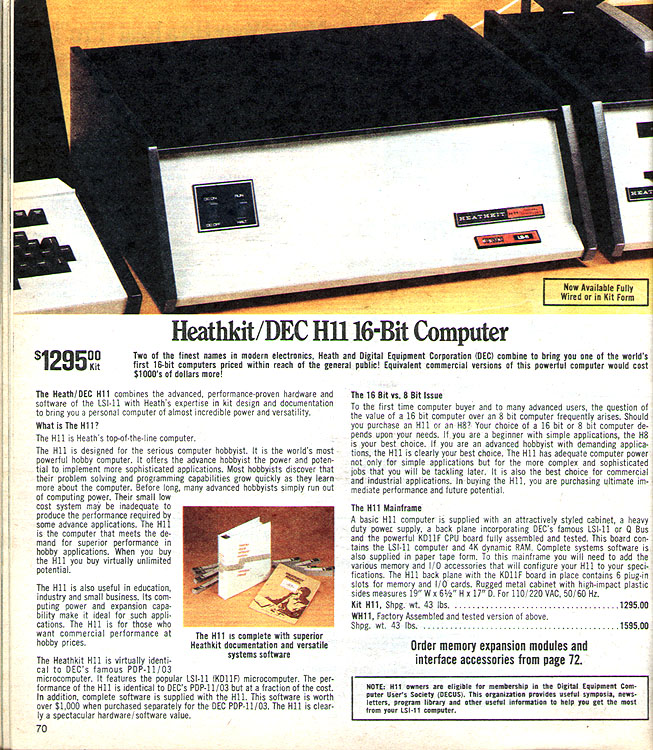
The Heathkit H11 was available fully assembled and tested for $1595 in 1978. It was a clone of the PDP-11 minicomputer in a desktop case.

snips-n-snails
  • 17,548
  • 3
  • 63
  • 120
  • 2
    This is clearly the winner of the "contest". It was available to anyone with a Heathkit catalog and ran in a stand-alone fashion. – Maury Markowitz Jun 17 '18 at 12:01
  • 2
    Also, I don't think it was a clone, was it? Didn't it use an actual DEC LSI-11 CPU? – cjs Sep 19 '19 at 20:47
  • You needed a separate terminal and external storage. In 1978, these two requirements would stop it from being a desktop system. – JeremyP Nov 03 '21 at 16:16
  • @JeremyP If the keyboard, monitor, and non-volatile storage weren't integrated into the chassis, it wasn't a desktop computer? – snips-n-snails Nov 03 '21 at 19:46
  • @snips-n-snails If you can't put it on the top of the desk, it's not a desktop computer. You're talking about a terminal that would be significantly bigger than a modern PC thanks to needing a CRT display, the computer itself, probably packaged for a 19 inch rack and a disk drive. Here's a DEC RP06 from 1977. It's about the size and shape of a top loading washing machine. – JeremyP Nov 04 '21 at 08:56
  • Here's a picture of an H11 showing a diskette subsystem perched on the CPU box and a glass TTY next to it. In my view this is almost as small as a full Apple ][ setup. – cardiff space man Jan 04 '22 at 23:39
  • @cardiffspaceman That would be the Heathkit H19 terminal next to it. – snips-n-snails Jan 06 '22 at 00:08
10
scruss
  • 21,585
  • 1
  • 45
  • 113
7

In 1979 or 1980, Convergent Technologies released their IWS (Integrated WorkStation). This was based on the Intel iapx86 (8086), and came in two configurations - the older configuration had the CPU and disk drives in separate "towers" somewhat larger than a current PC, with a CRT on the desk; the second configuration moved the CPU to a box approximately the size of a modern "pizza box" (but about twice as thick in the smallest dimension) CPU attached to a base, with a CRT attached to its left to the same base. The disk drives were 8", both floppy and hard.

In 1980 or 1981, the next generation of Convergent Technologies workstations were released, the AWS (Advanced WorkStation). This had essentially identical capabilities to the IWS, but the disk drives were incorporated into the the on-desk CPU configuration, and it used 5.25" ("full-height") drives rather than 8".

Jeff Zeitlin
  • 1,563
  • 1
  • 7
  • 13
  • Interesting. Sparse info on the web for Convergent. Do you have any good links that might better pinpoint a release date for a product they sold in significant quantity? – Brian H Mar 27 '17 at 13:12
  • I'm afraid not. Convergent sold very little under their own brand; most of their sales were to other companies that rebranded them. Some names to look for would be the Burroughs B21 and B22 (the B25 was also a (later) Convergent design), the NCR WorkSaver, the Mohawk Data Sciences HERO (later Momentum HERO), and the Prime Producer. The original of the B25 was also sold by DataPoint as the Vista PC, but I don't know if DataPoint also sold the AWS and IWS. The second-design IWS or AWS (can't tell which) is pictured here. – Jeff Zeitlin Mar 27 '17 at 13:30
  • There's a lot of info on bitsavers, including brochures, but I'm not sure there's anything that would give release dates for products with significant sales. – Stephen Kitt Mar 27 '17 at 13:31
  • Addendum to my previous comment: I took a closer look at the pictures from the link (one of which could be zoomed), and it reveals that there are no disk drives in the CPU box on the right. That makes it a second-design IWS, rather than an AWS. – Jeff Zeitlin May 02 '17 at 07:41
4

How about the LSI-11/2 (PDP-11/03) that was released in 1975? These machines were in small cabinets you could put beside your desk (not the 6' tall H960 rack). And they were used in process control, science and other fields. It was also available OEM for inclusion into other equipment.

1944GPW
  • 111
  • 1
  • 3