In the following exercise, I can't get started on question 2) as I am not sure what to do when there is an integral inside:
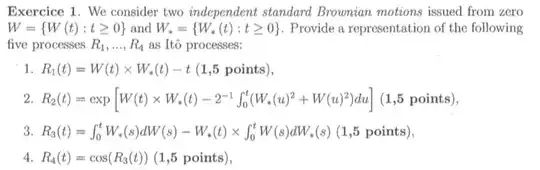
Could you help me out?
In the following exercise, I can't get started on question 2) as I am not sure what to do when there is an integral inside:
Could you help me out?
Let \begin{align*} X_t = W(t)W_*(t) - \frac{1}{2}\int_0^t\big(W_*(u)^2+ W(u)^2\big)du. \end{align*} Then, \begin{align*} dX_t &= W(t) dW_*(t) + W_*(t) dW(t) -\frac{1}{2}\left(W_*(t)^2+ W(t)^2\right)dt, \end{align*} as $W$ and $W_*$ are independent. Consequently, \begin{align*} X_t = \int_0^t \big[W(s) dW_*(s) + W_*(s) dW(s)\big] -\frac{1}{2}\int_0^t\left(W_*(s)^2+ W(s)^2\right)ds. \end{align*} Moreover, \begin{align*} \langle X, X\rangle_t = \int_0^t\left(W_*(s)^2+ W(s)^2\right)ds. \end{align*} That is, \begin{align*} d\langle X, X\rangle_t &= \left(W_*(t)^2+ W(t)^2\right)dt. \end{align*} Since $R_2(t) = e^{X_t}$, \begin{align*} dR_2(t) &= e^{X_t} dX_t + \frac{1}{2}e^{X_t}d\langle X, X\rangle_t\\ &= R_2(t)\Big( W(t) dW_*(t) + W_*(t) dW(t) \Big). \end{align*}


