19

The Baye's rule for conditional expectations states

$$ E^Q[X|\mathcal{F}]E^P[f|\mathcal{F}]=E^P[Xf|\mathcal{F}] $$

With $f=dQ/dP$ - thus being the Radon-Nikodyn derivative and $X$ being some random variable and $\mathcal{F}$ being some sigma-algebrad.

For I wasn't able to find the proof in any of the books that I usually use I tried to prove it myself. This rule is often used in the context of the change of numeraire technique.

The proof uses the definition/characterization of conditional expectations. Thus one mainly needs to show

$$\int_A E^Q[X|\mathcal{F}]E^P[f|\mathcal{F}]dP=\int_AE^P[Xf|\mathcal{F}]dP $$ For all $A\in\mathcal{F}$

Again using the characterisation of conditional expectation the right side equals $\int_A Xf dP$ and with $f$ being the Radon-Nikodyn-derivative this is equal to $\int_A X dQ$ thus

$$\int_AE^P[Xf|\mathcal{F}]dP=\int_A X dQ $$

On the other side using measurability of $E^Q[X|\mathcal{F}]$ with respect to $\mathcal{F}$ the left side equals $$\int_A E^P\left[(E^Q[X|\mathcal{F}] f)\vert \mathcal{F}\right] dP$$ Once again using the characterisation of conditional expectation this is $$\int_A E^P\left[(E^Q[X|\mathcal{F}] f)\vert \mathcal{F}\right] dP=\int_A fE^Q[X|\mathcal{F}] dP$$ Finally with $f$ being the Radon-Nikodyn density one arrives at

$$\int_A fE^Q[X|\mathcal{F}] =\int_A E^Q[X|\mathcal{F}] dQ=\int_A X dQ$$ and thus $$\int_A E^Q[X|\mathcal{F}]E^P[f|\mathcal{F}]dP=\int_A X dQ$$

This concludes the proof.

Two question:

  • does anyone know of a source where I could cross-check that
  • is there an alternative way to proof the result ?
Bob Jansen
  • 8,552
  • 5
  • 37
  • 60
Probilitator
  • 3,377
  • 1
  • 22
  • 37
  • 1
    The book "Statistics of Random Processes" Vol. 1 by Robert Lipster and Albert Shiryaev has a whole chapter devoted to various (abstract) forms of Bayes Law. If I remember correctly it is chapter 7. The eBook is available from SpringerLink if you have access. – pbr142 Apr 03 '14 at 11:27
  • thank you for the reference - seeing how it also answers my question - you can post it as an answer not only as a comment - the reference might be interesting to others – Probilitator Apr 03 '14 at 11:41

2 Answers2

10

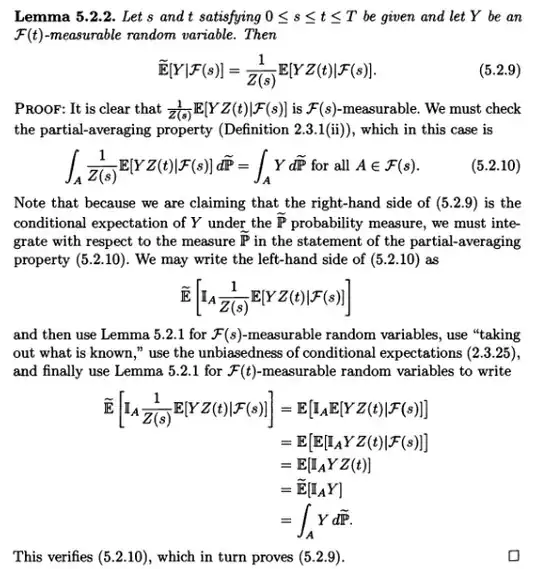
Is this the proof you are looking for?

enter image description here

-- from Shreve, S. E.'s book "Stochastic calculus for finance II, continuous-time Models", chapter 5.

athos
  • 2,231
  • 2
  • 27
  • 43
1

$$ \def\Filtr{\mathcal{F}} \def\EF{E^\Filtr} $$ Let $f=dQ/dP$, and denote by $E$, $E_Q$ the expectation with respect to the measure $P$, $Q$, respectively. Let us also write $\EF$, $\EF_Q$ instead of $E(\cdot|\Filtr)$, $E_Q(\cdot|\Filtr)$.

Assume that all random variables listed below are integrable, in particular, that $E|\xi|$, $E|f\xi|$, $E|f^2\xi|<\infty$. Let $\Filtr$ be any $\sigma$-field.

Thanks to self-adjointness property of conditional expectation ($E(\xi\EF\eta)=E(\eta\EF\xi)$), we have for every $A\in\Filtr$: \begin{align*} \newcommand{\eqby}[1]{\stackrel{\text{#1}}{=}} E(\xi f\EF(f1_A)) &= E(f1_A\EF(\xi f)),\\ E_Q(\xi\EF(f1_A)) &= E_Q(\EF(\xi f)1_A),\\ E_Q(\xi(\EF f)1_A) &= E_Q(\EF(\xi f)1_A),\\ \EF_Q(\xi\EF f) &\eqby{a.s.} \EF\xi f,\\ (\EF f)(\EF_Q\xi) &\eqby{a.s.} \EF\xi f. \end{align*} Second equality follows from the definition of $f$, third from the pull-out property ($\EF\xi\eta=\xi\EF\eta$, if $\xi$ is $\Filtr$-measurable) and from $\Filtr$-measurability of $1_A$, fourth from the definition of conditional expectation $\EF_Q$, and the last one by the pull-out property, as $\EF f$ is already $\Filtr$-measurable.

W.Czernous
  • 11
  • 3